
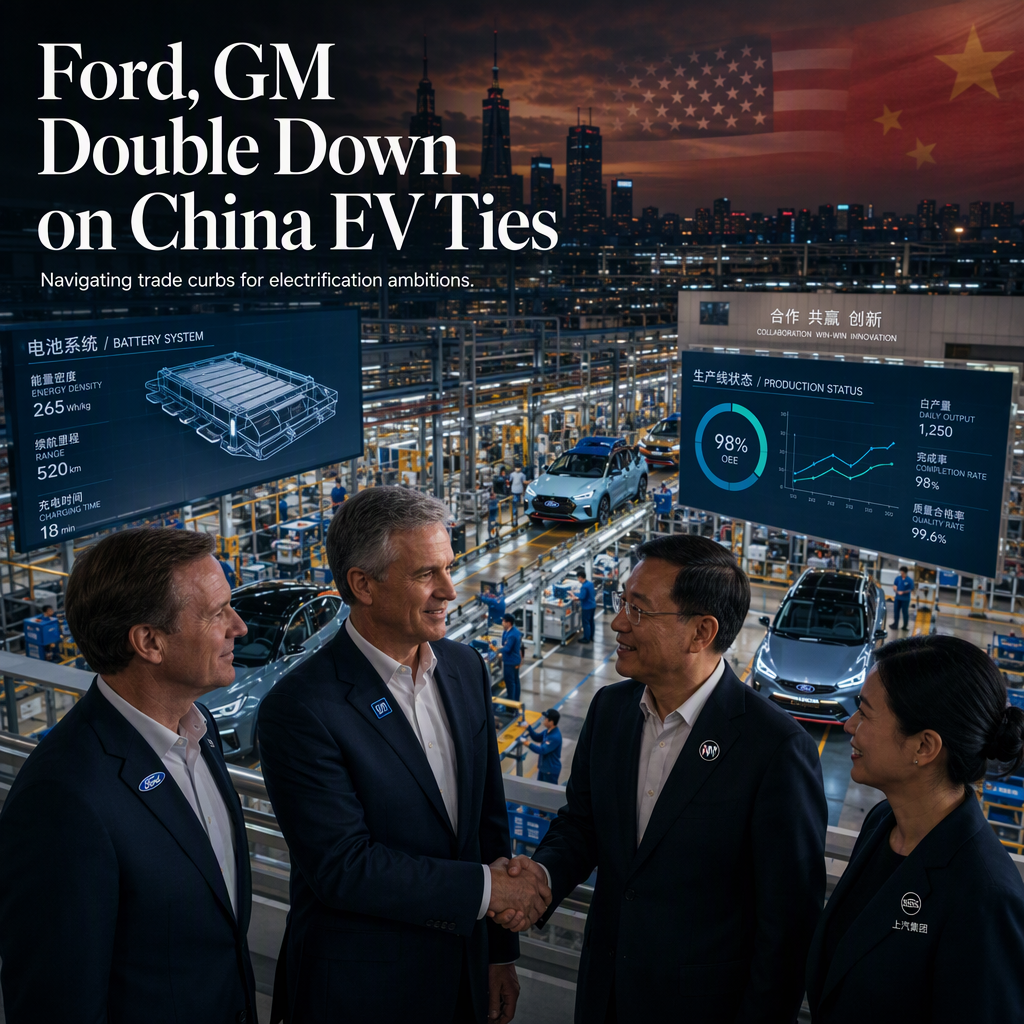
U.S. automakers Ford Motor and General Motors are reinforcing their electric vehicle (EV) partnerships with Chinese companies, even as the U.S. government imposes stricter restrictions on technology transfers and investments in China's EV sector [1]. In August, GM renewed its joint venture agreement with China's SAIC Motor, a move that secures GM's access to China's expansive automotive market and leverages SAIC's manufacturing capabilities and supply network, particularly for the Buick brand's EV portfolio [1].
Ford continues to collaborate closely with Chinese battery and EV technology firms, emphasizing that partnership and competition with China 'aren't mutually exclusive' [1]. Ford executives have stated that disengaging from China would hinder their electrification progress, given China's leadership in battery technology and EV production [1]. Both companies are navigating U.S. legal frameworks to maintain these business ties while complying with new regulations [1].
Analysts cited in the article warn that U.S. automakers risk losing ground in the global EV race if they sever connections with China's advanced battery and EV ecosystem [1]. Financially, GM has committed $35 billion to EVs and autonomous vehicles through 2025, while Ford has pledged over $50 billion in global EV investment through 2026, with access to cost-effective Chinese technology and manufacturing seen as critical to meeting these goals [1].
The ongoing partnerships highlight the interconnected nature of global auto supply chains and the strategic importance of Chinese expertise for U.S. automakers seeking to accelerate their EV ambitions [1].
CONCLUSION
Despite heightened U.S. trade restrictions, Ford and GM are doubling down on their Chinese EV partnerships to maintain competitiveness and achieve ambitious electrification targets. Their continued collaboration with Chinese firms underscores the strategic necessity of access to advanced technology and supply chains in the evolving global EV market.