
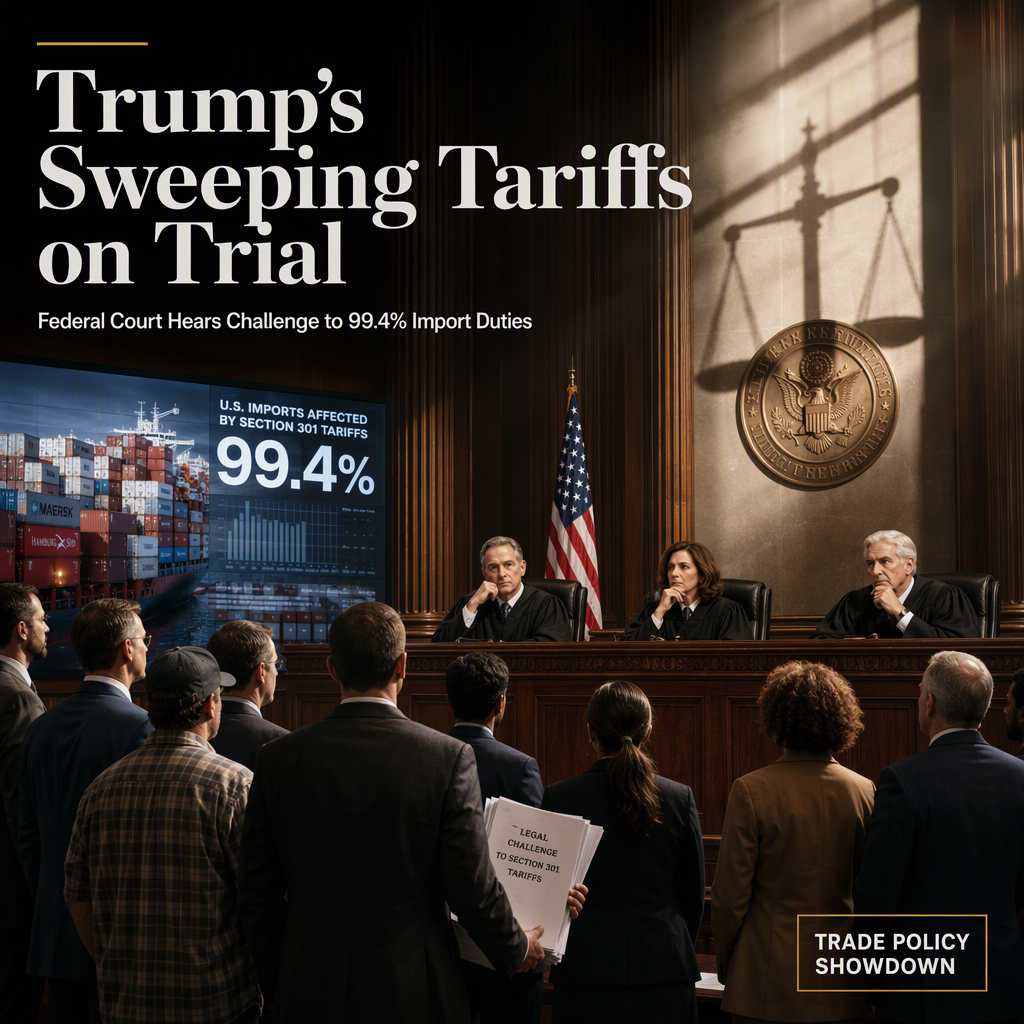
A panel of three judges at the U.S. Court of International Trade in Manhattan began hearing arguments from a coalition of small businesses and Democratic-led states challenging President Donald Trump's latest 'Section 301' tariffs on Wednesday morning [1]. The tariffs, which impose rates of 10% or 12.5% on goods from 86 countries and cover 99.4% of U.S. imports, are being contested on the grounds that they overstep legal boundaries set by the Trade Act of 1974 [1]. The Trump administration justified these tariffs by citing the failure of targeted countries to enforce bans on goods produced with forced labor practices [1].
During the hearing, the challengers' attorney, Pratik Shah, argued that the government's rationale was a 'pretext' for reviving Trump's broader tariff regime, and that the administration's use of Section 301 was 'unprecedented' due to the lack of country-specific findings required by statute [1]. One judge questioned whether the presence of additional motivations for the tariffs was sufficient grounds for ruling against them, highlighting the complexity of the legal arguments [1].
This is the third time in less than two years that courts have been asked to intervene against President Trump's attempts to impose sweeping tariffs on U.S. imports [1]. The latest Section 301 tariffs were implemented after the Supreme Court struck down Trump's 'reciprocal' tariffs in February 2026, which had required the administration to refund over $100 billion and led to a shift in strategy [1]. The administration initially imposed a worldwide 10% tariff under Section 122 of the Trade Act of 1974, but those were limited to 150 days and were also challenged in court [1]. As those expired in July, the new Section 301 duties were put in place [1].
A senior Trump administration official described the move as 'the most sweeping international labor rights action the United States has ever taken — that any country has ever taken' [1]. The outcome of the current legal challenge could have significant implications for U.S. trade policy and the vast majority of imports into the country [1].
CONCLUSION
President Trump's latest Section 301 tariffs, covering nearly all U.S. imports, are facing a significant legal challenge in federal court. The case centers on whether the administration's broad application of tariffs meets statutory requirements, with potential major consequences for U.S. trade policy and importers. The court's decision could reshape the scope and legality of future tariff actions.