
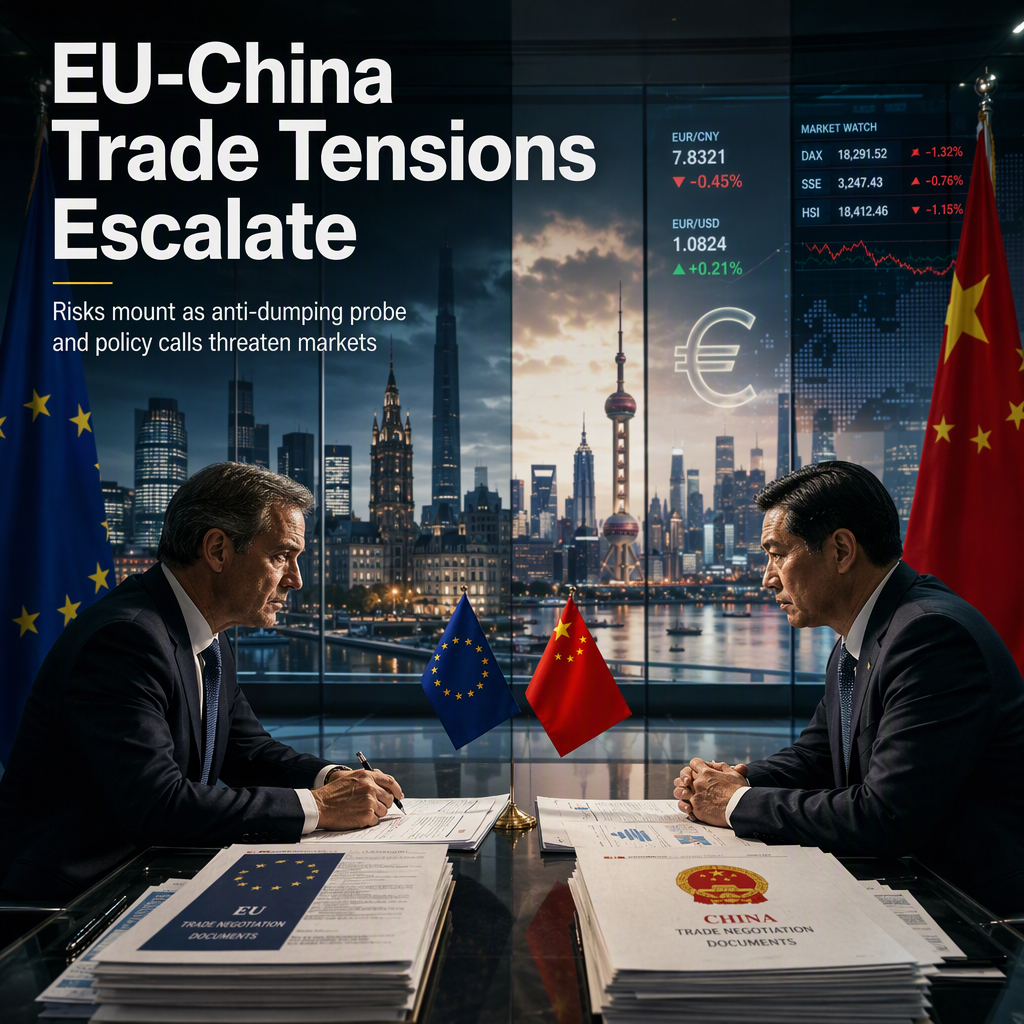
Commerzbank's Volkmar Baur highlights rising trade war risks between the European Union (EU) and China, following China's initiation of a new anti-dumping probe into EU nitrotoluenes, which is seen as part of broader trade frictions between the two economic powers [1]. A Franco-German non-paper has called for the EU to take stronger action against dumping, subsidies, and currency manipulation, signaling a shift from rhetoric to demands for concrete measures ahead of EU Trade Commissioner Maros Sefcovic’s trip to China [1].
During a meeting in late June, Sefcovic and his Chinese counterpart Wang Wentao agreed to seek a solution to the growing trade imbalance by October. The non-paper from French President Macron and German politician Merz underscores the urgency for tangible outcomes, warning that failure to address these imbalances could trigger a trade war with significant implications for currency markets [1].
The stakes are high for both regions: China remains a critical supplier of intermediate goods to Germany and the EU, while Europe has become an increasingly important export market for China, especially in the context of ongoing US-China trade tensions. Notably, in the first eight months of this year, Chinese exports to the EU increased by 15% year-on-year, and the trade surplus widened by 23% [1]. The timing of the non-paper’s release, just before Sefcovic’s China visit and the upcoming European Council meeting, suggests coordinated pressure for action [1].
CONCLUSION
Escalating EU-China trade tensions, marked by China's anti-dumping probe and EU calls for tougher measures, pose significant risks to both trade flows and currency markets. With both sides heavily reliant on each other economically, the outcome of ongoing negotiations and the European Council's decisions will be closely watched by market participants.