
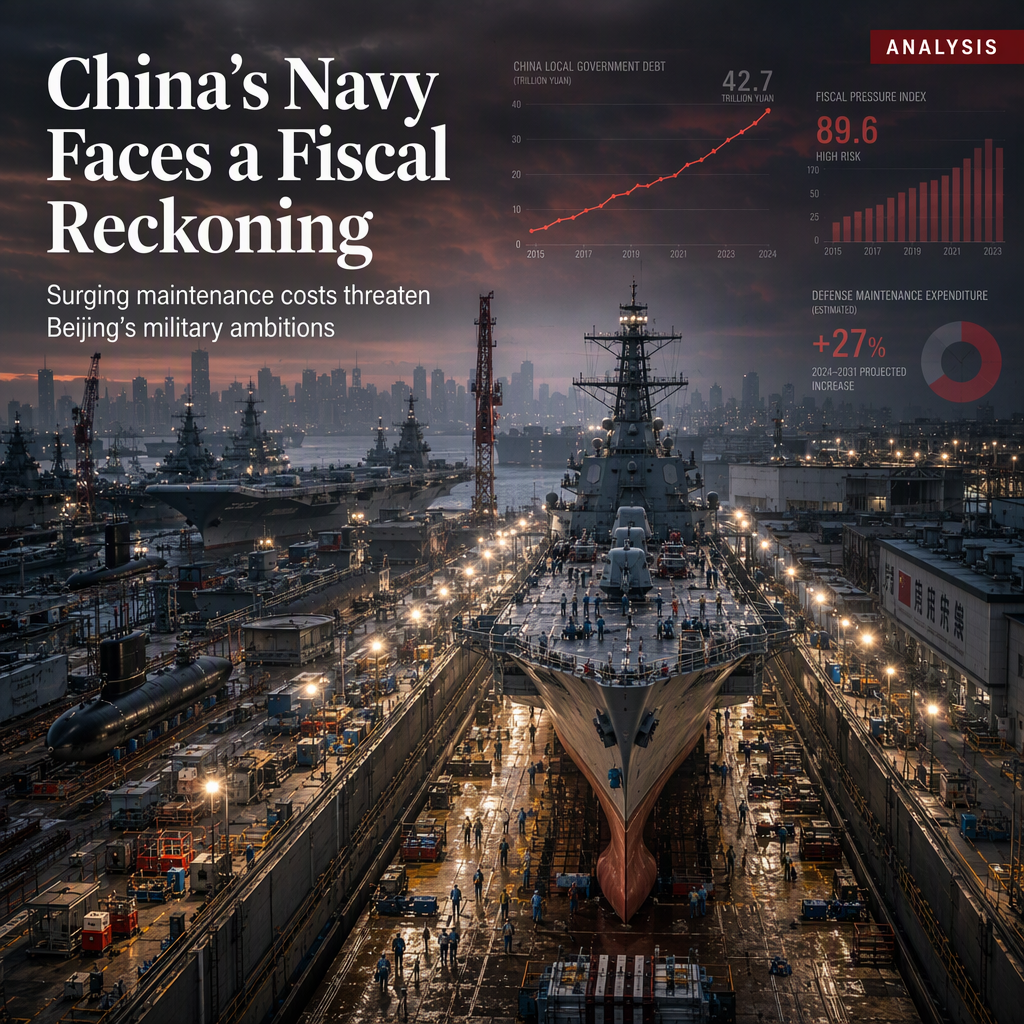
China is approaching a significant financial challenge as the costs to maintain its rapidly expanded navy are set to surge beginning in 2031. After a decade of aggressive shipbuilding—including destroyers, frigates, carriers, and submarines—the primary concern is shifting from construction to the long-term affordability of operating and maintaining this fleet. For modern navies, operations and support typically account for 60% to 70% of a ship's life-cycle cost, and the heaviest maintenance work on China's most capable surface combatants is expected to begin around 2031 and continue for a decade. This will strain repair yards, which must balance new construction with extensive overhauls, and stretch an already limited maintenance workforce. Additional costs such as fuel, munitions, and realistic training hours will further increase the financial burden [1].
These mounting naval expenses coincide with broader fiscal stress in China. In 21 provincial-level regions, local revenue covers less than half of spending, and land sales—the main source of provincial income—have collapsed. Over the past two years, Beijing has transferred 'hidden' local debt onto official books, lowering interest rates but increasing the visible debt burden. Interest payments now place a hard claim on weak cash flows, and while Beijing can still issue bonds and direct state banks to roll over debt, it cannot restore the rapid growth or healthy property market of the 2010s. Deflation is exacerbating the situation by making each yuan of debt more burdensome [1].
The article draws a historical parallel to 1930s Germany, where creative accounting masked the true cost of military expansion until the financial trick was exhausted. The implication is that China may face a similar reckoning as the bill for its naval expansion comes due, especially given the current fragility of its fiscal system [1].
While the recent state visit by President Xi Jinping to Washington resulted in a two-month extension of the trade truce and polite diplomatic exchanges, it did not address the underlying financial pressures facing China, particularly regarding its military ambitions and rare-earth supply vulnerabilities [1].
CONCLUSION
China's rapidly growing naval fleet will soon face a major financial test as maintenance and operational costs surge starting in 2031, compounding existing fiscal strains at both local and national levels. The sustainability of China's military expansion is in question, with significant market and geopolitical implications if fiscal pressures intensify. Investors and policymakers should closely monitor China's evolving debt dynamics and defense spending trajectory.