
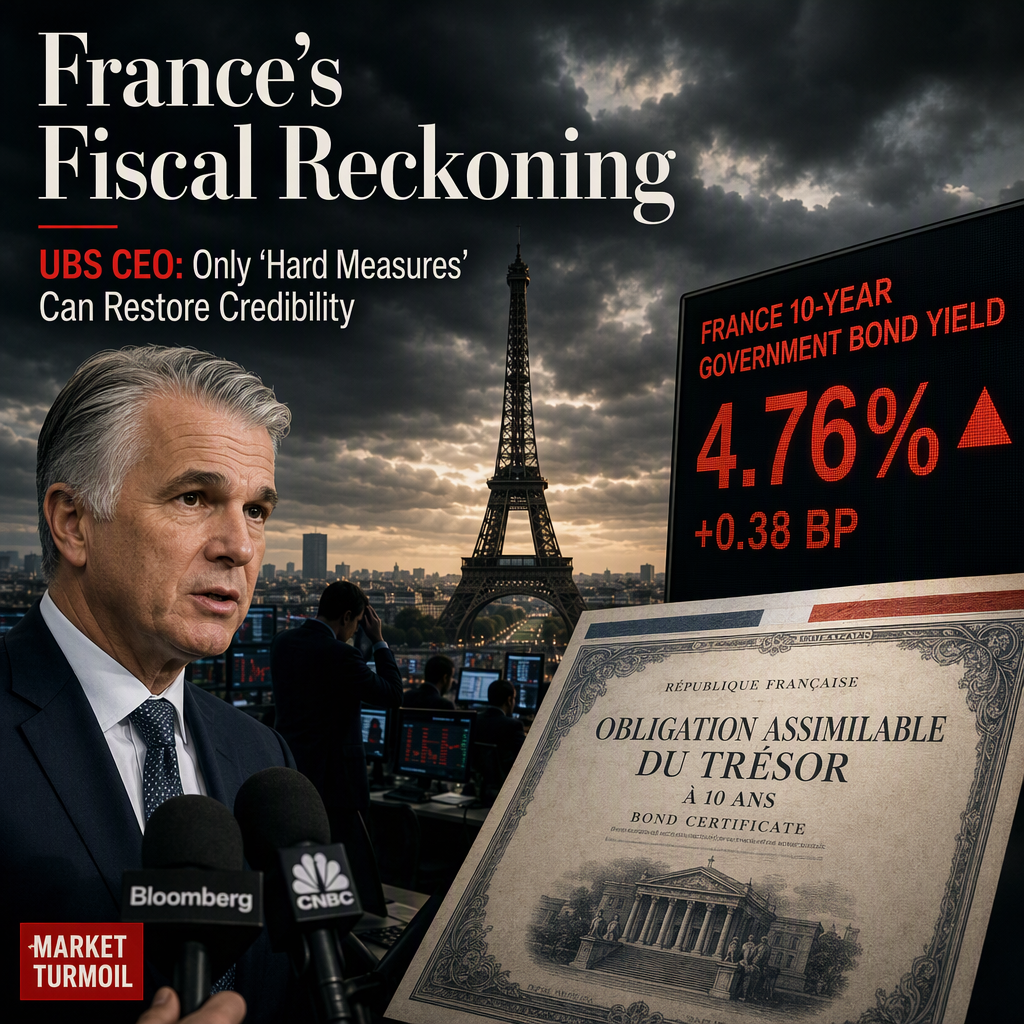
UBS CEO Sergio Ermotti has issued a stark warning regarding France's escalating debt crisis, stating that 'hard measures' are necessary to restore fiscal credibility and that 'small, incremental changes' will not suffice to address the country's mounting debt issues [1]. Ermotti drew parallels between the current turmoil in Europe's bond market and the eurozone's sovereign debt crisis of 2011, but emphasized that France's larger economy could make the situation more challenging to resolve this time [1].
Yields on French government bonds (OATs) have surged in recent weeks amid a broader sovereign debt sell-off across Europe, reflecting growing investor concerns about France's fiscal position [1]. On Tuesday afternoon, France's benchmark 10-year note yield stood at 4.7689% after easing by 9 basis points, with borrowing costs now higher in France than in Greece and Italy [1]. Mitch Reznick, head of cross-border credit at Federated Hermes, noted that France has rapidly become the main focus of the continent's bond market woes, with its debt increasingly being priced 'less like core Europe and more like the periphery' [1].
Reznick also highlighted that investors are shifting away from French government bonds in favor of German Bunds, which has widened the OAT-Bund spread to over 140 basis points [1]. He attributed this to concerns over France's high debt, large budget deficits, increased bond supply, and political uncertainty ahead of the presidential election [1]. Far-right presidential candidate Marine Le Pen has pledged significant spending cuts to control the debt, warning that France ultimately risks defaulting if action is not taken [1].
While the European Central Bank has so far remained on the sidelines, Reznick suggested that its stance could change if spreads continue to widen, indicating potential future intervention if market stress escalates further [1].
CONCLUSION
France's debt crisis has triggered a sharp rise in government bond yields and heightened market anxiety, with experts warning that only significant fiscal measures can restore confidence. Political uncertainty and investor flight from French bonds have intensified the situation, making France the epicenter of Europe's current bond market turmoil. The market takeaway is that without decisive action, France's fiscal challenges could have broader implications for European financial stability.