
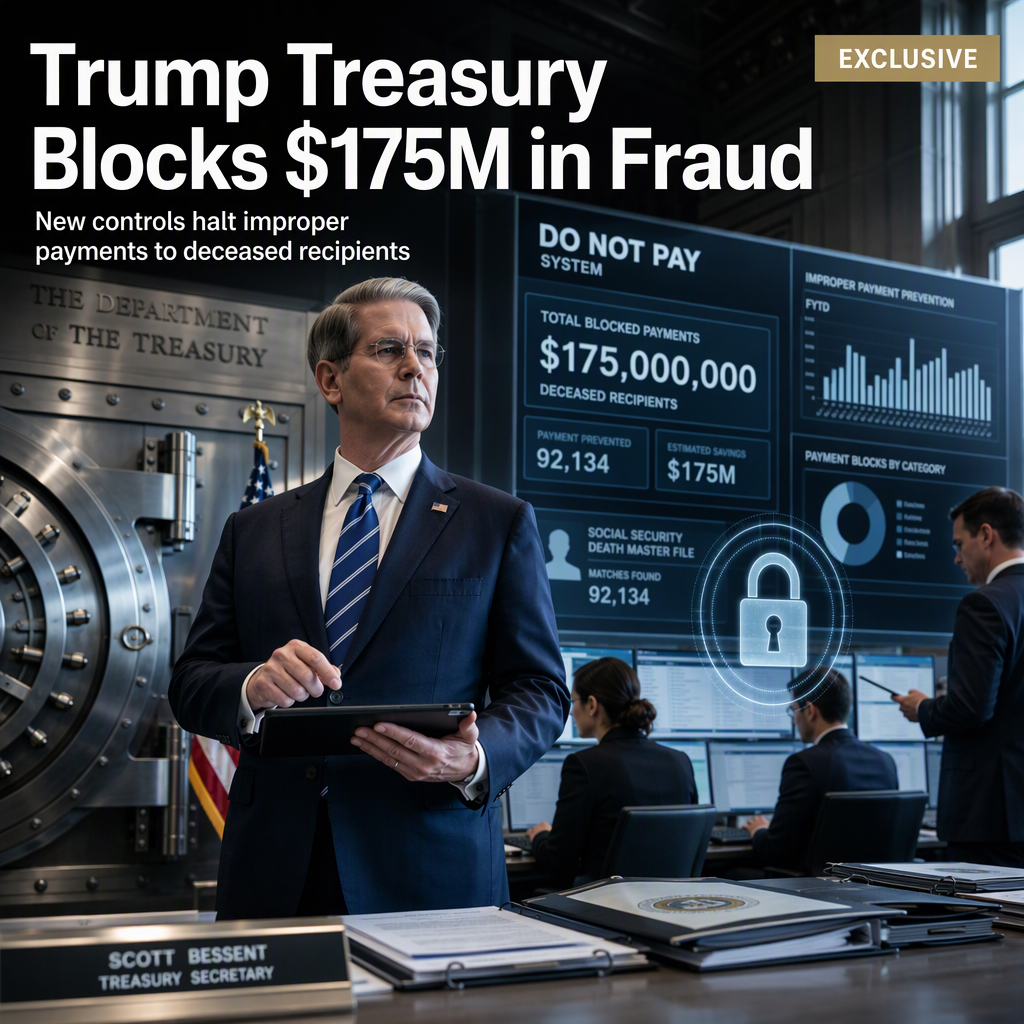
The U.S. Treasury Department, under the Trump administration, blocked $175 million in federal payments tied to deceased recipients during fiscal year 2026, marking a significant increase from the $99 million identified just months earlier. This surge in blocked payments follows the expansion of government-wide screening for improper payments, as part of a broader initiative to combat fraud, waste, and abuse in federal spending [1].
Senator John Kennedy, a Republican from Louisiana, praised Treasury Secretary Scott Bessent for the department's efforts, highlighting his own role in passing legislation to give Treasury greater access to Social Security death records. A temporary three-year data-sharing program began in December 2023, and President Trump signed the Ending Improper Payments to Deceased People Act into law in February 2026, making this access permanent [1].
In FY2026, Treasury screened over 1.1 billion federal payments totaling approximately $3.7 trillion, identifying and returning about 13,500 payments worth $175 million that would have otherwise gone to ineligible, deceased individuals. Secretary Bessent emphasized the use of improved data, stronger controls, and advanced technology to prevent fraud before payments are made, rather than recovering funds after the fact. The department also increased the reach of the "Do Not Pay" tool from 4% of federal programs at the end of FY2025 to over 99% in FY2026, fulfilling a key requirement of a March 2025 executive order from President Trump [1].
Additionally, Treasury screened more than 2.3 billion records against Do Not Pay data sources in FY2026, nearly quadrupling the 641 million records screened the previous year. These measures are part of a shift toward prevention as the federal government's primary defense against improper payments [1].
CONCLUSION
The Trump administration's expanded anti-fraud measures have resulted in a substantial increase in blocked improper payments to deceased individuals, saving taxpayers $175 million in FY2026. With nearly all federal programs now utilizing the Do Not Pay tool and enhanced data-sharing, the Treasury is prioritizing prevention and strengthening safeguards around federal spending.