
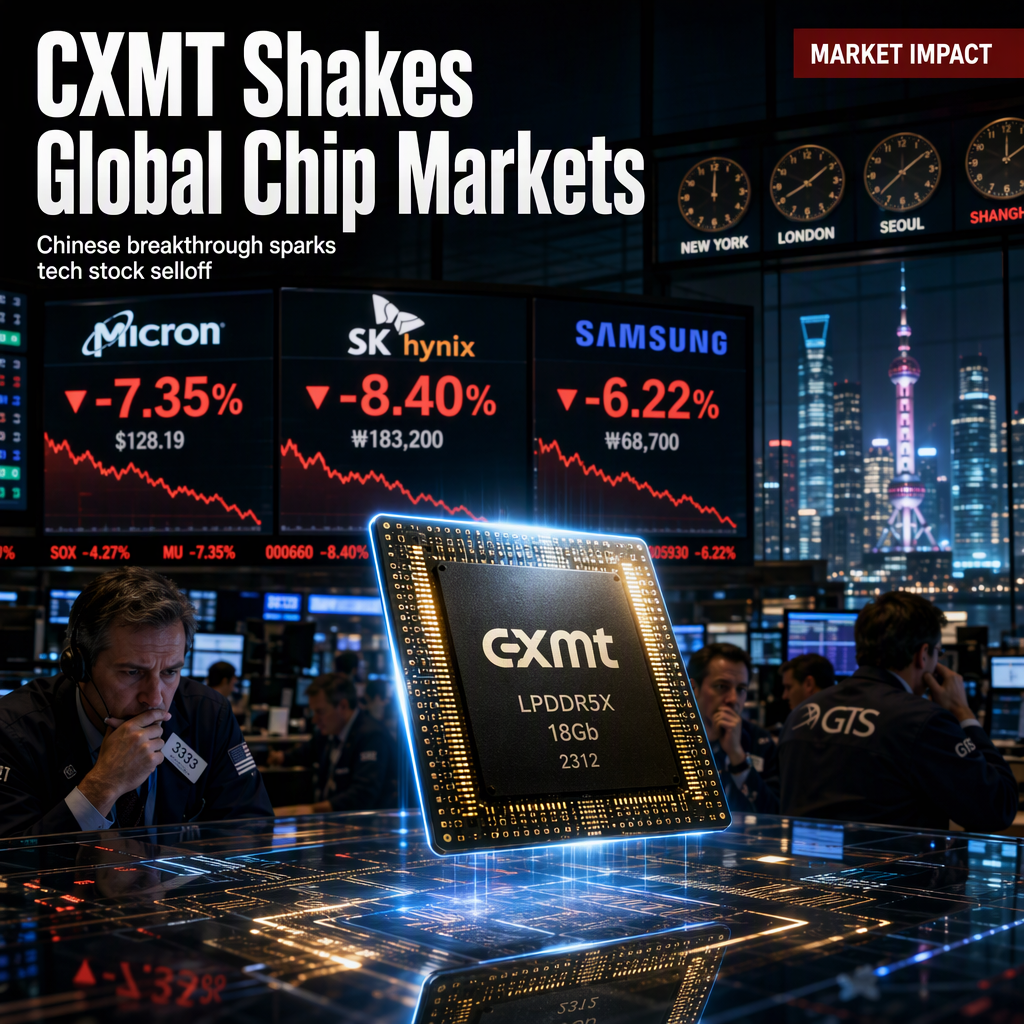
ChangXin Memory Technologies (CXMT), China's leading memory chipmaker, announced significant progress in developing new and more efficient memory chip designs, specifically a new architecture that increases memory density by packing more data into a smaller space [1]. This breakthrough, revealed over the weekend, caused a sharp selloff in global tech stocks on Tuesday, as investors reacted to CXMT's advancement in a sector dominated by Micron, SK Hynix, and Samsung [1].
Following the announcement, Micron's shares dropped 3.7% in premarket trading, SK Hynix's South Korean-listed shares closed 10% lower, and Samsung Electronics fell 7.4%. Other memory-related stocks, including SanDisk, Seagate, and Western Digital, also declined [1]. The market's reaction underscores the perceived threat CXMT poses to established global memory chipmakers, especially given its rapid rise in market share and technological progress [1].
CXMT recently completed a blockbuster IPO in July, soaring nearly 466% on its debut on Shanghai's STAR Market and becoming the most valuable China-listed company at the time. Although shares have since declined by 4% from their IPO-day price of 49 yuan, CXMT maintains a market cap of 3.46 trillion yuan ($520 billion), close to Tencent's 3.87 trillion yuan [1]. The company, founded in 2016 and headquartered in Hefei, has seen its share of the global DRAM market rise to around 10% [1].
Despite its progress, CXMT faces challenges accessing advanced chipmaking equipment due to U.S. export controls, including ASML's EUV lithography machines, which are essential for manufacturing the most advanced semiconductors [1]. CXMT reportedly plans to roll out a new server-memory product based on its new cell architecture by the end of 2026, utilizing "4F square" technology—a design also being pursued by SK Hynix, which presented its own roadmap for the tech in 2025 [1]. Analysts note that CXMT is often seen as trailing global competitors at the frontier of memory developments, but any news of breakthroughs can significantly impact investor perceptions of global rivals' market advantages [1].
CONCLUSION
CXMT's technological breakthrough and rapid market gains have triggered a global selloff in memory chip stocks, highlighting the company's growing influence in the sector. While CXMT faces challenges from export controls, its progress is reshaping investor sentiment and competitive dynamics among global chipmakers. The market will closely watch CXMT's upcoming product rollout and its ability to further narrow the gap with established rivals.