
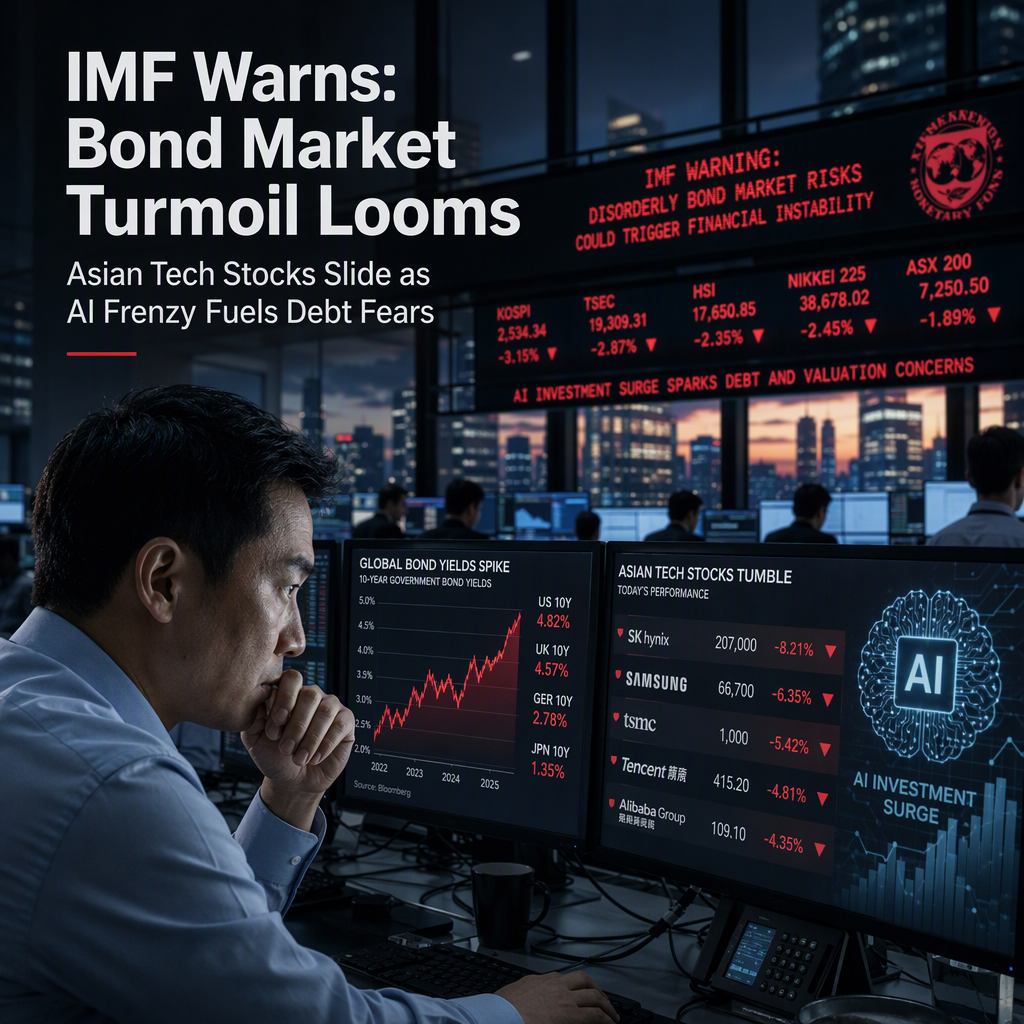
The International Monetary Fund (IMF) issued a warning that mounting global debt, persistent inflation, and AI-related borrowing could trigger a 'disorderly' spike in sovereign bond yields, potentially destabilizing financial markets [1]. The IMF's latest Global Financial Stability Report highlighted that government bond yields in several advanced economies have already climbed to multidecade highs, driven by higher energy costs stemming from the Middle East conflict and expectations for tighter monetary policy as central banks attempt to curb resurgent inflation [1].
Asian technology stocks, including SK Hynix, Samsung Electronics, and SoftBank Group, experienced significant declines due to concerns over AI financing and intensifying competition from Chinese firms [1]. The IMF noted that the current AI investment boom is providing some offset to the negative effects of the Middle East energy shock, leading the fund to raise its 2026 global growth forecast. However, the IMF cautioned that the resilience of the world economy is nearing its limits, with global public debt approaching its highest level since World War II and on track to soon exceed 100% of GDP [1].
The IMF warned that a sharp rise in sovereign bond yields would reduce asset values through higher discount rates, including for AI-related assets, and erode the value of government bonds used as collateral [1]. In a scenario where anticipated AI productivity gains fail to materialize, the IMF projected that U.S. equities could fall by 20% and global growth could be 1.1% below baseline estimates by 2028, with Asia potentially 1.7% lower [1].
Amid this backdrop of volatility, DBS CEO Tan Su Shan emphasized Singapore's stability and predictability, suggesting that the city-state's 'boring' reputation could be an asset for companies seeking to diversify supply chains and navigate rising trade and geopolitical risks [1].
CONCLUSION
The IMF's warnings underscore significant risks to global markets from rising debt, inflation, and AI-driven investment surges. Asian tech stocks have already reacted negatively, and the potential for a disorderly spike in bond yields could further destabilize asset values. Market participants are advised to monitor these developments closely, as the resilience of the global economy may soon be tested.