
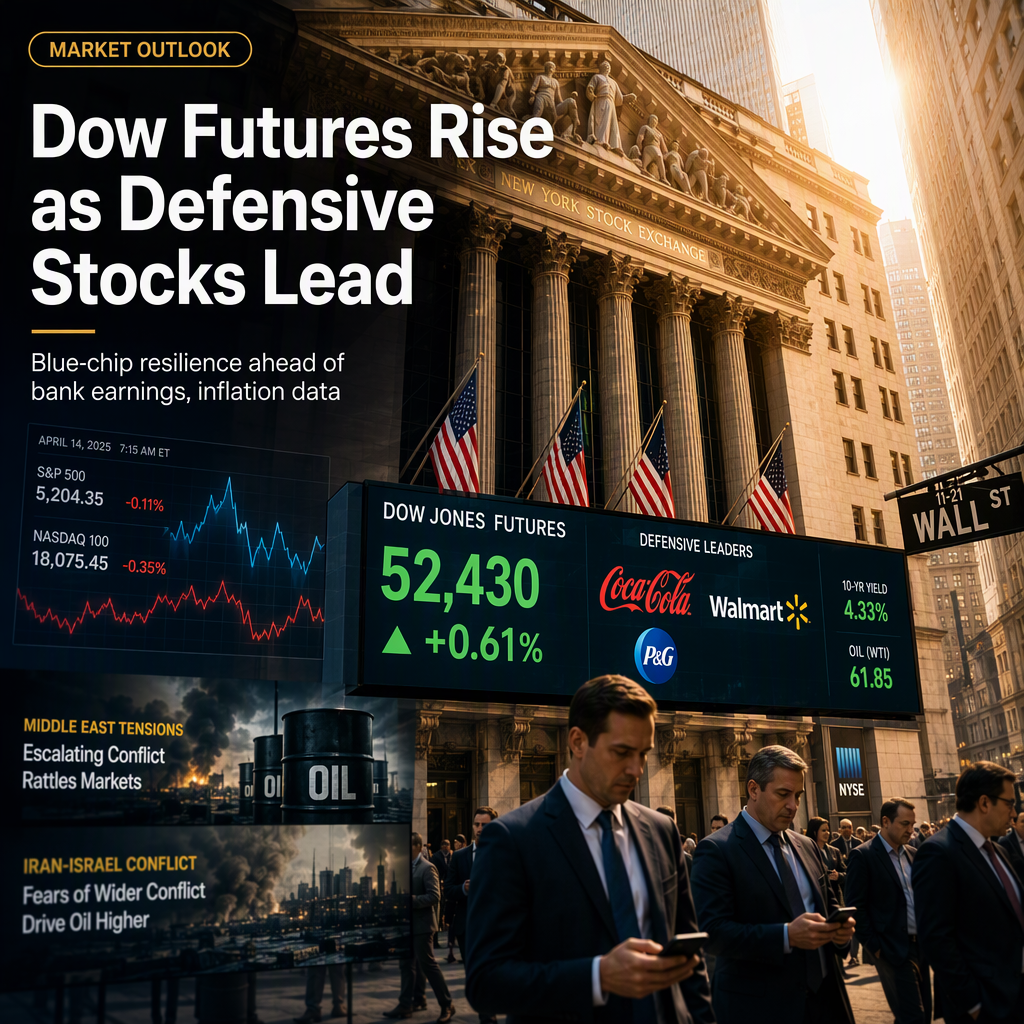
Dow Jones futures increased by 0.61% to trade near 52,430 during European hours on Tuesday, while S&P 500 futures remained steady around 7,850 and Nasdaq 100 futures fell 0.56% to near 30,730 [1]. This mixed performance in US stock futures comes amid ongoing volatility in crude oil prices, which is being driven by geopolitical tensions in the Middle East. These developments are impacting inflation expectations and industrial sector margins [1]. Defensive and blue-chip stocks such as Coca-Cola, Procter & Gamble, and Walmart showed relative strength, helping to offset weakness in technology and cyclical manufacturing stocks [1].
Investors are closely watching the official start of the third-quarter earnings season, with major financial institutions including JPMorgan, Goldman Sachs, Citigroup, and Wells Fargo scheduled to report their latest quarterly results today. These reports are expected to provide important insights into consumer health and corporate profitability [1]. In addition to earnings, market participants are evaluating new economic indicators such as existing home sales data and upcoming remarks from Federal Reserve officials Christopher Waller, Tom Barkin, and Susan Collins. These updates come just ahead of Wednesday’s September inflation report, which is anticipated to significantly influence the Fed’s next interest rate decision [1].
The current futures activity follows a divergent US regular session on Monday, where the Dow Jones Industrial Average gained 0.38%, while the S&P 500 and Nasdaq Composite slipped by 0.06% and 0.44%, respectively. Elevated bond yields and a decline in semiconductor shares weighed on broader market sentiment [1]. Despite this, US equity breadth remained resilient, with the equal-weighted index outperforming. According to analysts at Danske Bank, 321 S&P 500 constituents advanced versus 179 that declined, marking the seventh session in eight with positive breadth and continued outperformance for the equal-weighted index. They note that this trend challenges the idea that recent US equity performance has been narrowly driven [1].
CONCLUSION
The market is showing resilience, with defensive and blue-chip stocks supporting the Dow Jones despite ongoing volatility and sector-specific weakness. Investors are focused on upcoming earnings from major banks and key economic data, which are expected to shape near-term market direction and Federal Reserve policy.