
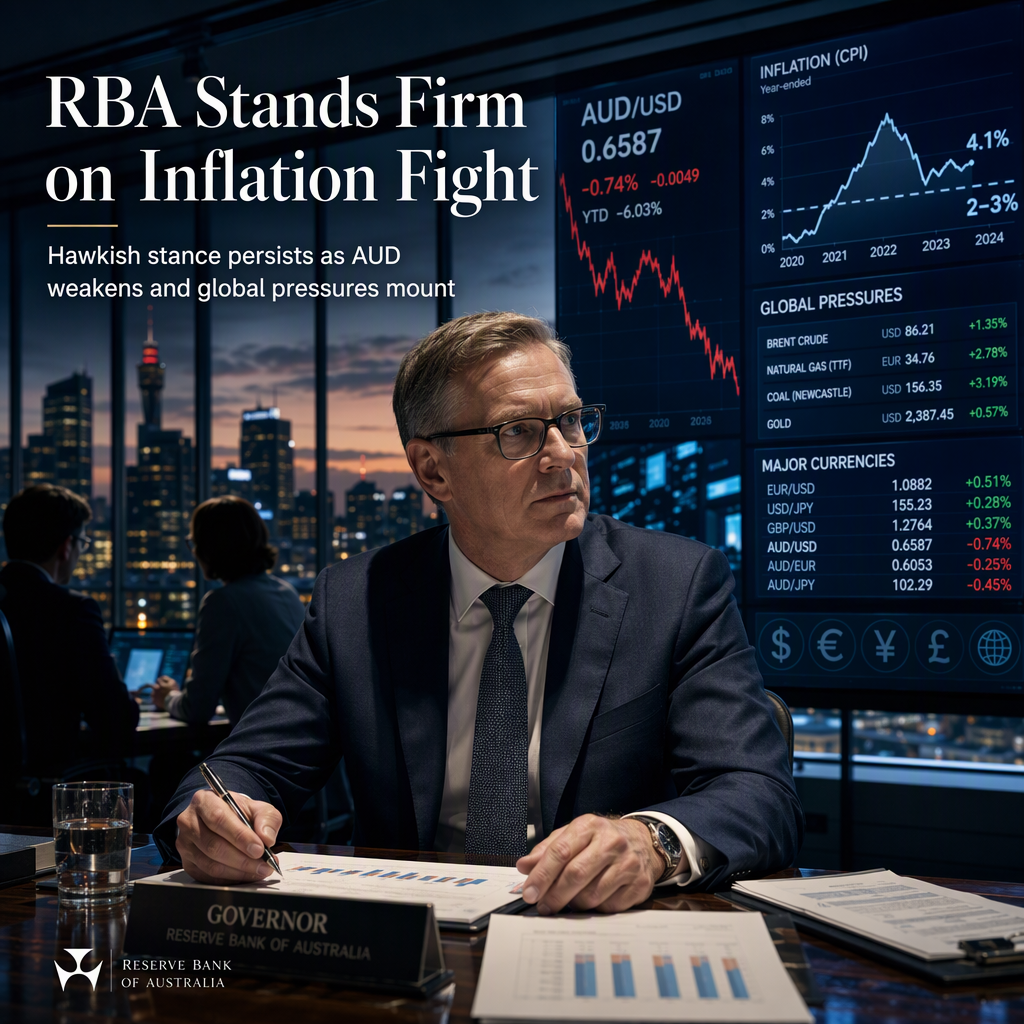
Commerzbank’s Volkmar Baur highlights that the Reserve Bank of Australia (RBA) is intensifying its focus on persistent high inflation, with trimmed-mean inflation remaining above the central bank’s 2–3% target band for over a year [1]. The RBA’s latest minutes reveal heightened concerns about both global and domestic cost pressures, including the risk of imported inflation resulting from a weaker Australian Dollar (AUD) [1]. The central bank also noted that a rise in the global neutral interest rate could further weaken the AUD if Australia’s neutral rate does not increase correspondingly, though the RBA appears to assume it has [1].
Looking forward, Commerzbank identifies three critical factors influencing the RBA’s policy outlook: the actions of other central banks, developments in energy prices, and domestic inflation dynamics and expectations [1]. If other central banks, such as the ECB or the Fed, raise rates more aggressively than anticipated, the RBA may feel compelled to tighten policy further to prevent excessive AUD depreciation [1]. However, Commerzbank does not expect the ECB or Fed to hike rates at their upcoming meetings, and therefore does not anticipate another RBA rate hike in early November [1].
Nonetheless, a further rate increase by the RBA in December remains possible if energy markets do not ease and inflation fails to show signs of improvement [1]. The RBA’s current stance prioritizes inflation control over economic growth, reflecting its commitment to anchoring inflation expectations and addressing imported price pressures [1].
CONCLUSION
The RBA’s policy outlook remains hawkish, with inflation control as the central focus amid ongoing global and domestic pressures. While no immediate rate hike is expected, a December move is possible if inflationary risks persist. Market participants should closely monitor energy prices and global central bank actions for further policy signals.