
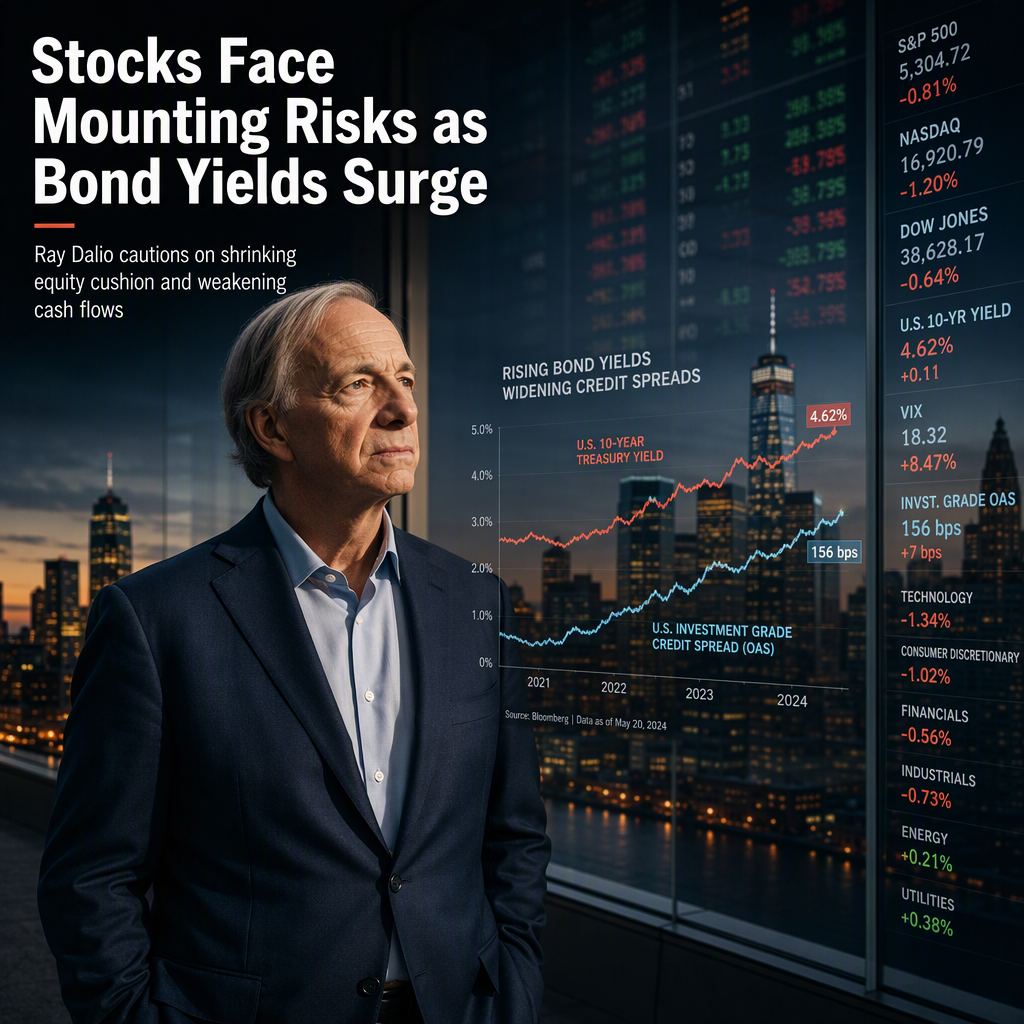
Billionaire investor Ray Dalio cautioned that the stock market's resilience to rising bond yields is diminishing, as the relative advantage of equities over bonds narrows and corporate cash flows show signs of weakening [1]. Speaking at the Milken Institute Asia Summit in Singapore, Dalio explained that equities have so far withstood the global bond sell-off due to robust earnings growth, which has kept expected stock returns attractive compared to bonds [1]. However, he warned that this cushion is shrinking as both stock prices and bond yields rise, making equities more susceptible to tighter financial conditions [1].
Dalio highlighted that U.S. Treasury yields are hovering near multi-decade highs, driven by large government deficits, persistent inflation, and increased borrowing for AI investments [1]. He noted that as the pricing advantage of stocks over bonds declines, credit spreads are beginning to widen, signaling growing market stress [1].
Focusing on corporate fundamentals, Dalio urged investors to pay closer attention to free cash flow rather than just earnings, warning that deteriorating cash generation could pose liquidity risks even if headline profits continue to improve [1]. He stated, "While earnings should continue to be improving, I would expect the free cash flows, I think, will be deteriorating" [1]. Despite these concerns, Dalio stopped short of forecasting an imminent earnings decline or a sharp market correction, noting that financial conditions have not yet tightened enough to significantly restrict credit and spending [1].
Looking ahead, Dalio predicted that the global bond sell-off has further to run, as governments and companies compete for capital amid rising debt issuance, which could sustain upward pressure on interest rates [1].
CONCLUSION
Ray Dalio's remarks signal growing caution for equity investors as the buffer against rising bond yields erodes and corporate cash flows weaken. While he does not foresee an immediate market correction, Dalio's outlook suggests that tighter financial conditions and ongoing bond market pressures could increase risks for stocks in the coming months.