
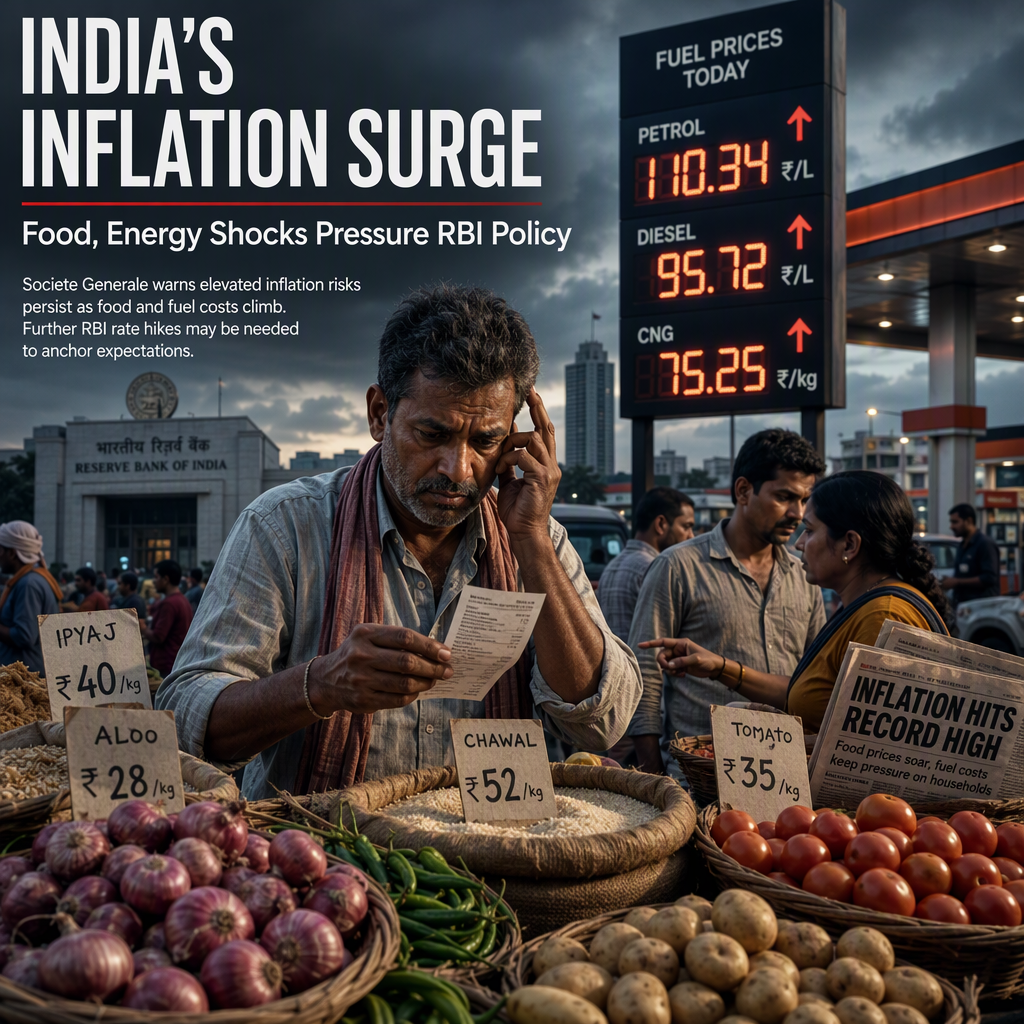
Societe Generale’s Kunal Kundu projects that India’s headline Consumer Price Index (CPI) inflation for September 2026 will surge to 5.6% year-on-year, up from 4.8% in August, primarily due to a broad-based food shock and escalating energy costs [1]. Food inflation is expected to reach approximately 7.5% year-on-year, which is considered more persistent and likely to influence household inflation expectations more significantly than a temporary spike in vegetable prices [1].
The report also anticipates that core CPI inflation will approach 4.5% year-on-year, signaling that underlying price pressures are intensifying despite relatively subdued mass-market demand [1]. The immediate impact on CPI will depend on the scale of domestic fuel-price adjustments [1].
Kundu cautions that real policy rates will remain negative even after the Reserve Bank of India’s (RBI) anticipated October rate hike, suggesting that additional monetary tightening may be necessary [1]. With headline inflation nearing the upper tolerance threshold, rising core inflation, and increasingly broad-based inflation shocks, the RBI may need to implement further policy measures to restore a positive real rate and mitigate the risk of second-round price effects [1].
CONCLUSION
Societe Generale highlights mounting inflationary pressures in India, driven by persistent food and energy shocks. The analysis suggests that the RBI may need to consider further tightening to restore positive real policy rates and contain inflation risks. Market participants should monitor RBI policy actions closely in response to these developments.