
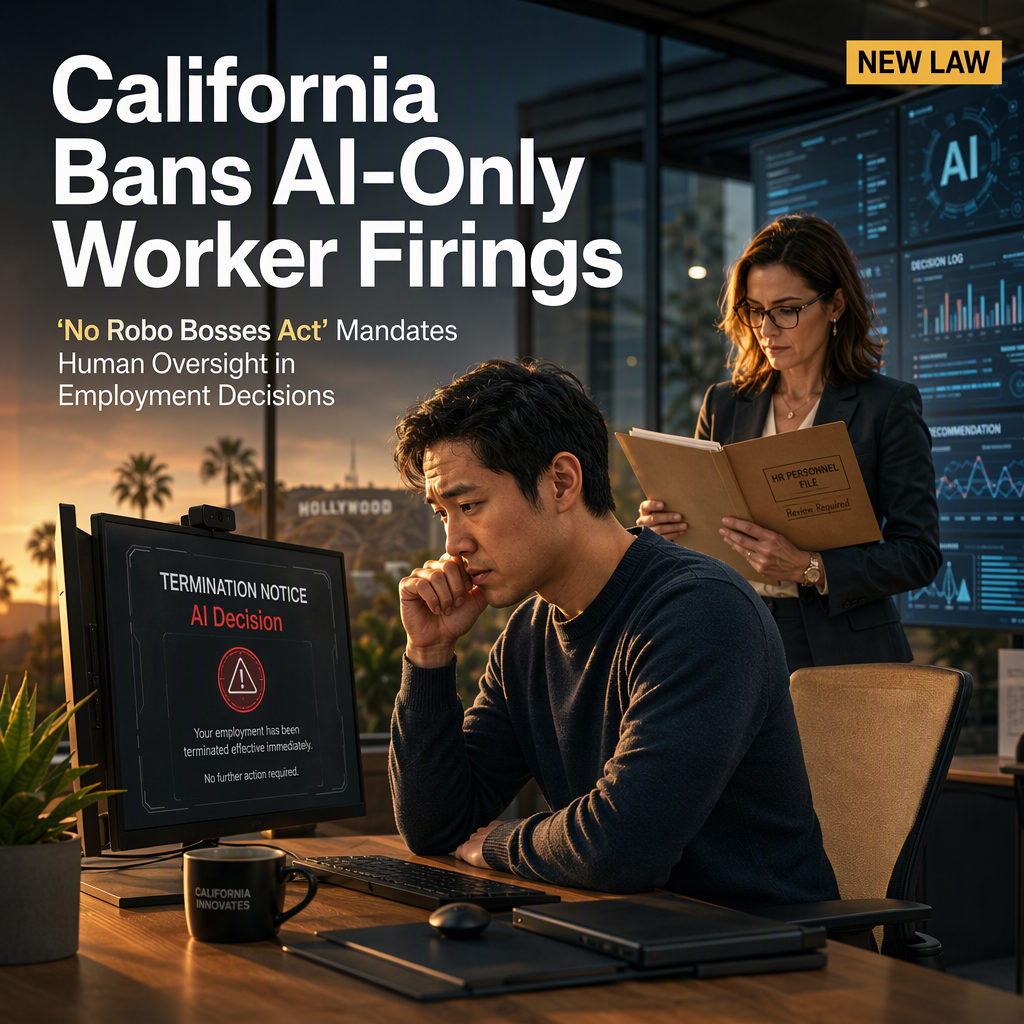
California Governor Gavin Newsom has signed the 'No Robo Bosses Act' (SB 947), a landmark law that prohibits employers in California from relying solely on artificial intelligence to fire or discipline workers [1]. The law mandates that if employers use AI as the primary tool in making termination or disciplinary decisions, a human reviewer must corroborate those decisions using additional information such as managerial evaluations, peer reviews, and personnel files [1]. Furthermore, employees affected by such decisions must receive written notice that AI was primarily used, a description of the employee data utilized, and a human point of contact for further explanation [1].
The bill was authored by State Senator Jerry McNerney and introduced in 2025 following advocacy from organized labor groups seeking to establish safeguards around the use of AI in workplace management [1]. McNerney emphasized that 'no worker should ever be fired or disciplined by a machine,' citing concerns over AI errors, misjudgments, and bias [1]. Lorena Gonzalez, president of the California Federation of Labor Unions, AFL-CIO, and lead sponsor of the act, stated that the law marks a significant step in regulating AI in workplaces and empowers workers and unions to push back against AI-driven management practices [1].
Governor Newsom's signing of the act follows a series of recent actions on AI, including a broader executive order addressing existential risks posed by AI models and a measure to establish a state framework for independent evaluation and auditing of AI systems [1]. Newsom criticized the federal government for failing to protect Americans in this area [1]. According to OECD survey results published late last year, the U.S. leads globally in the adoption of automated management software, with 90% of managers reporting their firms have adopted at least one such tool [1].
The passage of the 'No Robo Bosses Act' is expected to have significant implications for employers in California, particularly those utilizing AI-driven management systems, and may influence broader national conversations and regulatory approaches to AI in the workplace [1].
CONCLUSION
California's new law sets a precedent by restricting the sole use of AI in critical employment decisions, reflecting growing concerns about algorithmic bias and lack of human oversight. The move is likely to have a high market impact, especially for companies operating in California that rely on AI for workforce management. This legislation could serve as a model for other states or prompt further national debate on AI regulation in the workplace.