
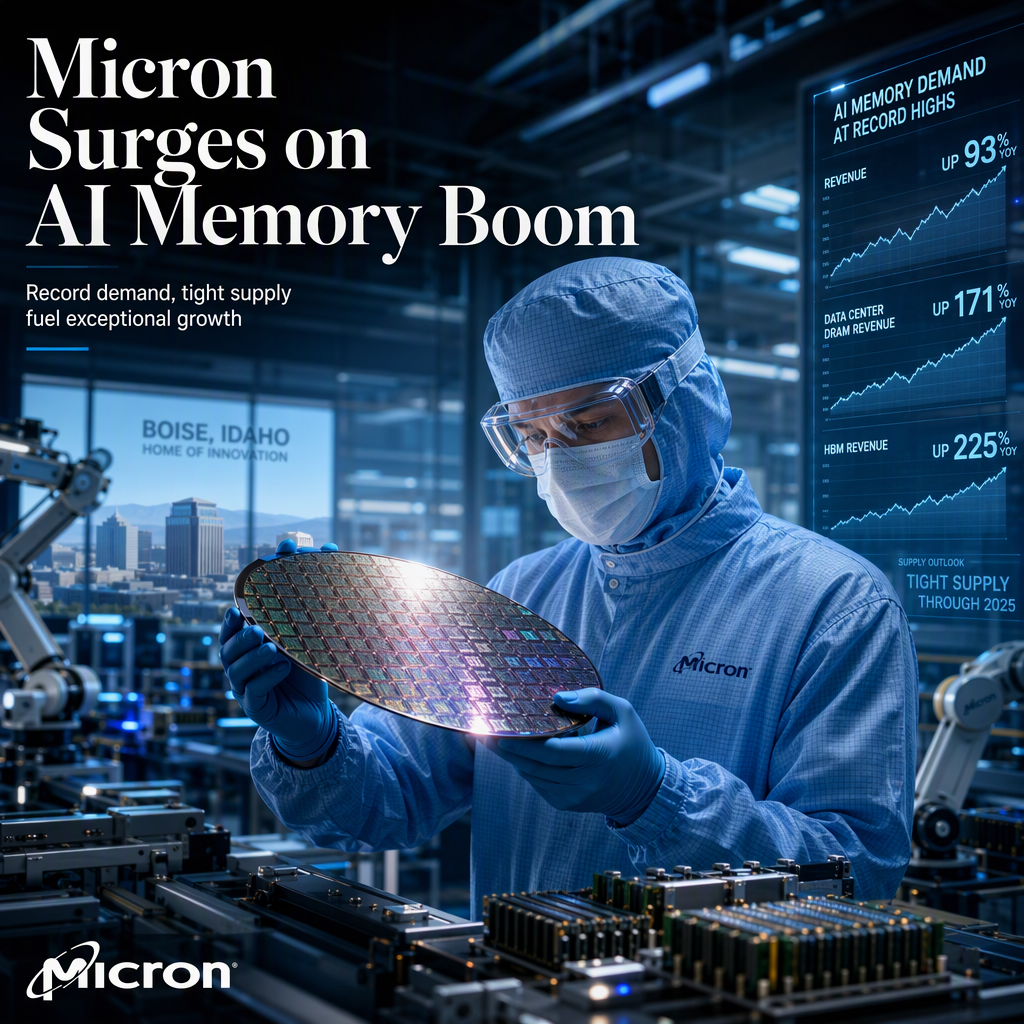
Micron delivered an exceptional fiscal 2026 fourth quarter, with revenue surging 379% year-over-year to $54.23 billion, significantly surpassing the $51.07 billion consensus forecast compiled by LSEG. Adjusted earnings per share (EPS) soared 1,002% to $33.42, also beating expectations of $31.61. These results were attributed to tight supply conditions and robust demand for memory products, particularly for AI applications, which drove up average selling prices, revenue, gross margins, and EPS [1].
Despite the strong quarterly performance, Micron shares traded in a tight range in after-hours trading and settled around the flat line following the company's post-earnings conference call. The stock had rallied approximately 11% in September and is up roughly 275% for the year, though it remains 12% below its record close of $1,213 on June 25 [1].
Micron's management highlighted that the demand for both DRAM and NAND memory products continues to significantly outpace supply, with no clear timeline for when the market will reach equilibrium. The company expects supply conditions to become even tighter in calendar years 2027 and 2028, as supply growth cannot keep up with demand. Notably, about 75% of Micron's expected output for 2027 is already allocated, and customers are already in discussions for 2028 allocations. CEO Sanjay Mehrotra emphasized the need for cleanroom additions—expanding manufacturing capacity—to help address the ongoing supply-demand gap [1].
The report underscores that high-bandwidth memory (HBM), a specialized form of DRAM, is a key enabling technology for AI workloads, and the growing memory needs of AI systems are a primary driver of the current market dynamics. The company is actively expanding its manufacturing footprint, including new semiconductor fabrication sites near its headquarters in Boise, Idaho [1].
CONCLUSION
Micron's record-setting quarter and robust outlook underscore the company's central role in meeting surging AI-driven memory demand. With supply expected to remain tight through 2028 and most future output already committed, Micron is well-positioned for continued growth. The market response has been positive, reflecting confidence in the company's strategic direction and industry leadership.