
The Bank of Japan's latest Tankan survey revealed that business sentiment among large Japanese manufacturers improved for the sixth consecutive quarter in the July-September period, driven by robust global demand for artificial intelligence-related goods and technologies [1]. Despite rising energy costs due to Middle East tensions, the AI investment boom has supported external demand and kept manufacturers optimistic, with analysts noting stable export demand and positive business outlooks [1].
In the tech supply chain, suppliers and manufacturers report that investment in AI hardware and data center buildouts remains at record highs, with production lines operating at full capacity to meet booming orders [2]. This surge comes despite recent volatility in AI-related stocks triggered by calls to slow frontier AI development, notably after Anthropic chief Dario Amodei's comments earlier in the month [2]. Market participants at a Silicon Valley convention emphasized that the supply chain remains undeterred by stock price fluctuations, viewing current dips as buying opportunities and highlighting backlogs stretching into 2027 [2]. Technical analysis indicates strong support levels for infrastructure stocks, with resistance only expected in the event of prolonged regulatory or macroeconomic headwinds [2].
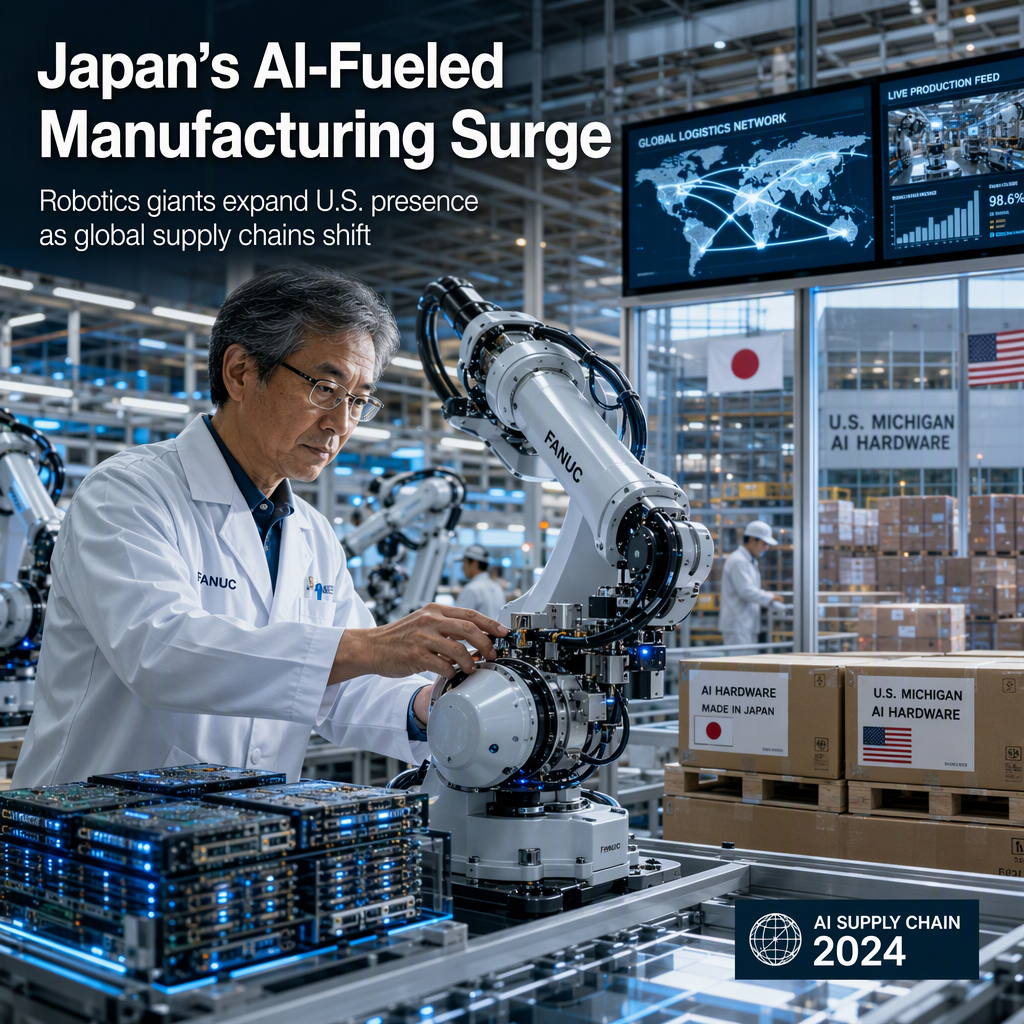
Japanese industrial robot makers, including Fanuc and Yaskawa, are responding to the AI boom by expanding their presence in the U.S. Fanuc is investing $90 million in a new plant and logistics center in Michigan, reflecting a broader shift from China to the U.S. among Japanese robotics companies [3]. This move is motivated by both market opportunities and risk management, as manufacturers seek to secure production lines and minimize reliance on Chinese components amid recent U.S. restrictions on robot imports [3]. The expansion of manufacturing capacity in the U.S. is seen as a strategic response to supply chain vulnerabilities and the evolving needs of U.S. factories for advanced, AI-powered robotics solutions [3].
Key executives and analysts across the sources highlight that the AI boom is fueling immediate production needs and long-term planning, with continued investment and expansion expected in the sector [2][3].
CONCLUSION
Japanese manufacturers and tech suppliers are experiencing a sustained boost in sentiment and demand, driven by the global AI investment boom. Strategic shifts in supply chains and expansion into the U.S. market by robot makers like Fanuc and Yaskawa underscore the sector's resilience and growth prospects. Despite volatility in AI-related stocks, the underlying fundamentals remain strong, with robust order backlogs and positive outlooks for continued expansion.