
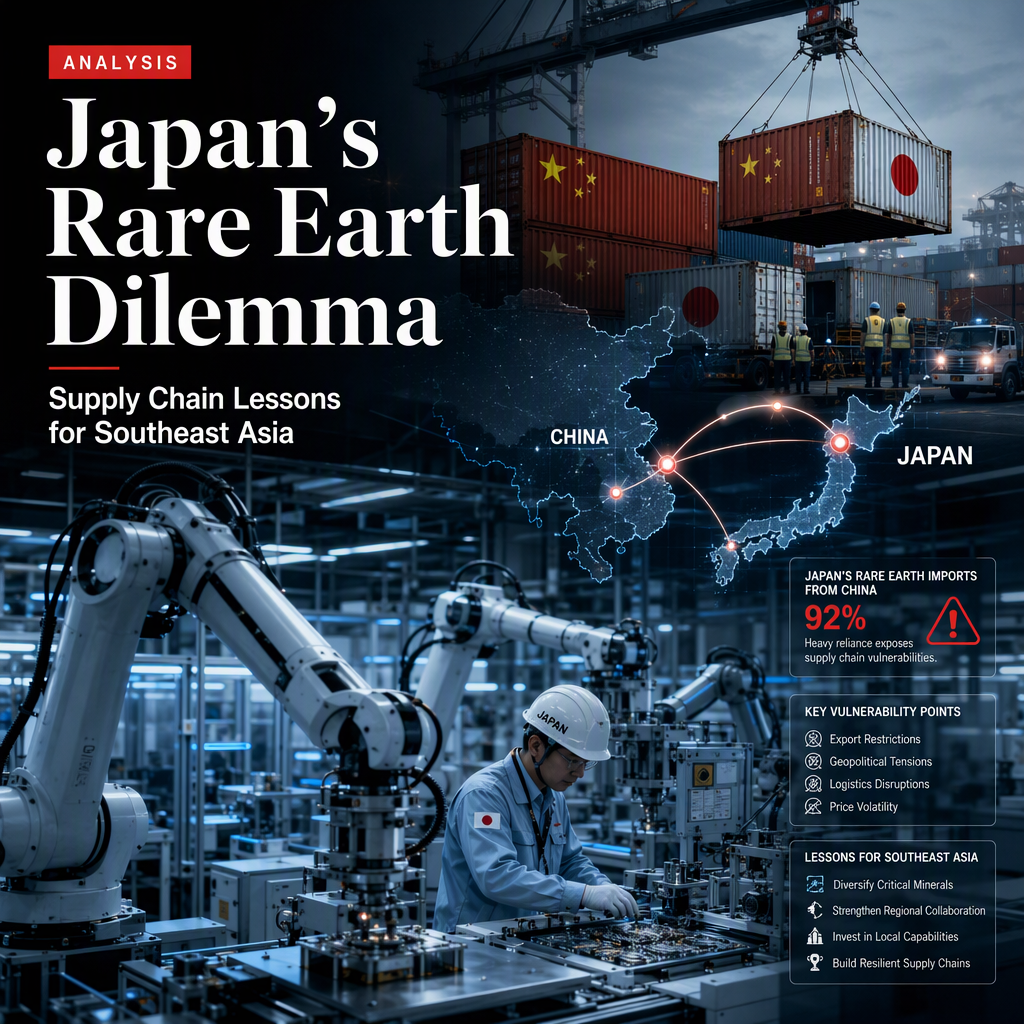
Japan continues to rely heavily on China for critical rare earth imports, with more than 50% of its rare earth supply originating from China. This dependence exposes significant vulnerabilities in supply chains essential for high-tech manufacturing and defense industries, despite ongoing diplomatic challenges between the two countries [1].
In response, Japan has implemented diversification strategies, including seeking alternative suppliers and investing in domestic production capacity. However, the article notes that the complexity and specialization of rare earth supply chains make rapid decoupling from China both difficult and costly. Japanese companies often continue sourcing from China due to the lack of viable alternatives or the high costs associated with switching suppliers [1].
The article draws parallels between Japan's situation and the challenges faced by Southeast Asian nations, which also grapple with balancing economic opportunities against the risks of overdependence on China. Japan's experience is presented as a case study in incremental diversification, government support for strategic sectors, and the importance of building resilient partnerships with multiple trading partners [1].
The Japanese approach to 'derisking' is characterized not by total disengagement from China, but by efforts to manage and mitigate vulnerabilities. The article suggests that policymakers in Southeast Asia can learn from Japan's pragmatic strategy, especially as global geopolitical tensions and supply chain disruptions become more frequent [1].
CONCLUSION
Japan's continued reliance on Chinese rare earths, despite diversification efforts, underscores the challenges of reducing supply chain vulnerabilities in specialized sectors. Southeast Asian countries can draw valuable lessons from Japan's incremental and pragmatic approach to derisking, focusing on resilience rather than complete disengagement.