
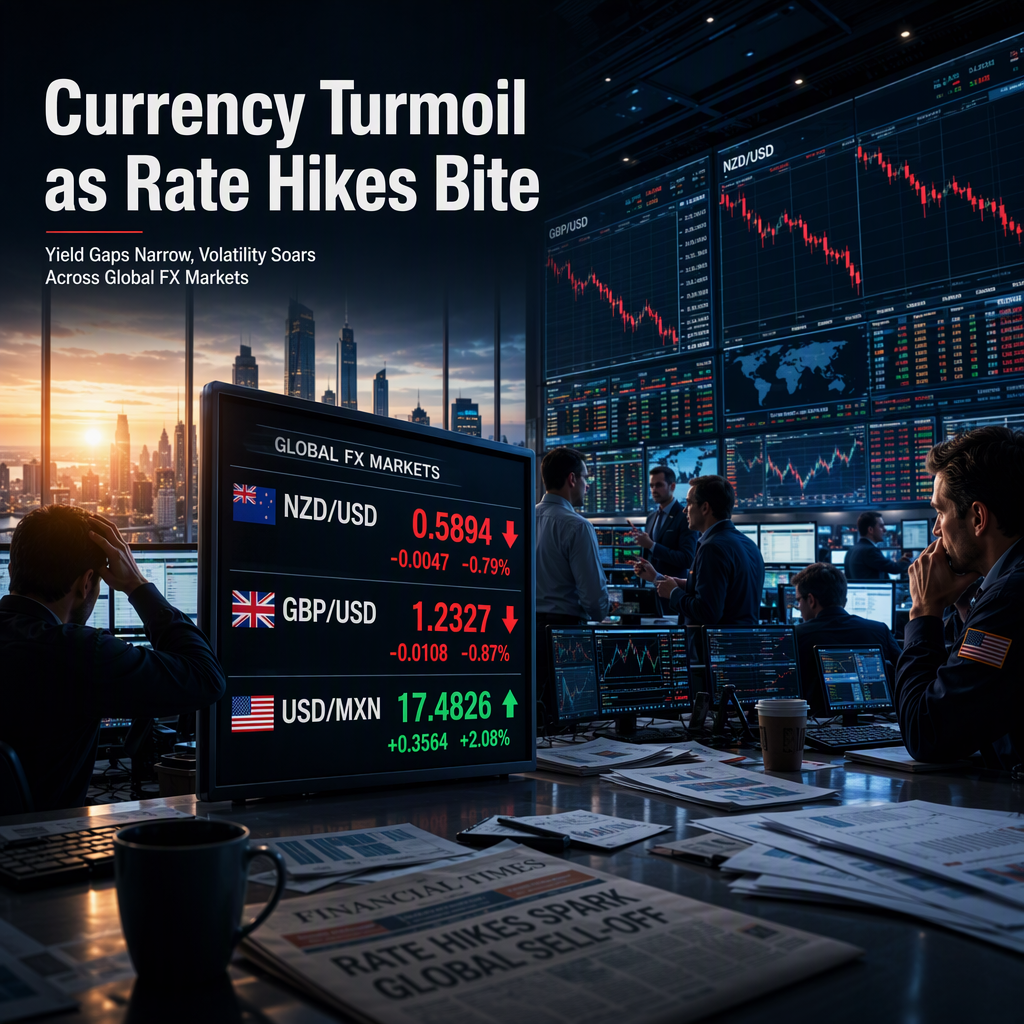
A wave of central bank rate hikes and shifting monetary policy expectations has triggered sharp moves across major currency pairs. The Reserve Bank of Australia (RBA) raised its cash rate to 4.60%, the highest since 2011, in a unanimous vote, signaling less further tightening than markets had priced. This move sent the Australian Dollar lower and pushed NZD/USD below 0.5650 for the first time in its recent slide, with resistance now at 0.5650 and support at 0.5625 and 0.5600. The Reserve Bank of New Zealand (RBNZ) raised its Official Cash Rate (OCR) to 2.75% on September 2, and odds for another hike to 3.00% on October 28 have climbed to about 80%, following Governor Breman's warning that higher crude oil prices could push inflation above assumptions. However, the Kiwi's reaction will depend on RBNZ's guidance, as the hike is already priced in and only firmer policy signals could surprise markets. Technical bias remains short for NZD/USD, with momentum stretched to the downside [1].
In the UK, GBP/USD fell to 1.3200, its lowest since late June, after Bank of England (BoE) external member Taylor said energy prices alone don't justify higher rates. Taylor, who voted to hold the Bank Rate at 3.75% on September 17, emphasized that further increases aren't compelling unless energy prices stay high and spread into broader inflation. The BoE's next decisions are scheduled for November 5 and December 17, with the agents' survey of firms' pay plans in January cited as key evidence for future moves. The 5% VAT on household electricity drops to zero on Thursday, expected to shave 0.1 percentage point off CPI inflation, while Ofgem's price cap rises 4%, adding about £60 to annual bills. Technical bias for GBP/USD is short, targeting a daily close under 1.3200 and the late-June low near 1.3150 [2].
The Mexican Peso broke above 18.00 against the US Dollar for the first time since April 2026, with USD/MXN trading at 18.04 and up 0.29% on the day. The sharp fall is attributed to a shrinking interest rate differential between Mexico and major economies, as well as rising US Treasury yields north of 5%, prompting capital repatriation. Banxico's rate is near 6.50%, while the Fed's range is 3.75%-4%, narrowing the gap to 2.50% from a post-pandemic peak of 6%. US Treasury yields (5.23%-5.61%) are now more attractive than Mexican MBONOS, given exchange rate risks. Fed officials offered mixed signals, with New York Fed President John Williams stating no urgency to tighten, while others like St. Louis Fed Alberto Musalem and Chicago Fed Austan Goolsbee expressed concerns about accommodative policy and persistent inflation. US consumer sentiment deteriorated due to elevated oil and gas prices, while job openings dipped, indicating a solid job market. USD/MXN's technical outlook is bullish, trading well above key moving averages, though the Relative Strength Index at 82.80 signals overbought conditions [3].
Across all three markets, upcoming US data releases—including inflation, GDP, and jobs reports—are expected to have outsized influence on currency pairs, with Friday's payrolls likely to move NZD/USD and GBP/USD more than domestic releases. In Mexico, traders are watching September's Business Confidence and S&P Global Manufacturing PMI on October 1 [1][2][3].
CONCLUSION
Central bank rate hikes and narrowing yield differentials have triggered significant currency moves, with NZD/USD, GBP/USD, and USD/MXN all breaking key levels. Market sentiment is negative, driven by concerns over inflation, policy uncertainty, and capital flows. Upcoming US economic data is expected to further impact these pairs, keeping volatility elevated in the near term.