
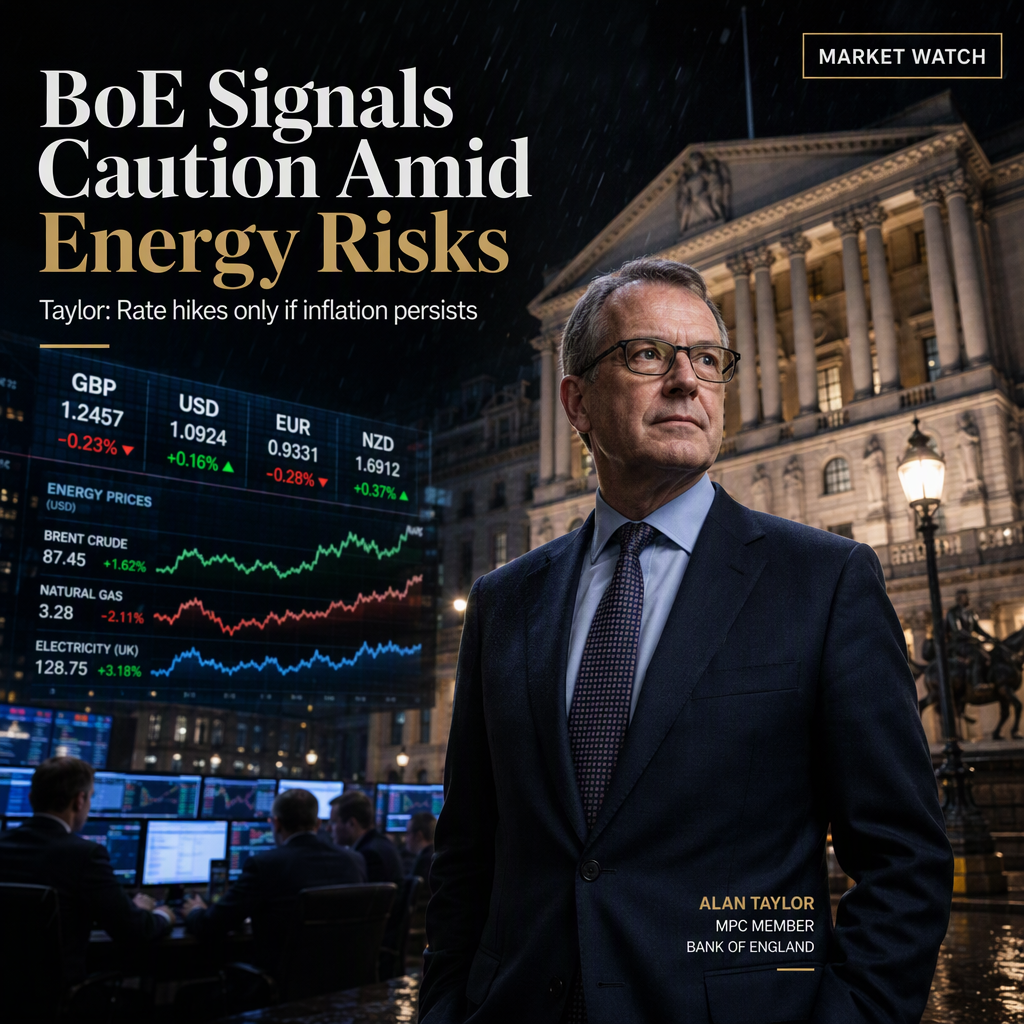
Bank of England (BoE) Monetary Policy Committee member Alan Taylor stated that monetary policy should not react mechanically to movements in energy prices, emphasizing that the BoE's response should be vigilant but disciplined. Taylor highlighted that if energy prices remain high for an extended period and second-round effects begin to emerge, the case for rate hikes would be strengthened. However, he noted that the burden of proof for additional tightening should rest on clear evidence of these second-round effects gaining traction, and currently, the case for further rate increases is not compelling to him unless these conditions are met [1].
At the most recent BoE meeting, Taylor voted with the majority to keep rates unchanged at 3.75%. He remarked that the current policy stance is restrictive enough and that the economy appears less susceptible to a repeat of the inflation dynamics seen in 2022. Taylor also pointed out that evidence does not support the occurrence of a general inflation shock, though he acknowledged a non-trivial risk to inflation remains [1].
Regarding currency movements, the British Pound (GBP) has shown mixed performance this month. It was the strongest against the New Zealand Dollar, appreciating by 2.44%, while it depreciated by 2.58% against the US Dollar and by 0.08% against the Euro. These shifts reflect ongoing market reactions to monetary policy expectations and global economic developments [1].
Looking ahead, Taylor suggested that once energy risks abate, policy will need to move in the other direction, implying potential rate cuts in the future. However, he reiterated that any decision for further tightening should be based on concrete evidence of inflation persistence driven by energy price shocks [1].
CONCLUSION
BoE’s Alan Taylor signaled a cautious approach to further rate hikes, emphasizing the need for clear evidence of inflation persistence before tightening policy. The British Pound has shown mixed performance against major currencies this month, reflecting market uncertainty. The overall market takeaway is that the BoE is likely to maintain its current stance unless prolonged energy shocks lead to broader inflation pressures.