
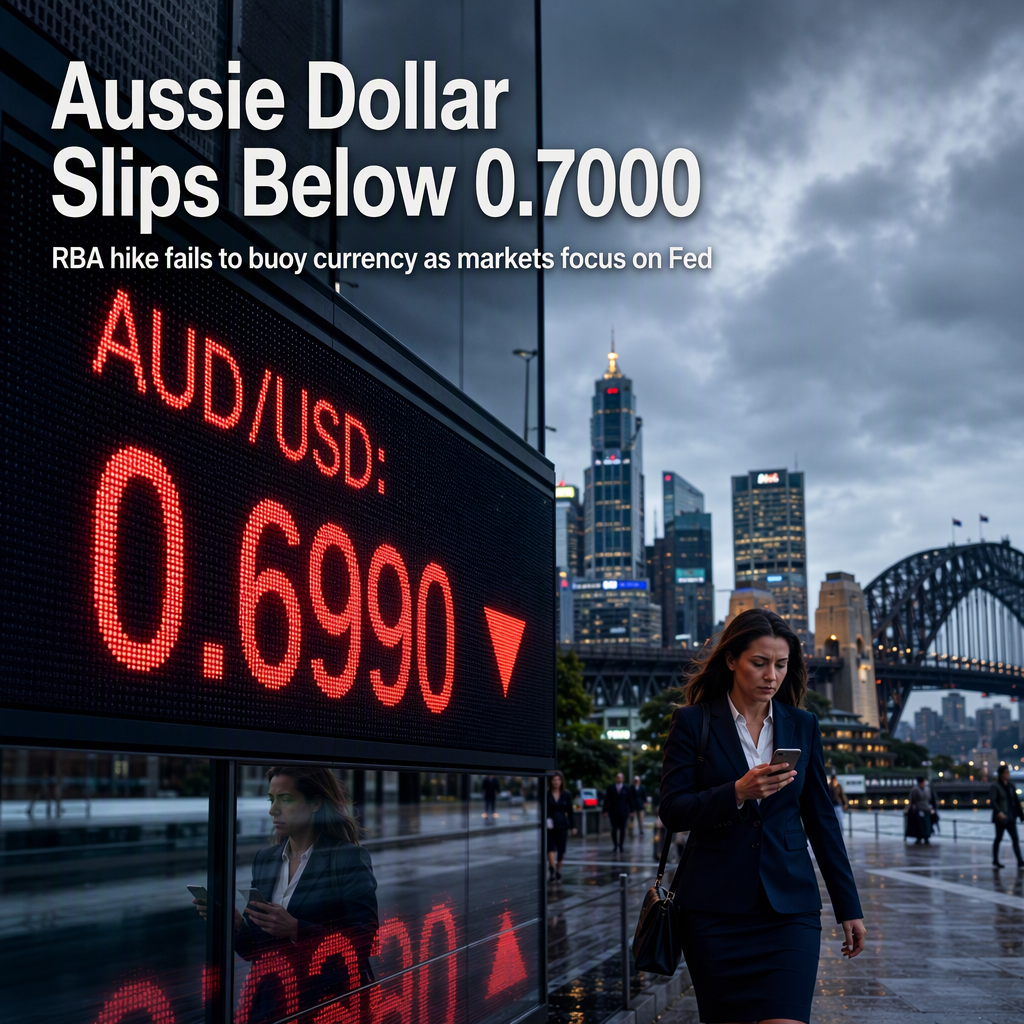
The Australian Dollar (AUD) fell below the 0.7000 mark against the US Dollar (USD) following the Reserve Bank of Australia's (RBA) decision to raise its Cash Rate by 25 basis points to 4.60%, the highest level in approximately 15 years [1]. Despite an initial rally that saw AUD/USD climb toward 0.7030, the pair reversed course and dropped as low as the 0.6980 region, trading around 0.6990 at the time of writing, down 0.39% on the day [1].
The RBA's rate hike was unanimously decided, with policymakers reiterating that inflation remains too high and further increases could be delivered if necessary [1]. However, the move was widely anticipated by markets, and attention quickly shifted to RBA Governor Michele Bullock's press conference. Bullock revealed that the Board had considered both a 25-bps increase and keeping rates unchanged, and expressed hope that the four hikes delivered this year would be sufficient to slow inflation. She also indicated that further tightening might not be required if inflation eases, which added a 'dovish taint' to the decision according to ING's FX Strategist Francesco Pesole [1]. TD Securities characterized the hike as a 'risk management hike' rather than the start of a new tightening cycle [1].
Governor Bullock emphasized the lagged impact of monetary tightening and noted recent weakness in household spending, as well as signs of easing in housing and labor-market conditions [1]. While the RBA remains prepared to raise rates again if necessary, these factors suggest a cautious approach going forward [1].
On the other hand, the US Dollar remains supported by elevated US Treasury yields and expectations that the Federal Reserve could tighten monetary policy further, with upcoming US economic data such as the PCE Price Index and Nonfarm Payrolls expected to influence the Fed's next move [1]. The divergence in central bank outlooks is seen as a key factor for AUD/USD, with uncertainty over further RBA hikes limiting support for the Aussie, while potential Fed tightening could keep the pair below the 0.7000 psychological level [1].
Technical analysis shows AUD/USD trading at 0.6992 with a bearish near-term bias [1].
CONCLUSION
The RBA's widely expected rate hike failed to provide lasting support for the Australian Dollar, as dovish signals from Governor Bullock and ongoing US Dollar strength weighed on AUD/USD. Market participants remain focused on upcoming US economic data and central bank outlooks, which are likely to determine the pair's direction in the near term.