
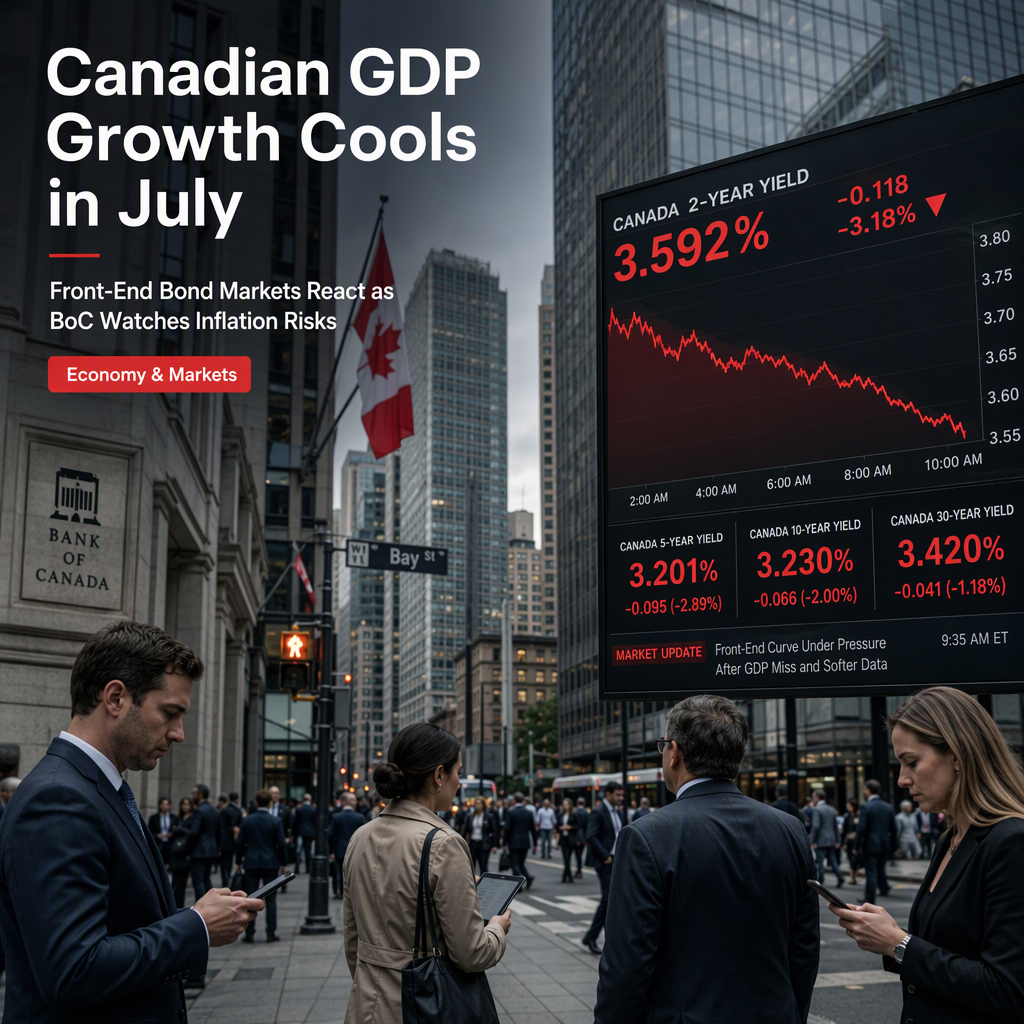
Canadian Gross Domestic Product (GDP) growth moderated in July after three consecutive strong months, with both goods and services output remaining flat, according to Alexandra Ducharme of National Bank of Canada [1]. Despite this slowdown, Statistics Canada's preliminary estimate suggests a 0.2% increase in GDP for August. Assuming no growth in September, GDP by industry is tracking a 2.0% annualized increase for the third quarter, indicating a relatively solid quarterly advance [1].
TD Securities Macro Research Insight reports that markets began to sell off following the flat July GDP print, with the move concentrated in the front to mid-curve. Bank of Canada (BoC) pricing remained unchanged after the report, and US yields were noted to be near key technical levels [2]. TD Securities expressed disagreement with the fundamentals behind the sell-off, attributing it to recent positioning washouts rather than the GDP data itself. The cross-market move was subdued, and TD Securities maintains a bias toward 1y5y-1y2y steepeners for a front-end view, while cautiously adding 2-year long positions [2].
The GDP moderation is likely easing some of the Bank of Canada's concerns about the economy's resilience amid intensified trade tensions and the ongoing oil shock. However, National Bank of Canada warns that continued conflict could increase the risk of higher energy costs spilling over into underlying inflation, especially if economic activity remains resilient [1].
No specific analyst forecasts or forward-looking statements regarding future GDP growth or BoC policy changes were provided, but both sources highlight the importance of monitoring ongoing trade tensions and energy costs for potential impacts on inflation and monetary policy [1][2].
CONCLUSION
Canadian GDP growth slowed in July but remains on track for a solid third quarter, with a 2.0% annualized increase projected. Markets reacted with a sell-off in the front to mid-curve, though Bank of Canada pricing stayed unchanged. Analysts caution that ongoing trade tensions and energy costs could pose risks to inflation and economic resilience.