
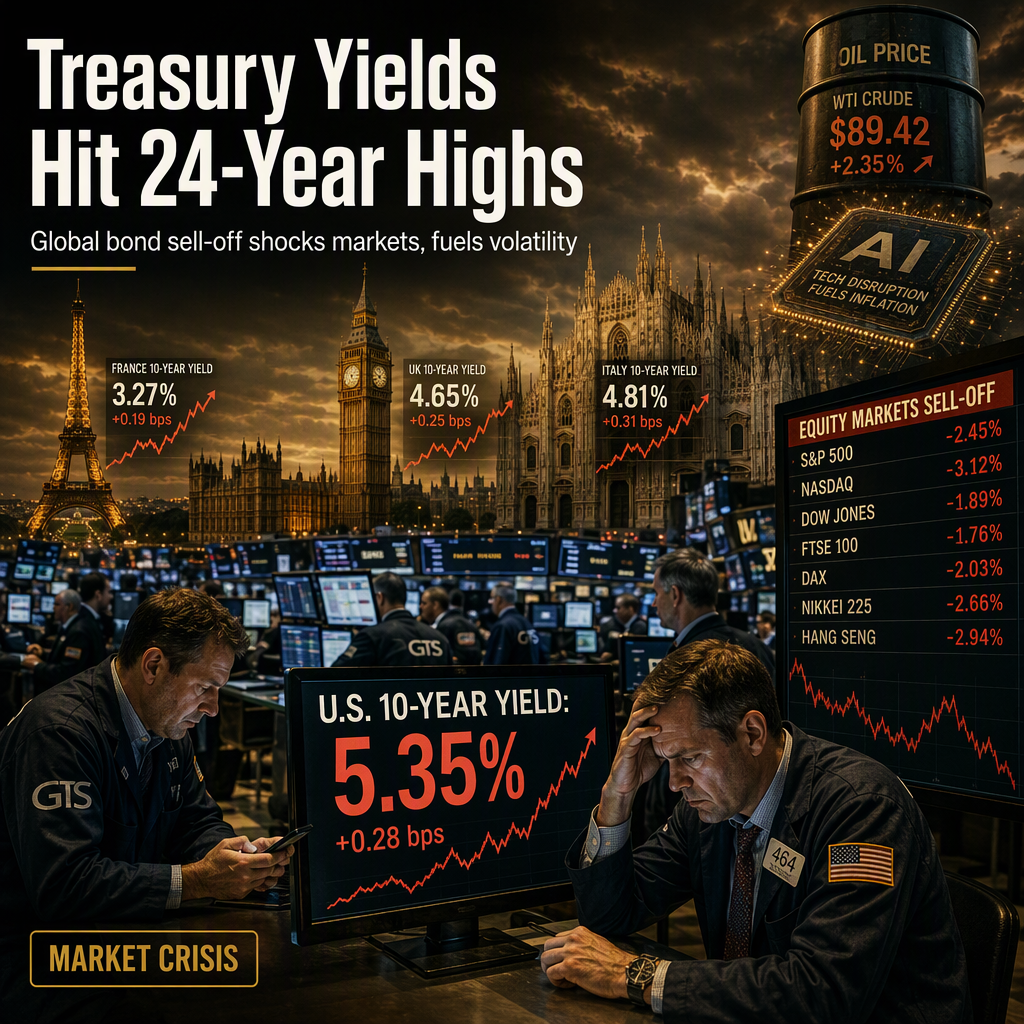
A global bond sell-off accelerated, pushing U.S. Treasury yields to their highest levels in 24 years on Wednesday. The 10-year Treasury yield climbed as high as 5.35%, while the 30-year yield reached 5.73%, both marking their highest points since 2002 [1]. Benchmark government bonds in France and Italy also saw sharp increases, with both on track for their largest one-day jumps since March, when the Iran war began [1]. The U.K.'s 30-year government bond yield hit its highest level since 1998 [1].
The surge in bond yields triggered a broad sell-off in equities. Europe's Stoxx 600 index fell 1%, with France and Germany's benchmark indexes dropping more than 1%. Italy's FTSE MIB index slid nearly 2.5% [1]. In the U.S., stocks dipped in early trading, with the S&P 500 down 0.6% and the Nasdaq Composite declining by 0.8%, following record closes for both indexes the previous day [1].
Rising oil prices added further pressure, as Brent crude climbed 1% to over $102 per barrel [1]. The U.S. Treasury Department is set to sell $39 billion in 10-year notes, with investors closely monitoring the market's reaction [1]. The increase in bond yields has intensified the strain on governments already facing soaring borrowing costs since the start of the year [1].
International Monetary Fund chief Kristalina Georgieva warned that governments must urgently address their unprecedented debt levels and predicted that global government bond yields would remain under pressure, partly due to the expanding artificial intelligence sector [1]. She noted that the era of interest rates below GDP growth rates has ended, increasing fiscal challenges for policymakers [1]. Reports also surfaced that SpaceX may raise $40 billion to purchase AI chips from Nvidia, potentially adding to the surge in private sector borrowing, though NBC News has not independently confirmed these reports [1]. Some economists believe that large-scale borrowing by AI companies could further pressure government bond yields [1].
CONCLUSION
The global bond sell-off has driven U.S. Treasury yields to multi-decade highs, sparking declines in equity markets and raising concerns about government and corporate borrowing costs. With additional pressure from rising oil prices and the AI-driven borrowing boom, market participants and policymakers are bracing for continued volatility and higher yields in the near term.