
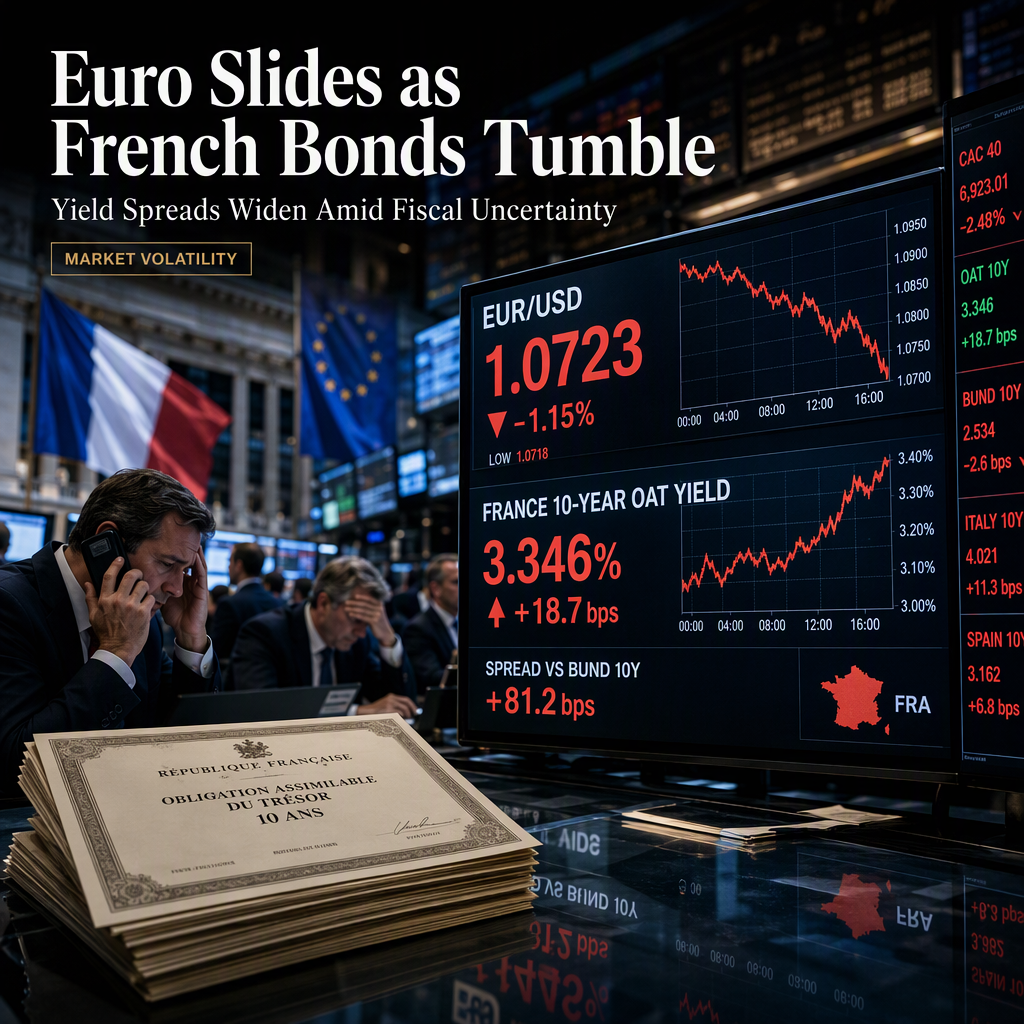
The Euro (EUR) experienced significant pressure against major currencies on Wednesday, falling 0.63% to around 1.1188 against the US Dollar, making it the weakest among its peers for the day [1]. The renewed sell-off in French government-backed securities has reignited concerns about widening yield spreads between French bonds and those of other Eurozone countries, further weighing on the Euro [1]. French 10-year bond yields surged 2.56% to near 4.91%, reversing the previous day's decline [1].
On Tuesday, French bonds saw strong buying interest after presidential candidate Marine Le Pen proposed increasing spending cuts to €140 billion from €125 billion, which led to France’s 10-year yield dropping by approximately 11 basis points [1]. However, market participants remain skeptical about the minority government's ability to pass these budget cuts in Parliament without special concessions [1]. The French Higher Committee for Public Finance, the country's fiscal watchdog, described the government's draft 2027 budget as very 'optimistic' last week, coinciding with the introduction of the €125 billion spending cut plan [1].
Additionally, a stronger US Dollar contributed to the Euro's decline, with the US Dollar Index (DXY) trading almost 0.5% higher at around 102.34 [1]. Investors are also awaiting the release of the Federal Open Market Committee (FOMC) minutes from the September meeting, scheduled for later in the day at 18:00 GMT, which could further influence market sentiment [1].
CONCLUSION
The Euro's sharp decline was driven by renewed concerns over French fiscal policy and bond market volatility, compounded by a stronger US Dollar. Market skepticism about the feasibility of proposed French spending cuts and the outlook for Eurozone fiscal stability has heightened risk aversion. Investors are closely watching upcoming FOMC minutes for further market direction.