
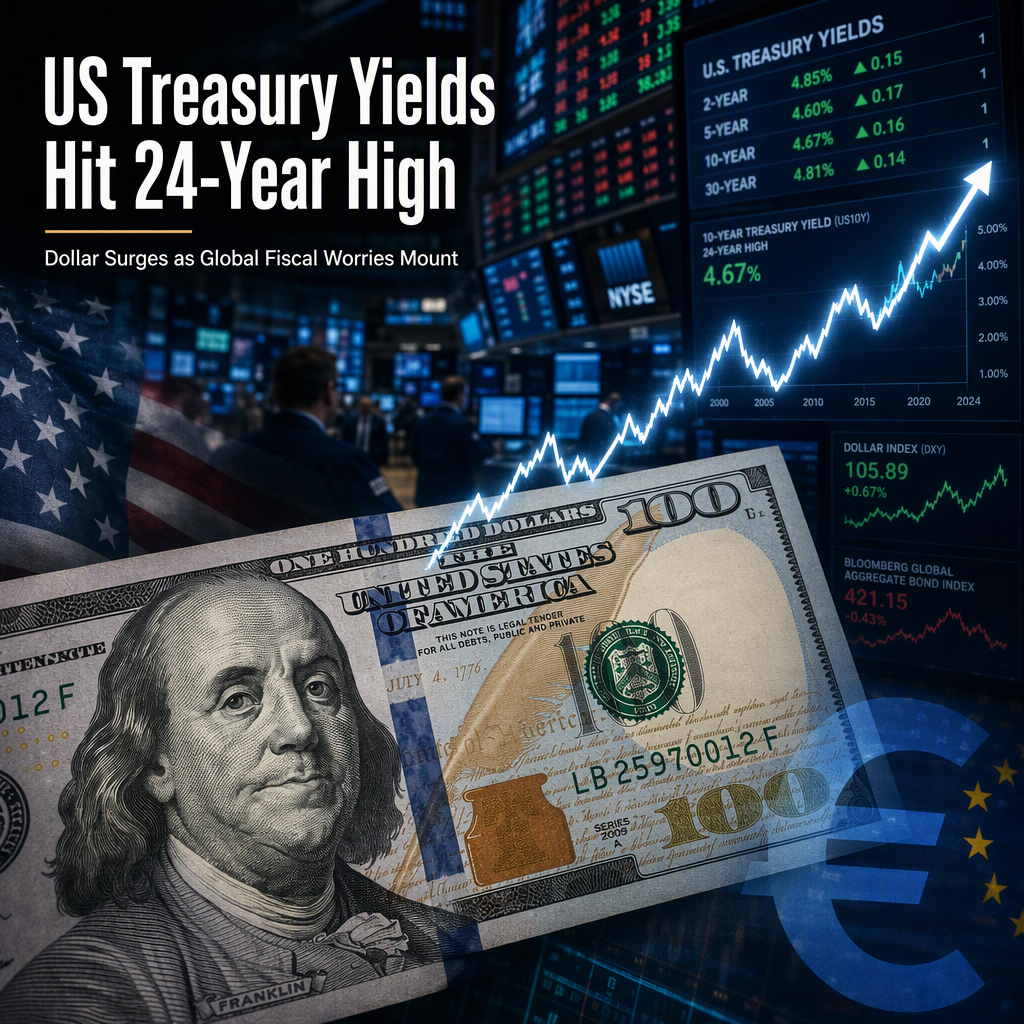
US Treasury yields soared on Wednesday, with the 10-year yield reaching 5.35%, its highest level since 2002, and the 30-year yield hitting 5.724%, a 24-year high [1][2][5]. This sharp rise in yields was driven by investor concerns over inflation, persistent high energy prices, and fiscal policy risks, particularly in the US and France [1][2][4][5]. The US Dollar Index (DXY) climbed to 102.32–102.35, near its 18-month high, reflecting the Greenback's broad strength against major currencies, especially the Euro, which fell to its lowest level in 17 months at 1.1195, down 0.57% on the day [1][2][5]. The Euro's weakness was exacerbated by fiscal concerns in France, leading to higher French borrowing costs and wider bond spreads, as investors favored German debt as a safer alternative [1][5]. ABN Amro strategists noted that the Euro tends to weaken when bond yields in major Eurozone countries rise sharply due to political or fiscal concerns, and periods of uncertainty often coincide with net short Euro positions and lower EUR/USD rates [1]. Brown Brothers Harriman (BBH) highlighted that persistently high energy prices are skewing risks for inflation, policy rates, and bond yields higher, supporting the USD and energy exporters' currencies over energy importers' currencies like the Euro [4]. The US Treasury's upcoming $39 billion auction of 10-year notes and a new 30-year bond sale on Thursday further contributed to selling pressure in Treasuries, as investors demanded higher yields [2][5]. Money markets currently price in an 18% chance of a Fed rate hike at the October meeting, but an 85% chance for December, according to Prime Terminal [2]. Recent US economic data, including softer employment and PCE inflation figures, have reduced expectations for additional monetary tightening in the near term [1][3]. The New York Fed's September Survey of Consumer Expectations showed that households expect short-term inflation to rise, with one-year ahead expectations increasing from 3.6% to 3.9%, while longer-term expectations remain above the Fed's 2% target [6]. The survey also indicated deteriorating perceptions of household financial situations [6]. Market participants are closely watching the release of the Federal Open Market Committee (FOMC) September meeting minutes for further clues on the Fed's policy outlook [1][2][3][4].
CONCLUSION
The surge in US Treasury yields and the US Dollar Index underscores heightened investor concerns over inflation, fiscal risks, and global bond market volatility. With the Euro under pressure due to French fiscal worries and energy prices remaining elevated, the market is bracing for continued USD strength and cautious central bank policy. The upcoming FOMC minutes and Treasury auctions are expected to provide further direction, but current sentiment favors the US Dollar amid persistent uncertainty.