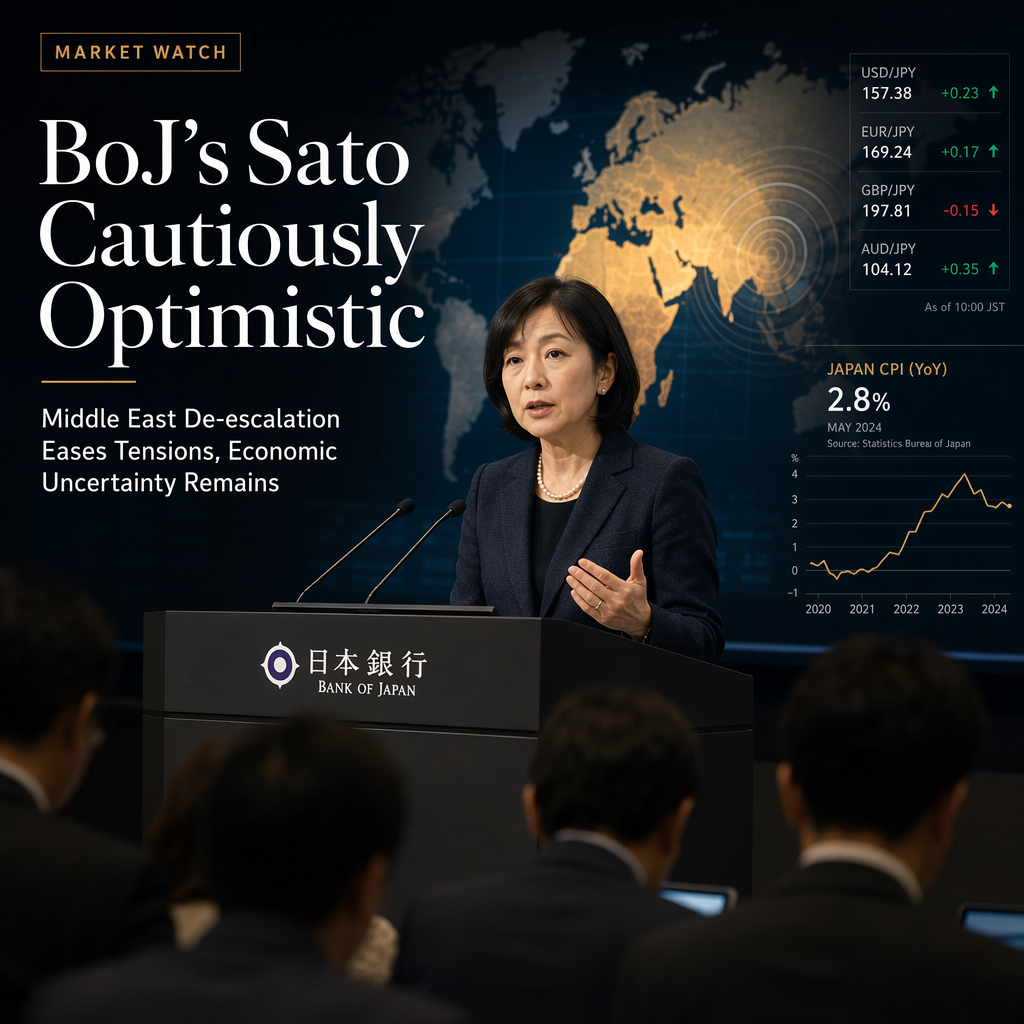
Bank of Japan (BoJ) board member Ayano Sato, newly appointed under Prime Minister Sanae Takaichi's administration, stated during a scheduled press conference that the recent de-escalation of the Middle East conflict is a welcome development for the economy. However, Sato emphasized that uncertainty regarding the economic outlook persists and that the BoJ will closely scrutinize the impact of Middle East developments on Japan's economy and prices [1].
Sato noted that Japanese firms are more actively raising wages and prices, which could mean that the impact of a weak yen on inflation may be greater than in the past. While a weak yen benefits exports, it also increases import prices, leading to lower real household income. Sato highlighted the importance of fiscal and monetary policies playing their respective roles: monetary policy should focus on inflation, while fiscal policy should address the impact on households and firms [1].
Sato refrained from commenting on specific foreign exchange (FX) levels but stated that short-term, volatile FX moves are undesirable and that FX rates should reflect economic fundamentals. She also stressed the need to monitor both downside risks to growth and upside risks to inflation, and to determine whether recent inflation is temporary and cost-driven or more sustained and demand-driven [1].
Following Sato's remarks, there was no immediate reaction in the Japanese Yen (JPY). At the time of reporting, USD/JPY was trading 0.22% higher near 162.30 [1].
CONCLUSION
BoJ board member Sato's comments underscore cautious optimism regarding geopolitical developments but highlight persistent economic uncertainty. The market response was muted, with no significant movement in the Japanese Yen following her remarks.