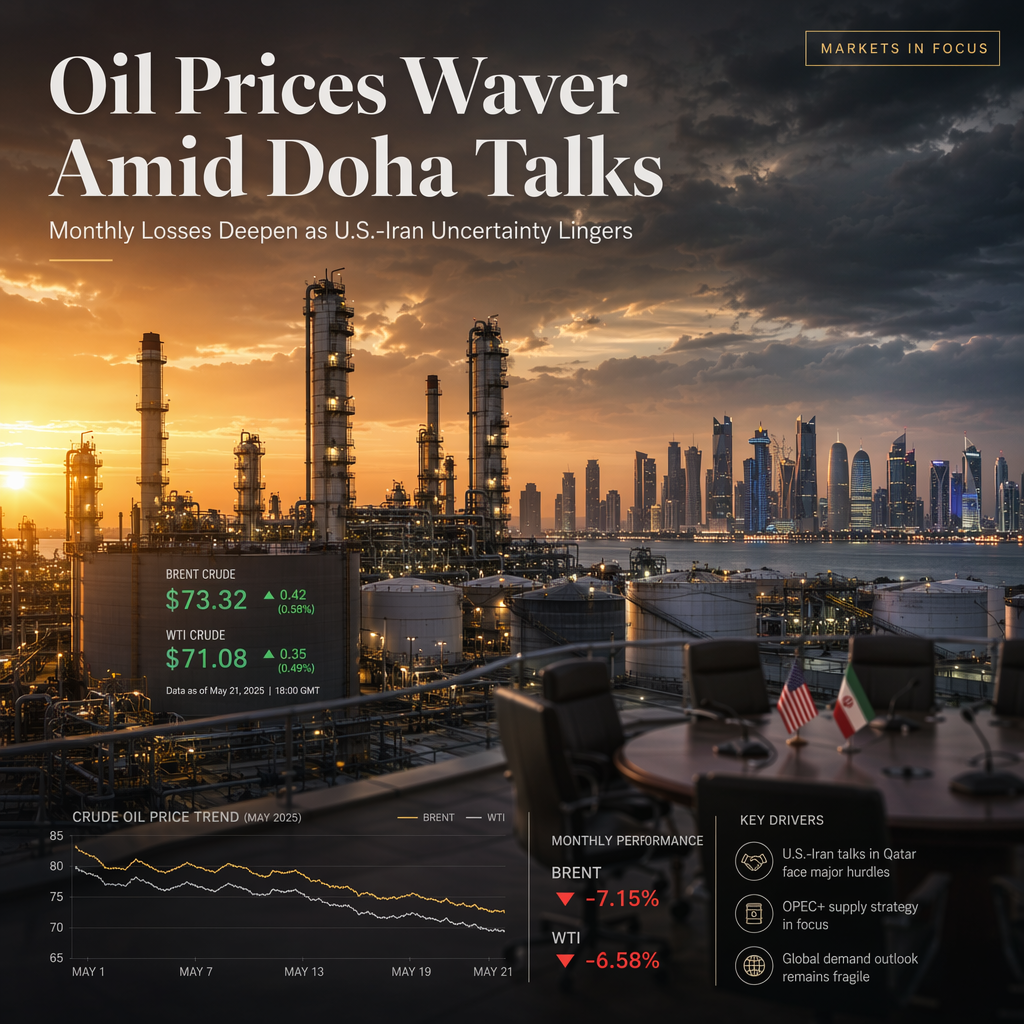
Oil prices saw a modest uptick on Tuesday as traders focused on the potential for renewed talks between the U.S. and Iran in Doha, Qatar, following a period of heightened volatility in the energy markets. International benchmark Brent crude futures for August delivery rose 0.2% to $73.32 per barrel, reversing earlier losses, while the September contract climbed 0.5% to $74.29. U.S. West Texas Intermediate (WTI) futures for August delivery increased 0.5% to $71.08. Despite these gains, both Brent and WTI are on track for significant monthly declines, with Brent set to end June about $19 lower (a 20% drop) and WTI down $16 (a 19% fall) compared to the closing session on May 29 [1].
The market's attention is fixed on the prospect of U.S.-Iran talks in Doha, after U.S. President Donald Trump stated on Monday that discussions would occur in Qatar's capital, claiming Tehran had 'requested a meeting' following an exchange of strikes over the weekend. However, a spokesperson for Iran's Foreign Ministry denied that talks were scheduled in the coming days, clarifying that an Iranian technical delegation's visit to Qatar was unrelated to any meetings with U.S. officials. This mixed messaging highlights the fragility of the interim peace deal reached earlier in June, when the U.S. and Iran agreed to a 14-point memorandum of understanding on June 17 to pause hostilities that had disrupted oil flows through the Strait of Hormuz, a critical chokepoint handling around 20% of global oil traffic [1].
Energy analysts have expressed surprise at the speed and severity of the recent oil market sell-off, noting that the market appears to be treating the temporary ceasefire as a permanent resolution. ING strategists cautioned that the situation remains highly volatile, stating, 'The price action in recent weeks reflects a market that is treating this temporary ceasefire between the US and Iran as a permanent deal. This is clearly not the case, and as we have seen over the last four months, the situation can change very quickly.' They also noted that while a permanent deal addressing the nuclear issue within 60 days would be optimistic, there is potential for the ceasefire to be extended, which would delay a lasting resolution [1].
CONCLUSION
Oil prices have rebounded slightly but remain on track for steep monthly losses as traders weigh conflicting signals about U.S.-Iran talks and the durability of the recent ceasefire. The market remains highly sensitive to developments in the region, with analysts warning that the situation could shift rapidly. Uncertainty over a permanent resolution continues to drive volatility in global oil markets.