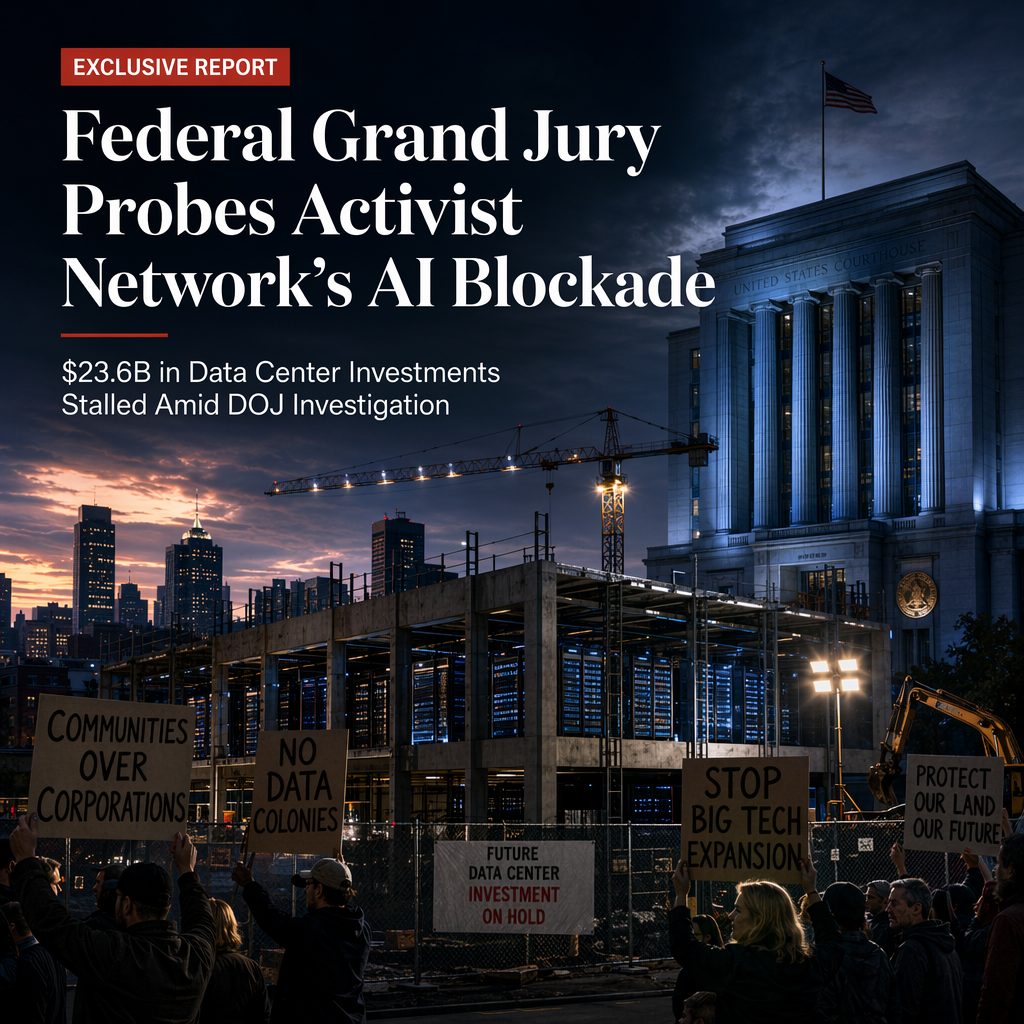
The Department of Justice, through the Southern District of New York, has opened a grand jury investigation into the finances behind the activist network tied to American Marxist businessman Neville Roy Singham, according to a report first obtained by Fox News Digital [1]. Sam Lyman, former Treasury senior advisor and current head of research at the Bitcoin Policy Institute, described the probe as 'an enormous development' and one of the most significant federal actions scrutinizing the organization and its involvement in far-left protests in the United States [1].
A new report released by Lyman details the Singham network's extensive role in organizing opposition to artificial intelligence (AI) infrastructure and data center projects nationwide. The Party for Socialism and Liberation, identified as a key political and activist arm of the Singham network, has participated in 21 campaigns across 14 states, resulting in the delay, scaling back, or blocking of approximately $23.6 billion in proposed AI and data center investments [1].
The report documents 19 case studies in cities and counties such as Charlotte, N.C.; Prince George's County, Md.; DeForest, Wisc.; Monterey Park, Calif.; Denver, Co.; Tucson, Ariz.; Athens, Ga.; Durham, N.C.; Madison, Wisc.; New Orleans; and Cleveland, among others. These campaigns led to 10 local data center moratoria, one permanent data center ban, and four rejected or withdrawn projects. The authors suggest that the actual impact may be even greater, as several additional cases are likely not included in the current tally [1].
Lyman emphasized that the Party for Socialism and Liberation has been 'boots on the ground' in dozens of protests targeting data centers, highlighting the network's significant influence on the trajectory of AI infrastructure development in the United States [1].
CONCLUSION
The DOJ's grand jury investigation into the Singham network marks a major escalation in federal scrutiny of activist opposition to AI and data center projects. With an estimated $23.6 billion in investments affected, the probe could have significant implications for future AI infrastructure development and regulatory oversight in the United States.