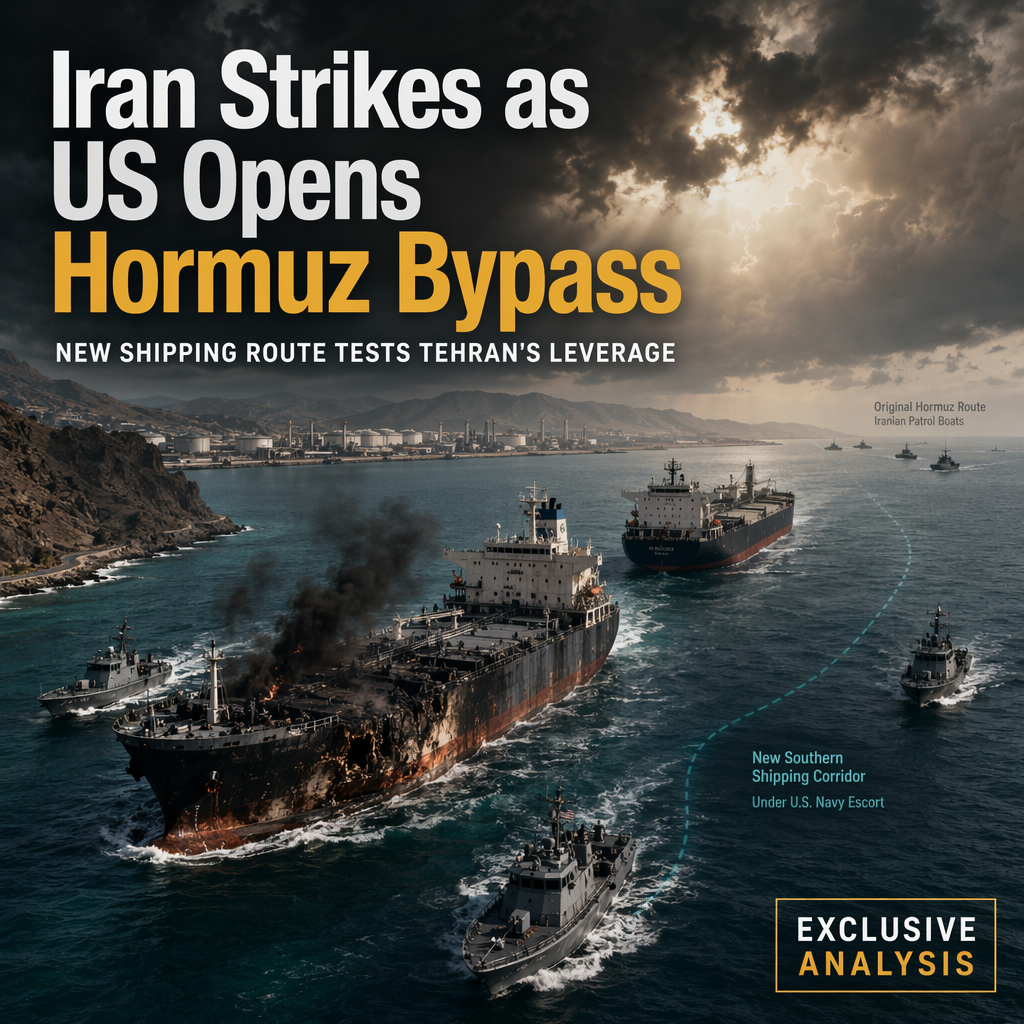
Iran has launched attacks on commercial vessels at the same time the United States and Oman began directing more ships through a new southern shipping corridor along Oman's coastline, which is intended to reduce Iran's influence over the Strait of Hormuz [1]. According to maritime intelligence firm Windward, nearly half of inbound commercial traffic through the strait is already using this alternative route [1]. Former U.S. military commanders and regional analysts suggest the timing of Iran's attacks is strategic, aimed at preserving Tehran's leverage as Gulf states invest in infrastructure that bypasses Hormuz [1].
Retired Navy Rear Adm. Mark Montgomery stated that the new southern route undermines Iran's ability to control or toll shipping, prompting Iran to attack vessels using the corridor [1]. Vice Adm. Kevin Donegan, former commander of the Navy Fifth Fleet, explained that Iran's strategy is not to halt shipping entirely but to make it commercially unworkable by driving up insurance premiums, thereby discouraging commercial shipping companies from using the route [1].
Following Iran's attacks, the U.S. responded with strikes on Iranian military targets linked to maritime operations. Iran then retaliated with attacks on U.S. facilities and regional partners. Subsequently, President Donald Trump announced that both sides had agreed to halt further strikes and return to negotiations in Doha [1]. However, Iran has denied that its negotiators would be meeting with U.S. officials in Qatar on Tuesday [1].
A memorandum of understanding negotiated after the ceasefire stipulates that Iran, Oman, and Gulf littoral states will negotiate the strait's 'future administration and maritime services,' with commercial traffic moving toll-free for 60 days [1]. President Trump has insisted on social media that there will be 'NO TOLLS' after the negotiating period, although the memorandum does not explicitly guarantee this outcome [1].
CONCLUSION
Iran's recent attacks on shipping highlight its efforts to maintain strategic leverage over the Strait of Hormuz as new routes reduce its influence. The situation has led to military escalation and a temporary ceasefire, with ongoing negotiations set to determine the future administration of the strait. Market uncertainty remains high as the outcome of these talks and the potential for future disruptions are unresolved.