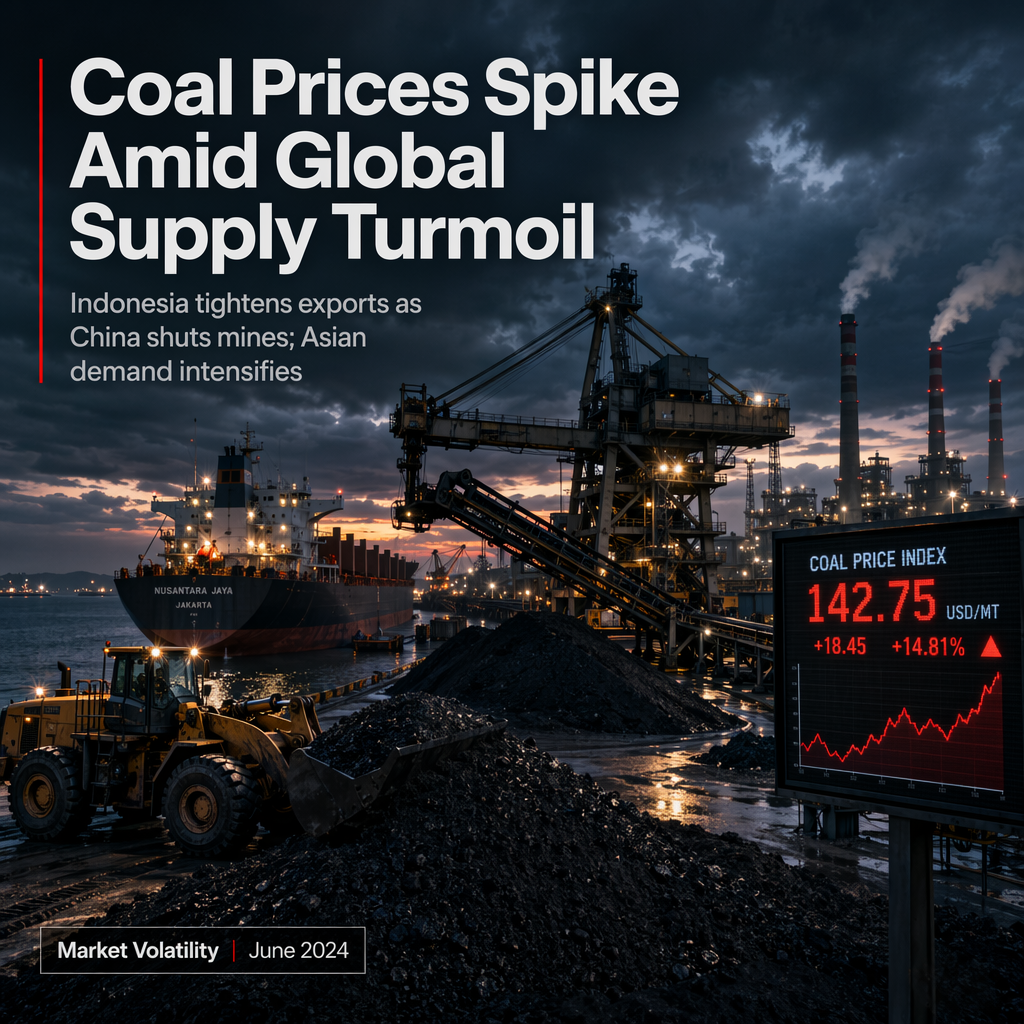
Thermal coal prices have experienced a sharp increase following Indonesia's implementation of stricter export controls and a deadly mining accident in China's Shanxi province, which has resulted in the suspension of several mines and further constrained global supply [1]. Indonesia, recognized as the world's largest thermal coal exporter, now requires exporters to report to a new state-owned company starting this month, a policy shift that has heightened concerns about supply security among international buyers already contending with elevated prices due to disruptions in alternative fuels such as LNG [1].
The market reaction has been significant, with benchmark Newcastle coal futures surging above $150 per metric ton—a 20% increase from the previous month—driven by the dual catalysts of Indonesian export restrictions and the Chinese supply shock [1]. Technical analysts have identified the next resistance level at $160 and support at $140 per metric ton, suggesting that if the current supply crunch continues, prices could reach new highs in the coming weeks [1].
The ongoing Iran war has exacerbated the situation by causing a global LNG shortage, prompting power generators in Asia, particularly in Japan and South Korea, to increase their reliance on coal, thereby tightening the market further [1]. According to a Singapore-based commodities trader, "Buyers are scrambling to secure cargoes amid fears of further disruptions. There's a lot of uncertainty, and that's driving up prices" [1].
Market participants are closely monitoring the stabilization of Indonesia's new export reporting system and the potential resumption of mining operations in Shanxi, China. Until there is greater clarity on these fronts, market sentiment remains bullish and volatility is expected to persist [1].
CONCLUSION
The combination of Indonesia's export controls and the suspension of Chinese coal mines has driven coal prices sharply higher, with market sentiment remaining bullish amid ongoing supply uncertainty. The situation is further intensified by a global LNG shortage, leading to increased coal demand in Asia. Until supply conditions improve, volatility and elevated prices are likely to continue.