
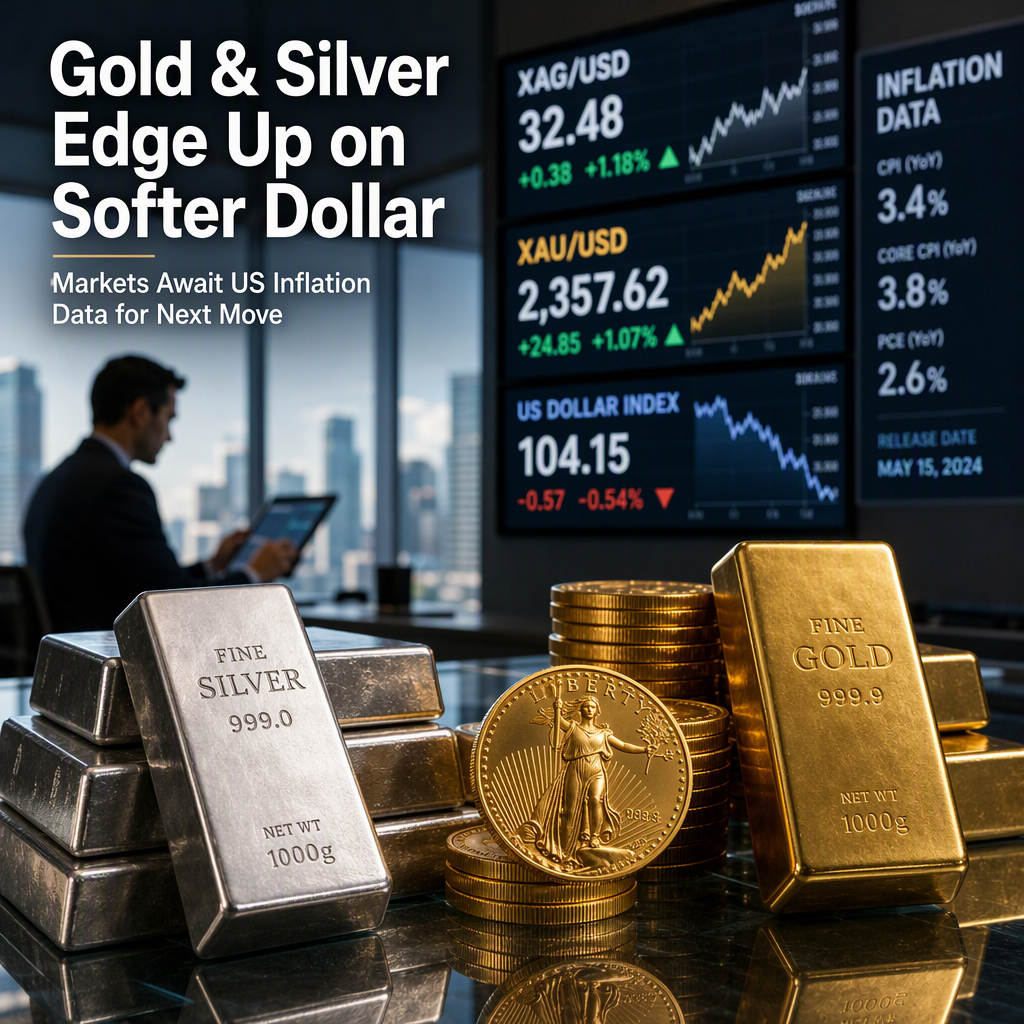
On Tuesday, silver prices (XAG/USD) increased to $60.53 per troy ounce, marking a 0.35% rise from Monday's $60.31, according to FXStreet data. Despite this uptick, silver has declined by 14.85% since the start of the year. The Gold/Silver ratio remained steady at 69.17, unchanged from the previous day, indicating relative stability between the two metals' valuations [1].
Gold (XAU/USD) also retraced Monday’s losses, buoyed by a softer US Dollar and easing US Treasury yields, as well as a moderate pullback in oil prices. The US Dollar Index (DXY) fell by 0.25% on Tuesday, which, according to correlation studies, tends to support precious metal prices. However, the overall market mood remains cautious, with limited downside expected for the US Dollar. Gold rebounded from the $4,150 area and traded around $4,190, but remained below the recent two-week high of $4,230 [2].
Investors are closely watching upcoming US inflation data, with the Consumer Price Index (CPI) due Wednesday and the Producer Price Index on Thursday. These reports are expected to provide further clarity on the Federal Reserve’s near-term policy direction. Although Cleveland Fed President Beth Hammack reiterated her call for higher interest rates, this had no significant impact on the US Dollar or precious metals. Market expectations for a Fed rate hike in October are low, with only a 20% probability, but hopes for a December hike persist [2].
Technical analysis suggests that gold needs to break above the $4,230 resistance level to confirm a bullish trend shift. If successful, the next targets are $4,310 and $4,400. On the downside, a break below $4,135 could lead to a retest of last week's lows at $4,071 and potentially the $4,000 support area [2].
CONCLUSION
Both silver and gold prices saw modest gains as the US Dollar and yields eased, with markets awaiting key US inflation data for further direction. While silver remains down significantly year-to-date, gold is showing signs of recovery but faces technical resistance. The upcoming inflation reports are likely to be pivotal for the next moves in precious metals.