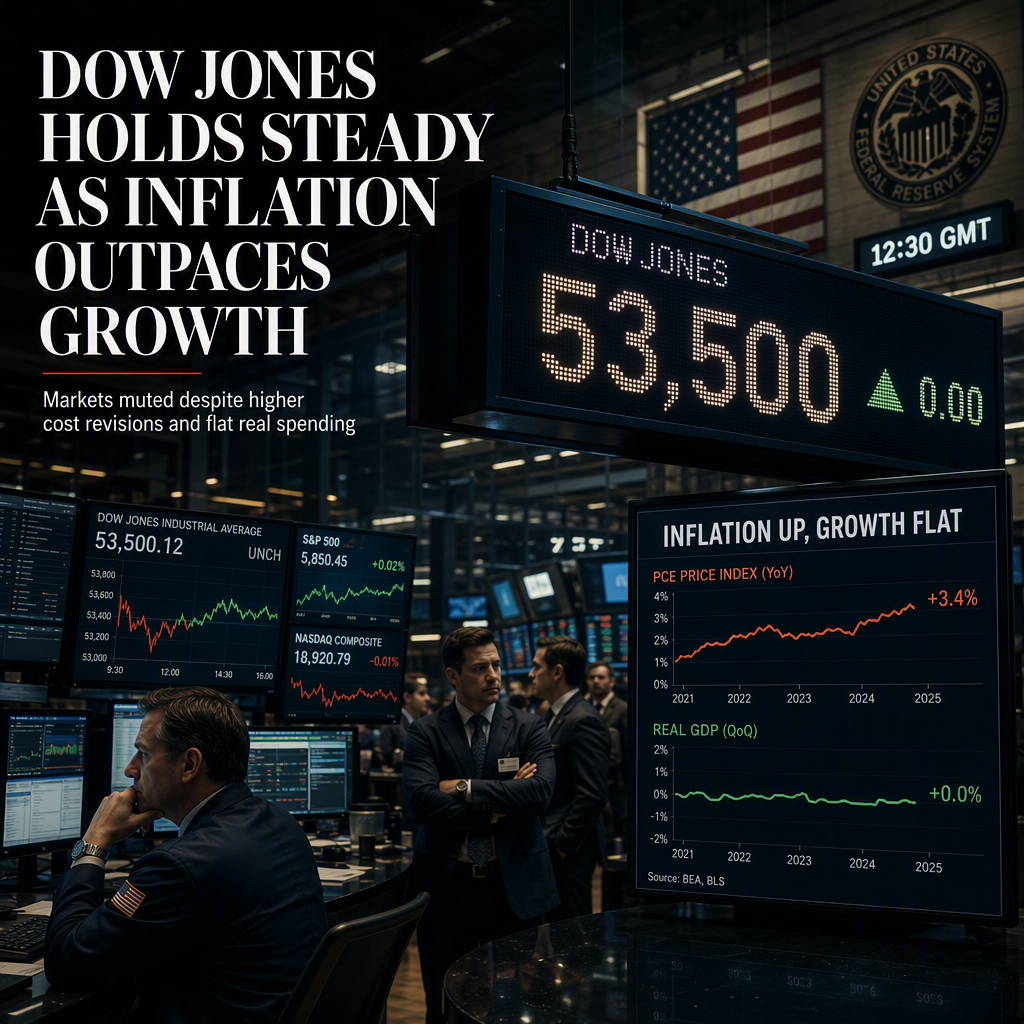
The Dow Jones Industrial Average traded just below 53,500, down roughly 100 points for the session, following the release of economic data at 12:30 GMT that was largely deemed uneventful by the market [1]. July core Personal Consumption Expenditures (PCE) prices increased by 0.2% month-over-month and 3.3% year-over-year, both matching consensus expectations and serving as key figures for rate expectations [1]. However, revisions to second-quarter economic data revealed that while real Gross Domestic Product (GDP) growth remained unchanged at an annualized 1.5%, all associated price measures were revised higher: the GDP price index rose to 6.4% from 6.3%, quarterly headline PCE prices to 5.3% from 5.1%, and quarterly core PCE prices to 3.7% from 3.4%, all exceeding consensus forecasts that anticipated no revision [1].
The revisions indicate that the quarter became more expensive without any increase in output, as the entire adjustment was attributed to higher prices rather than greater production [1]. Despite the significance of a 0.3 percentage point upward move in quarterly core prices—larger than the monthly core print that garnered market attention—the market reaction was muted, with the Dow Jones largely ignoring the development [1].
On the consumer side, personal income in July rose by 0.4%, surpassing the 0.3% consensus, while personal spending increased by 0.2%, in line with expectations. The monthly PCE price index also rose by 0.2%, resulting in real consumer spending remaining flat for the month as nominal spending growth was entirely absorbed by price increases [1]. This suggests that households chose to save the difference between income and spending, a behavior not indicative of consumer confidence for the second half of the year, especially following a preliminary August sentiment reading that erased two months of improvement in a single print [1].
Durable goods orders appeared strong at 1.1% versus a 0.7% consensus, but excluding transportation, the figure dropped to 0.4%, missing expectations. The more refined measure of business investment—nondefense capital goods orders excluding aircraft—slowed to 0.2% in July from 1.2% in June, indicating a loss of momentum in capital spending [1].
CONCLUSION
Despite higher-than-expected inflation revisions and flat real consumer spending, the Dow Jones showed little reaction, suggesting market participants are focused on other factors or awaiting further data. The upward revisions to price measures without corresponding output growth highlight persistent inflationary pressures, while consumer and business spending data point to potential caution ahead.