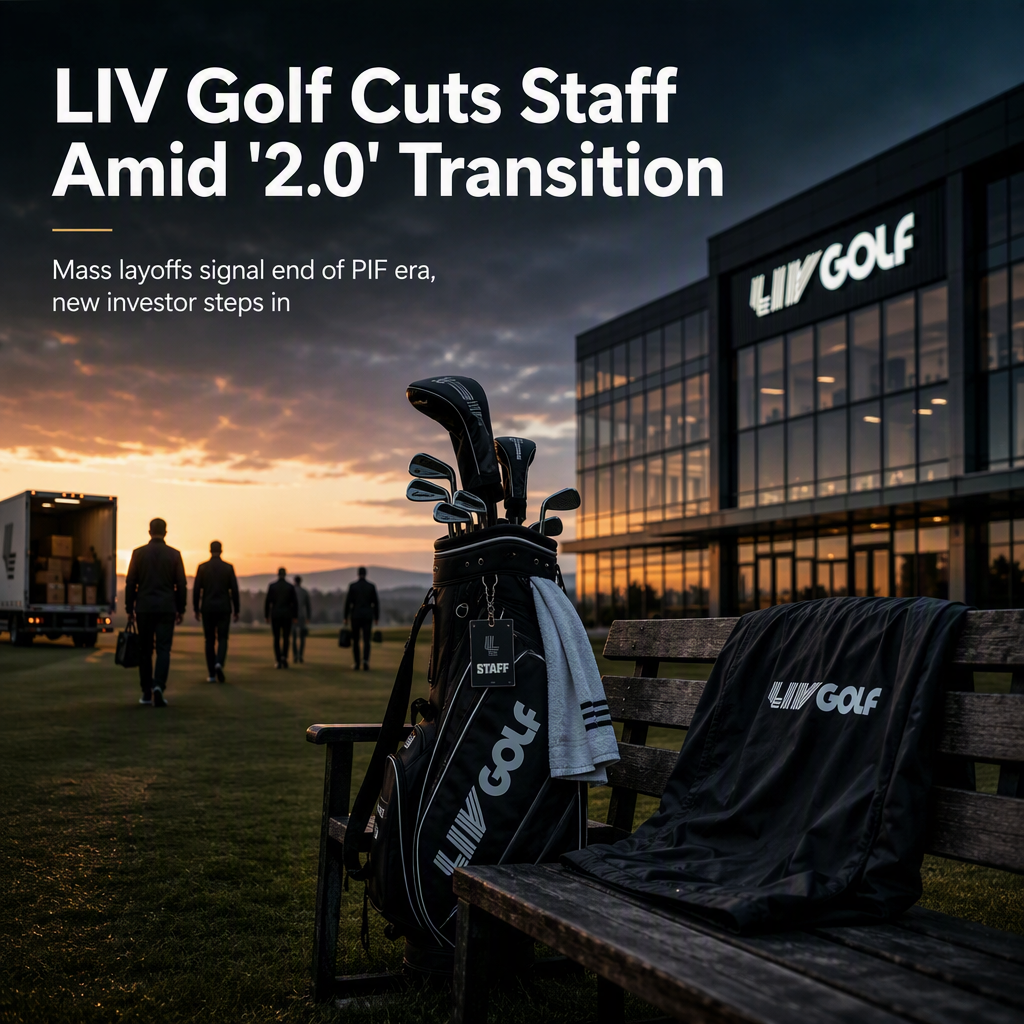
LIV Golf has notified many of its employees that their employment will end beginning the first week of September, marking a significant restructuring as the organization prepares for its next phase with new investors [1]. The layoffs follow the Saudi Public Investment Fund's (PIF) announcement that it will cease funding the circuit at the conclusion of the 2026 season, prompting LIV Golf to scale back operations and transition toward 'LIV 2.0' [1]. The 2026 campaign concluded on August 23 in Indianapolis, with the Team Championship in Michigan, originally scheduled for the end of August, canceled earlier in the month [1].
A LIV Golf spokesperson stated, "The funding commitment announced by PIF earlier this year will reach its conclusion. As a result, we are scaling back operations as we transition to the next chapter of LIV Golf and work toward making LIV 2.0 a reality," emphasizing gratitude for employees' contributions and a commitment to supporting those affected during the transition [1]. Despite the layoffs, LIV leadership remains optimistic about the league's future, expressing hope that many laid-off employees may return and that the league will continue in 2027 under the new 'LIV 2.0' version [1].
LIV Golf CEO Scott O'Neil announced on August 5, prior to the circuit's event at Trump National Bedminster, that a new investor had been secured and a term sheet signed, though specific details about the investor have not yet been disclosed [1]. O'Neil stated, "LIV Golf has an agreement in place with a lead investor, signed by the investor and approved by the Board, to anchor the transaction and play a key role in supporting the path forward for the League’s next era, driven by and for the players" [1].
Looking ahead, LIV Golf's reported plan for the 2027 schedule includes 10 events, with five in the United States and five internationally. Players competing in the league will hold a majority of equity in the new iteration [1].
CONCLUSION
LIV Golf's mass layoffs and operational scaling reflect a pivotal transition as the league prepares for a new era with fresh investment and player-driven equity. While the immediate impact is negative for employees, leadership remains optimistic about the league's future and its planned 2027 schedule. The market is likely to view these developments as a medium-impact event, with uncertainty balanced by forward-looking optimism.