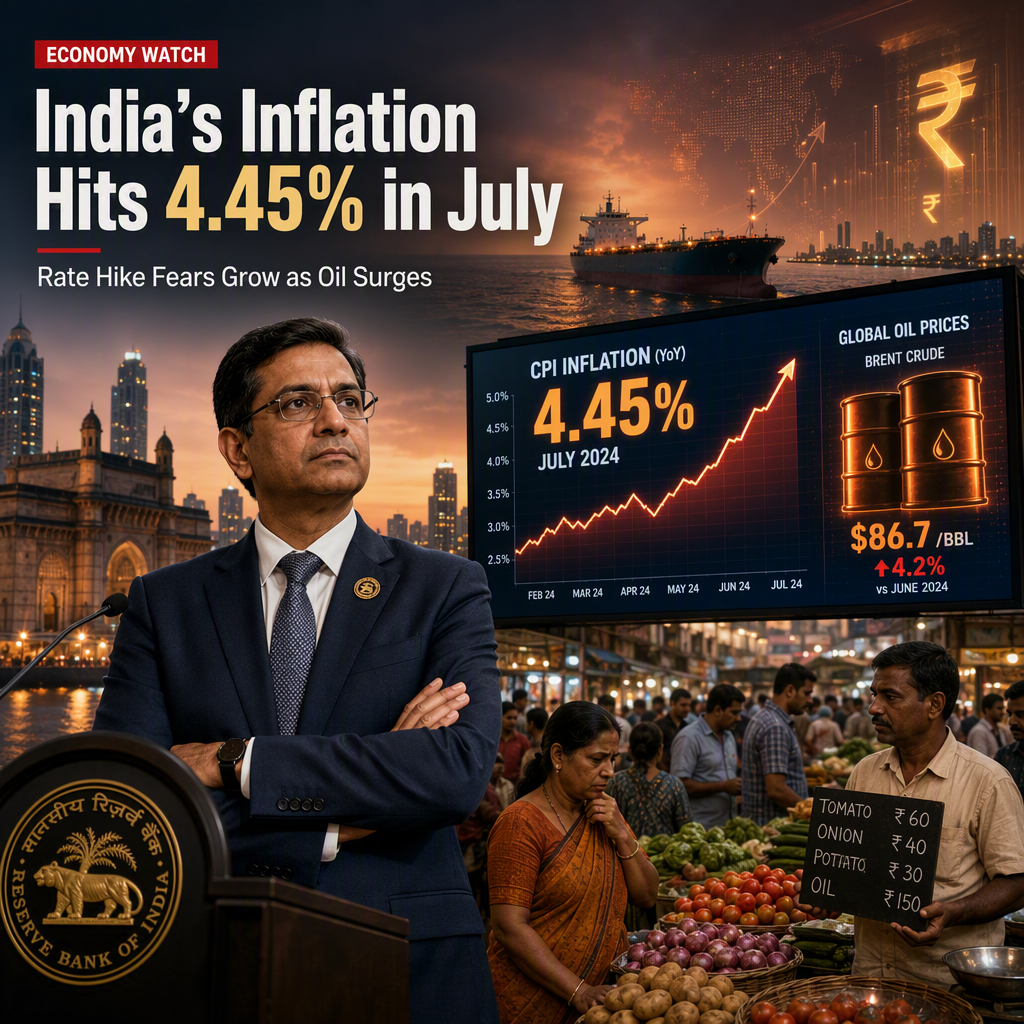
India's Consumer Price Index (CPI) accelerated to 4.45% year-on-year in July, up from 4.38% in June, marking the ninth consecutive monthly increase and coming in just below the market consensus of 4.5% [3][9]. Food inflation reached 5.5%, while personal and goods transport inflation exceeded 7% each, according to the Ministry of Statistics and Programme Implementation [9]. The headline inflation figure was slightly below economists' expectations, but still above the Reserve Bank of India's (RBI) 4% target [3][9].
The Indian Rupee (INR) reacted modestly to the CPI release, with USD/INR trading around 95.3350 and losing 0.05% on Tuesday [3]. MUFG’s Michael Wan noted that inflation is largely under control, supporting expectations for rates to stay on hold in the near term, but anticipates policy rates to rise, with projected 50bps hikes starting from the December 2026 meeting [5]. Morgan Stanley expects the RBI to deliver a cumulative 75bp rate hike, taking the policy rate to a terminal level of 6.0% [9].
Global factors are influencing India's inflation outlook. The war in Iran has disrupted energy supply chains, leading to higher global oil prices, which reached around $90 per barrel on Wednesday [9][7][1]. India, importing nearly 85% of its fuel needs, is particularly vulnerable to these disruptions, and the recent attacks on vessels in the Red Sea and Gulf of Oman have heightened concerns over shipping routes [9][1][7]. OCBC analysts highlighted that the rebound in oil prices has renewed pressure on net oil importers like India, Indonesia, the Philippines, and Thailand, worsening terms of trade and imported inflation [7].
RBI Governor Sanjay Malhotra stated that headline inflation has moved above target, but core inflation remains moderate. He cautioned that while India's growth is resilient, the outlook is uncertain due to factors such as the southwest monsoon, El Nino, geopolitics, and global trade policy. The RBI expects headline inflation to peak in the quarter ending December, with core inflation showing a similar trend [9][5]. MUFG and Morgan Stanley both see the bias of risks tilted towards higher rates, with Morgan Stanley projecting headline inflation to average 5% in the financial year ending March 2027 [5][9].
CONCLUSION
India’s July inflation data, while slightly below expectations, reinforces the likelihood of rate hikes later this year as global oil prices surge and supply chain disruptions persist. The RBI is expected to maintain a cautious stance, with analysts projecting policy tightening starting in December. Market reaction has been modest, but the outlook remains clouded by external risks and domestic inflation pressures.