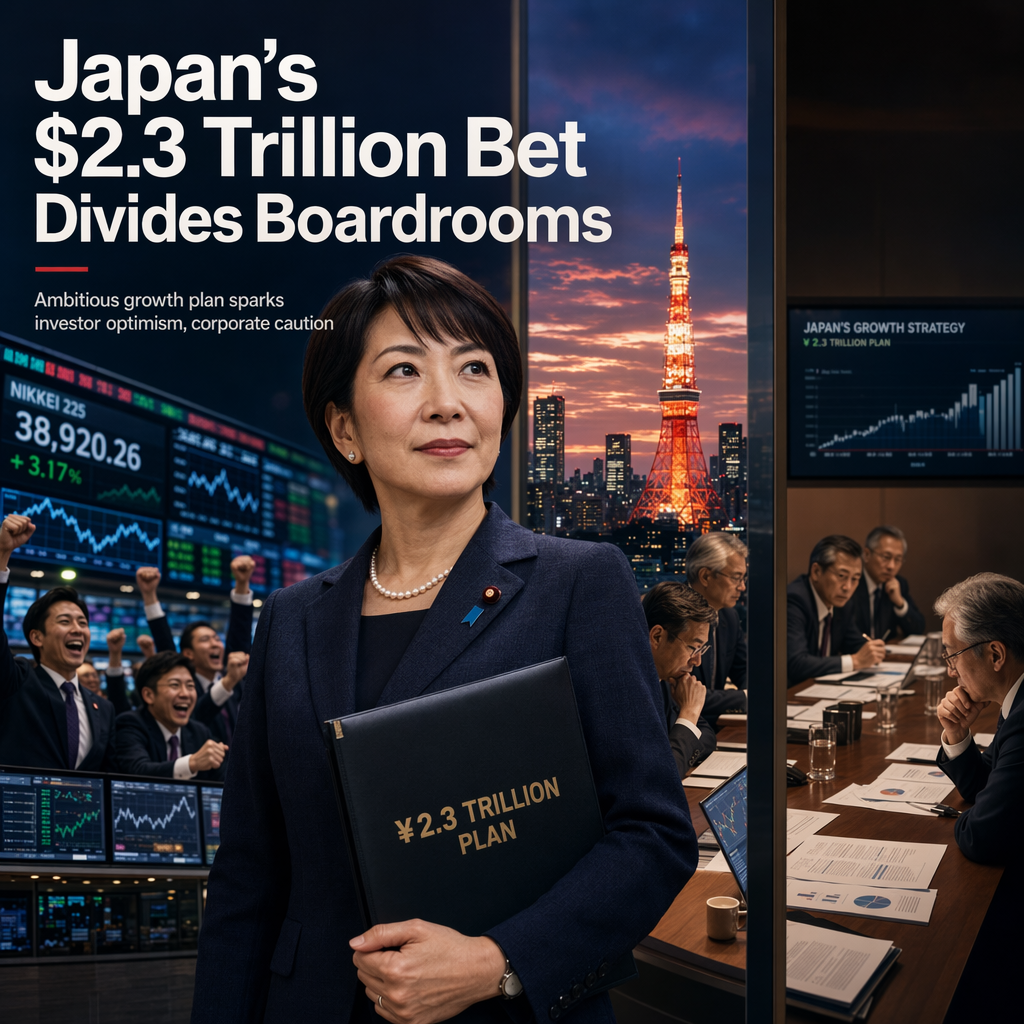
Japanese Prime Minister Sanae Takaichi's government has finalized an annual economic and fiscal blueprint featuring an ambitious $2.3 trillion investment plan, which has generated a mixed response among Japanese businesses and investors [1]. The plan, announced last week, aims to mobilize $2.3 trillion with a strong emphasis on technology, research, and startup funding [1]. While the scale of the proposal has energized many investors, some corporate executives have expressed concerns about the lack of clarity and strategic focus in the blueprint [1].
Some business leaders see significant opportunities in the government's growth drive, particularly in the technology and startup sectors, and are eager to see how the government will support their expansion [1]. However, others worry that the targets are overly ambitious and could be difficult to achieve without more concrete policy measures [1]. A senior executive at a major electronics manufacturer stated, "There's a lot of excitement among investors, but for those of us planning budgets and strategy, it's still not clear how this $2.3 trillion will be allocated or what the priorities are" [1].
Despite these concerns, market sentiment has generally been positive. Some analysts predict that the plan could boost the Nikkei index and attract foreign investment if implemented effectively [1]. A Tokyo-based market strategist commented, "The scale of the proposal is unprecedented. If the government delivers, we could see significant inflows into Japanese equities, especially in the tech and startup sectors" [1].
Nevertheless, questions remain regarding the specifics of the spending and how the government will balance growth with fiscal responsibility. Some executives have called for greater transparency and more detailed roadmaps to ensure effective execution of the $2.3 trillion strategy [1].
CONCLUSION
Prime Minister Takaichi's $2.3 trillion investment plan has sparked optimism among investors and analysts, particularly for Japan's technology and startup sectors. However, the lack of clarity and concrete policy details has left some business leaders cautious, highlighting the need for greater transparency and strategic direction.