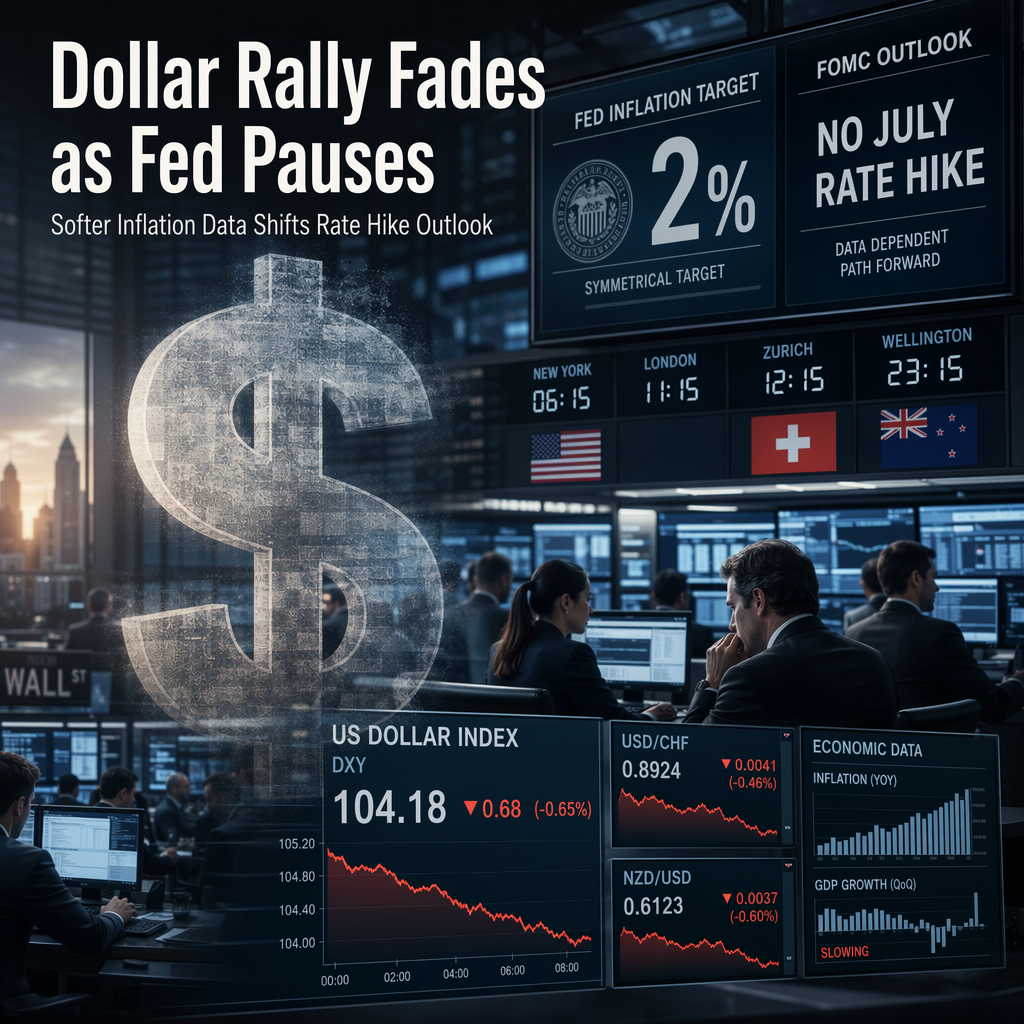
The US Dollar's recent rally has lost steam following the release of softer-than-expected US inflation and GDP data, which have prompted a reassessment of Federal Reserve (Fed) rate hike expectations. The US Personal Consumption Expenditures (PCE) Price Index, the Fed's preferred inflation gauge, rose 4.1% year-over-year in May, matching market expectations, while the monthly increase of 0.4% came in below the 0.5% consensus forecast [1][2]. Core PCE held steady at 0.3%, also in line with expectations [2]. Meanwhile, US GDP data for Q1 showed consumer spending slowed to 0.5%, down from a previous estimate of 1.4%, with the downward revision mainly attributed to weaker services consumption [3].
These data releases have led investors to scale back expectations for a 25-basis-point Fed rate hike at the July meeting, with the CME FedWatch tool showing the probability dropping to around 29.9%, down from 38.5% a week ago [1]. The US Dollar Index (DXY) retreated to around 101.12 after reaching a more than one-year high near 101.80 earlier in the week [2]. Despite the softer data, some Fed officials, including Chicago Fed President Austan Goolsbee and New York Fed President John Williams, emphasized the need to bring inflation back to the 2% target, with Williams stating it remains imperative for the Fed to do so [2][3].
Market reactions were evident in currency pairs: NZD/USD traded around 0.5650, up 0.05% on Friday, but the New Zealand Dollar struggled to capitalize on the Greenback's weakness due to expectations that the Reserve Bank of New Zealand (RBNZ) will keep its Official Cash Rate unchanged at its July meeting [1]. ASB Bank now forecasts the RBNZ to remain on hold before resuming gradual tightening from September, with the Official Cash Rate projected to peak at 3.25% in early 2027 [1]. Meanwhile, USD/CHF edged lower to around 0.8071, extending losses for a second consecutive day after hitting an 11-month high of 0.8139 on Wednesday, as the Swiss Franc strengthened [2]. The Swiss National Bank (SNB) has kept its policy rate at 0% as inflation remains near the lower end of its 0-2% target range [2].
Analyst opinions reflect a dovish tilt: MUFG’s Lee Hardman expects the Fed to keep rates on hold and the Dollar to weaken later in 2026, with inflation projected to ease to 3.5% by year-end and reach the 2% target in 2028 [3]. A Reuters poll found that 78 of 102 economists expect the Fed to keep interest rates unchanged at 3.50-3.75% through the end of 2026 [2]. The IMF noted that the SNB's monetary policy stance is appropriate but highlighted the need for flexibility in response to potential shocks [2].
Overall, the divergence in monetary policy expectations between the Fed, RBNZ, and SNB, as well as the evolving inflation outlook, are likely to continue shaping currency markets in the near term [1][2][3].
CONCLUSION
Softer US inflation and GDP data have tempered expectations for imminent Fed rate hikes, leading to a loss of momentum for the US Dollar and strengthening of currencies like the Swiss Franc. While some central banks are expected to hold rates steady, analysts anticipate further Dollar weakness if the Fed maintains its dovish stance. Diverging monetary policy paths and inflation trends remain key drivers for currency markets going forward.