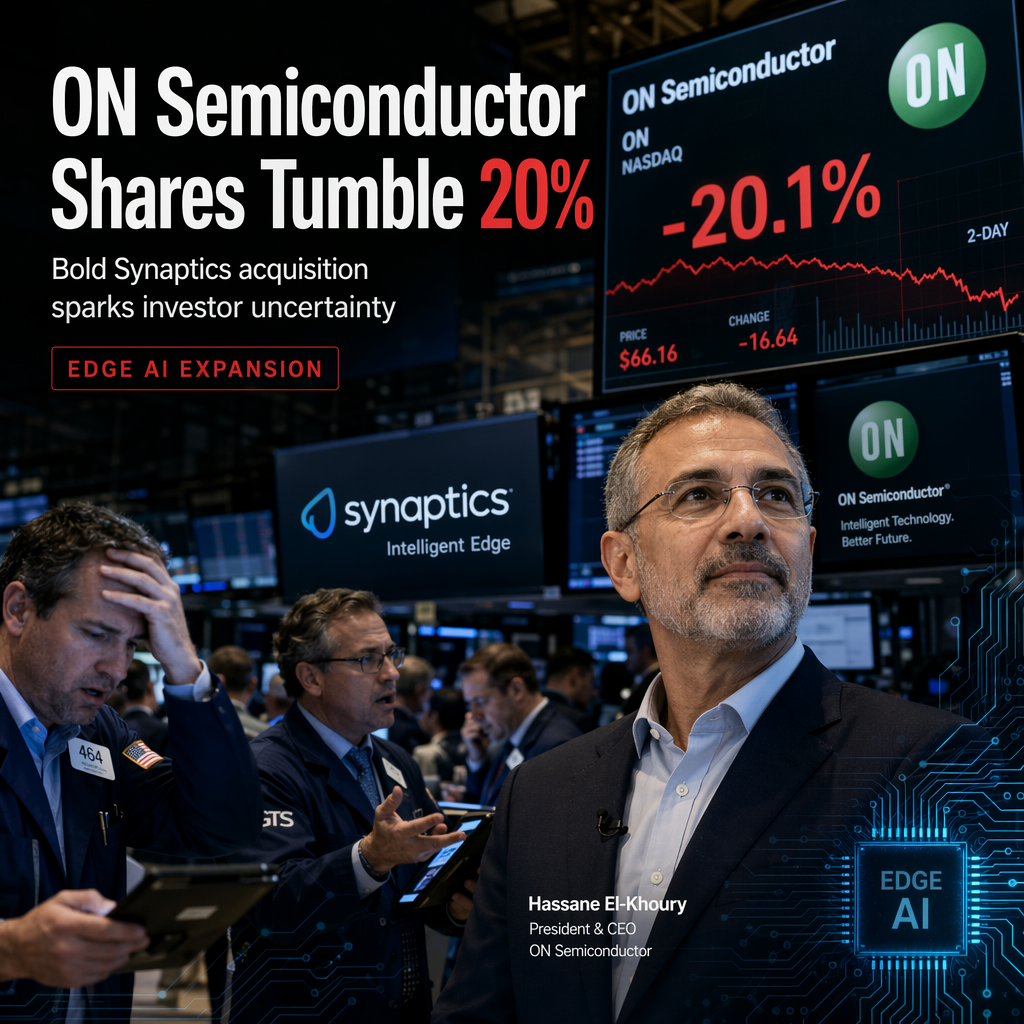
ON Semiconductor announced plans to acquire Synaptics in an all-stock deal, marking its largest acquisition to date, with the aim of capitalizing on the growing market for physical artificial intelligence (AI) solutions [1]. Following the announcement, ON Semiconductor's shares dropped by 20% as investors reacted to the news [1]. CEO Hassane El-Khoury defended the strategic rationale behind the acquisition, emphasizing that the move would expand the company's addressable market by an additional $30 billion, or $243 billion by 2030, according to the company's release [1].
The acquisition is expected to open new markets for ON Semiconductor, including an AI-centric compute platform, and bolster its Edge AI capabilities through Synaptics' Astra platform, which utilizes AI processors and wireless connectivity [1]. El-Khoury highlighted that there is no product overlap between the two companies, making the deal attractive from both research and development and product perspectives [1].
ON Semiconductor is positioning itself for a future where physical systems, such as robots and autonomous vehicles, can sense and make decisions in real time, leveraging the combined strengths of both companies [1]. The company expects the deal to close in mid-2027 and anticipates generating $200 million in annual synergies within 18 months of closing [1].
Despite the market's negative reaction, El-Khoury reassured stakeholders that ON Semiconductor's core business remains strong, with the data center segment running smoothly and accelerating [1].
CONCLUSION
ON Semiconductor's acquisition of Synaptics represents a significant strategic shift toward physical AI and Edge AI markets, but the announcement triggered a sharp 20% decline in its share price. While management remains confident in the company's core business and the long-term value of the deal, the immediate market reaction reflects investor uncertainty about the acquisition's impact.