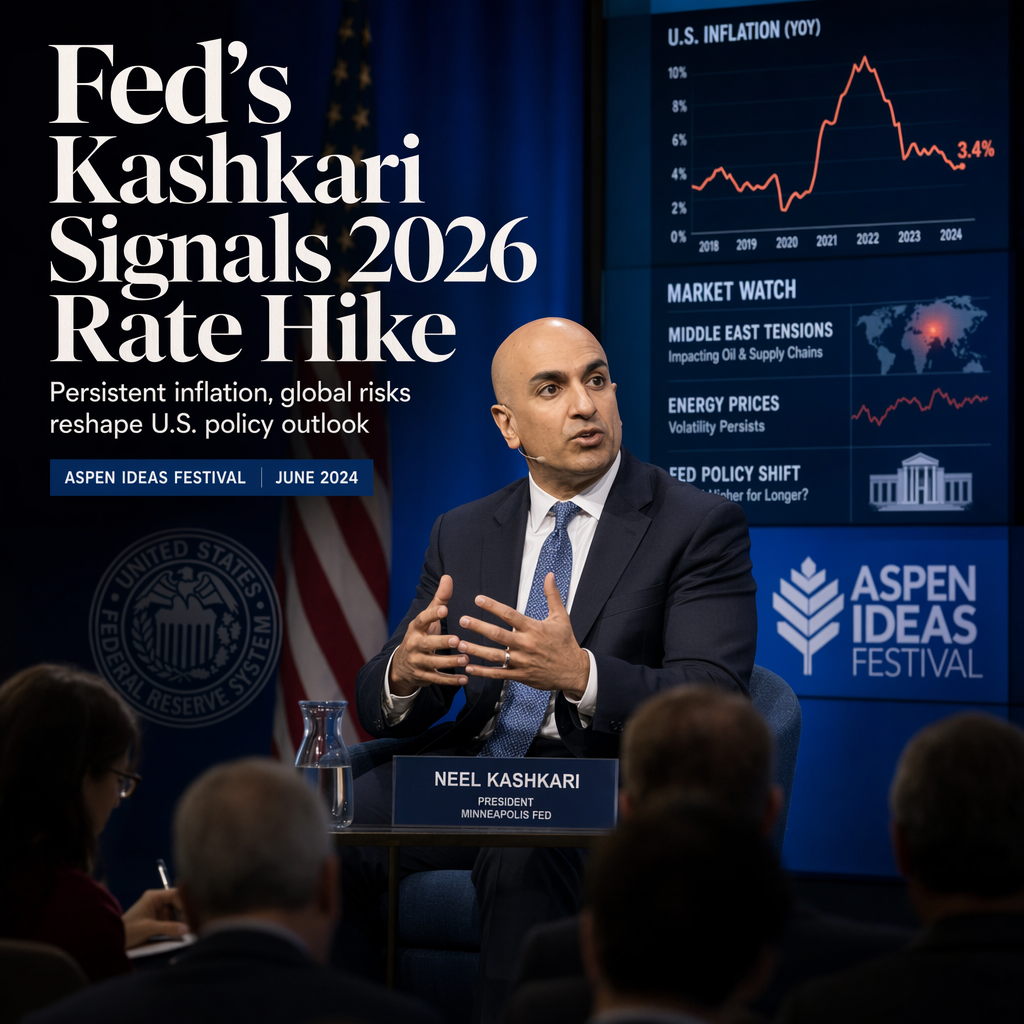
Minneapolis Federal Reserve President Neel Kashkari announced a significant shift in his monetary policy outlook, stating that he now expects one interest rate increase to be necessary this year, reversing his previous expectation of a rate cut by year-end. Kashkari made these remarks during a panel discussion at the Aspen Ideas Festival, just over a week after the Federal Open Market Committee (FOMC) voted to keep its benchmark rate unchanged [1].
Kashkari attributed his change in stance to persistent inflationary pressures, which he linked to ongoing geopolitical tensions in the Middle East and other supply-side factors. He specifically cited spiking inflation tied to fighting in the Middle East, disruptions in the Strait of Hormuz affecting fertilizer and energy prices, tariffs increasing the cost of imported goods, and massive investments in data centers and related infrastructure as key drivers of rising prices [1].
Recent data from the Commerce Department showed the headline inflation rate, as measured by the Fed's preferred gauge, rose to 4.1%, the highest since April 2023. Core inflation, excluding food and energy, reached 3.4%, the highest since October 2023. Inflation has now remained above the Fed's 2% target for five consecutive years [1].
Kashkari expressed skepticism that energy price-induced cost surges would abate soon, citing ongoing instability in the Middle East and doubts about Iran's commitment to a ceasefire agreement. He stated, "I don't trust Iran to honor whatever agreement has been made," and noted evidence suggesting Iran may already be reneging on the deal [1].
Other Fed officials expressed differing views following the recent FOMC meeting. New York Fed President John Williams expects inflation to ease and believes current policy is well-positioned, while Chicago Fed President Austan Goolsbee remains concerned about inflation but declined to comment on future rate moves [1].
CONCLUSION
Neel Kashkari's shift from expecting a rate cut to a rate hike underscores the Federal Reserve's heightened concern over persistent inflation and ongoing geopolitical risks. The divergence in views among Fed officials highlights uncertainty about the future path of monetary policy, with market participants likely to closely monitor upcoming inflation data and global developments.