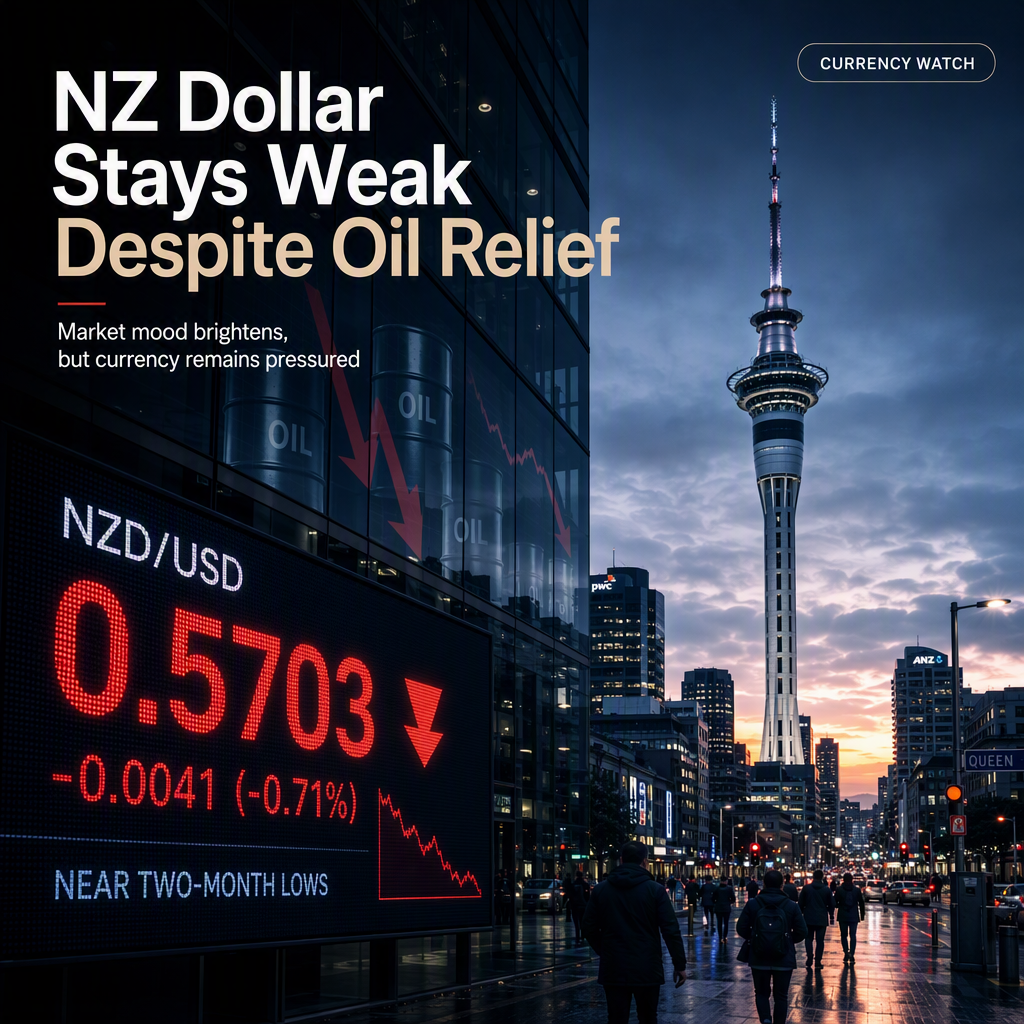
The New Zealand Dollar (NZD) remains just above its two-and-a-half-month lows against the US Dollar (USD), despite a modest improvement in overall market sentiment driven by a sustained reversal in Oil prices. The NZD/USD pair continues to hover near the 0.5700 level, which was reached last week, and is currently down 4.5% from its mid-August highs [1].
The positive market mood at the start of the week is largely attributed to a significant decline in Oil prices, with Brent Crude falling below the $100 mark and trading at $97.20 per barrel, its lowest in nearly two weeks. This represents an 8% drop from last week’s highs, offering some relief to the New Zealand economy, a net Oil importer [1]. The correction in Oil prices has been accelerated by reports of a significant increase in Saudi Arabian exports in September, which has alleviated concerns about supply disruptions. Additionally, Admiral Brad Cooper, Head of the United States Central Command, stated that Oil shipments through the Strait of Hormuz reached their highest levels in six months in September, supported by US naval protection and mine clearance operations [1].
Despite these developments, the US Dollar remains strong, buoyed by the Federal Reserve’s recent 25 basis point interest rate hike and a notably hawkish message from Chairman Kevin Warsh, which surprised investors and fueled expectations of further tightening. This has contributed to the USD’s broad-based strength and kept the NZD under pressure [1]. Ongoing geopolitical tensions in the Middle East, including a Houthi attack on the Saudi Arabian capital and escalating US-Iran threats, have also supported the USD as a safe-haven currency [1].
Earlier in the day, the People’s Bank of China maintained its benchmark interest rate at 3% for the 16th consecutive time, in line with expectations. This decision had minimal impact on the NZD [1].
CONCLUSION
The New Zealand Dollar remains weak near multi-month lows, pressured by a strong US Dollar and ongoing geopolitical risks, despite some relief from lower Oil prices. Market sentiment has improved slightly, but the NZD shows little sign of recovery amid persistent headwinds. Investors continue to monitor US monetary policy and Middle East developments for further direction.