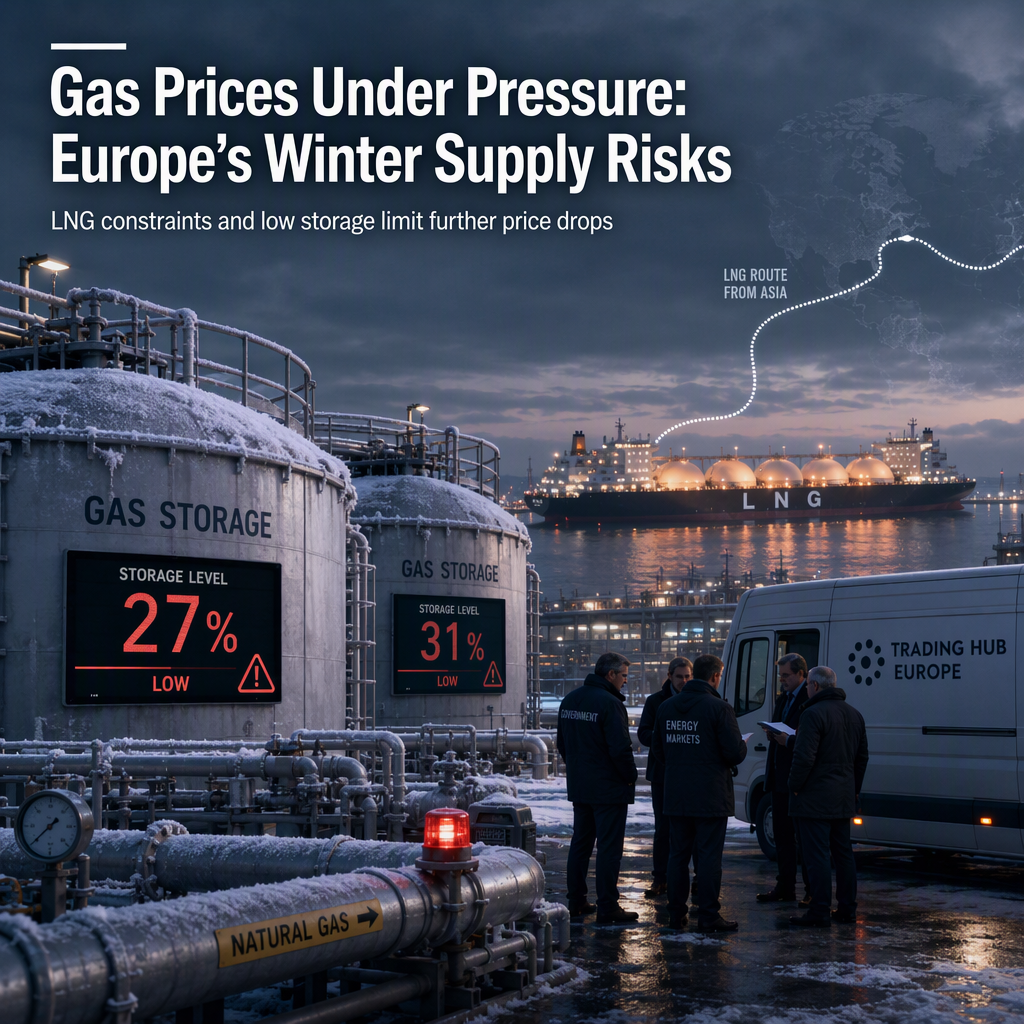
European natural gas prices experienced a temporary decline of more than 8% following news that US President Trump would speak with Iranian President Pezeshkian at the UN General Assembly, according to Norman Liebke at Commerzbank. This drop was attributed to diplomatic headlines, but Commerzbank argues that further downside in prices is likely to be limited due to ongoing supply constraints and low storage levels in Europe [1].
The closure of the Strait of Hormuz has significantly restricted Qatari LNG exports, with current flows at just 20% of pre-war levels, based on Bloomberg data. This supply limitation has contributed to elevated Asian gas prices and increased the risk of price volatility in Europe, especially as the continent heads into the winter heating season [1].
European gas storage is currently at 70% capacity, which is about 15 percentage points below the five-year average. The situation is more acute in Germany, where storage facilities are filled to just under 57%, or 27.5 percentage points below the five-year average. These low storage levels have prompted discussions within the German federal government about potential emergency gas purchases with Trading Hub Europe, the market area operator. If such purchases are authorized and conducted on a large scale, Commerzbank warns that gas prices could rise sharply again [1].
Additionally, the price differential between European and Asian LNG markets is being closely watched. Once the difference reaches EUR 6 per MWh, it becomes more attractive for US suppliers to ship LNG to Asia rather than Europe due to higher transportation costs. This dynamic is expected to limit further widening of the price gap, as Europe increasingly relies on LNG imports to compensate for low storage [1].
CONCLUSION
European natural gas prices are unlikely to see significant further declines due to ongoing LNG supply constraints and below-average storage levels. The risk of emergency purchases and potential price spikes remains elevated, particularly as the winter heating season approaches. Market participants should monitor storage developments and government actions closely.