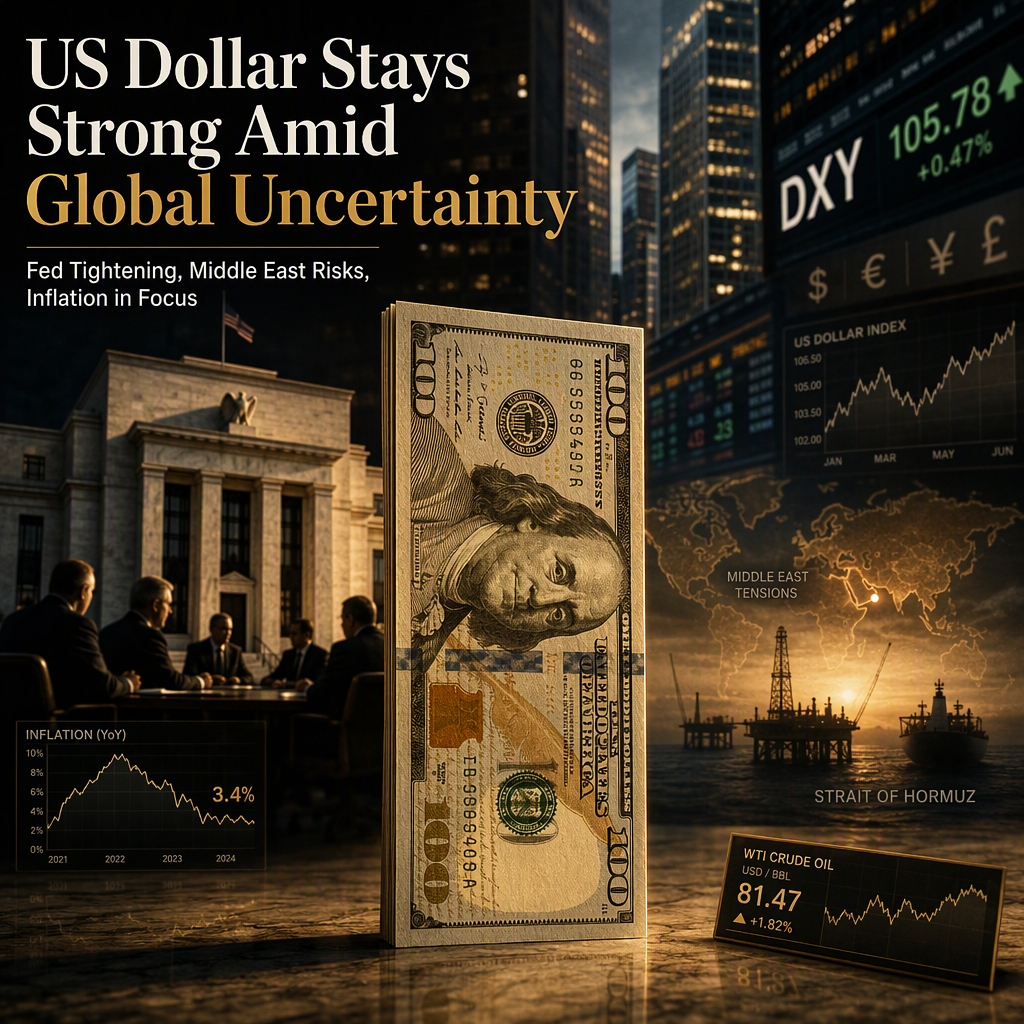
The US Dollar (USD) remains resilient, supported by a hawkish Federal Reserve (Fed) stance and ongoing global economic and geopolitical developments. Following the Fed's recent 25 basis point rate hike to a range of 3.75%-4.00%, 16 of 18 Fed officials anticipate at least one more increase this year, with market expectations reflecting nearly a 90% probability of another hike according to the CME FedWatch tool [3][4]. Fed officials, including Boston Fed President Susan Collins, Chicago Fed President Austan Goolsbee, and Minneapolis Fed President Neel Kashkari, have emphasized that inflation risks are increasingly driven by robust domestic demand in addition to elevated energy prices, suggesting that interest rates may need to remain higher for longer [3][4].
Despite improved global risk sentiment—partly due to the potential reopening of the Strait of Hormuz and falling energy prices—the USD has held firm. The US Dollar Index (DXY) traded around 100.40-100.45 after reaching its highest level since late July, while front-end US yields remain anchored by hawkish Fed rhetoric [2][3][4]. Lower oil prices have eased immediate inflation concerns, but strategists at OCBC and Brown Brothers Harriman (BBH) maintain a constructive outlook for the USD, citing the US economy's growth advantage over major peers and persistent Fed tightening risks [2][3].
In currency markets, the Canadian Dollar (CAD) remains weak against the USD, with USD/CAD testing resistance levels. Scotiabank strategists note that the Bank of Canada (BoC) has left the door open to tighter policy, but policymakers may be more sensitive to CAD weakness with inflation near 3%. Technical analysis points to further USD/CAD gains, with targets at 1.4050 and potentially 1.4125 in the short term [1]. Meanwhile, the Euro (EUR) has struggled to benefit from European Central Bank (ECB) rate hike expectations, as elevated oil prices weigh on the Eurozone's growth outlook. Analysts at MUFG highlight that Eurozone rate markets are pricing in three to four more ECB hikes this year, with over a 50:50 probability of another hike in October [3].
Commodity markets have also reacted to these developments. Silver (XAG/USD) declined 0.38% to around $65.85, pressured by rising US yields and expectations of further Fed tightening. The prospect of a reopening of the Strait of Hormuz could further ease oil prices and inflation concerns, potentially reducing pressure on US interest rate expectations and providing some support to Silver [4].
Geopolitical factors remain in focus, with ongoing tensions between the US and Iran and potential meetings at the United Nations General Assembly in New York. Any resolution regarding the Strait of Hormuz could impact energy prices and, by extension, inflation and monetary policy outlooks [3][4].
CONCLUSION
The US Dollar continues to demonstrate strength amid hawkish Fed signals, robust US economic performance, and persistent inflation concerns. While falling oil prices and improved risk sentiment have tempered some safe-haven demand, expectations for further Fed tightening and geopolitical uncertainties keep the USD well-supported. Market participants remain attentive to upcoming central bank decisions and developments in the Middle East, which could influence both currency and commodity markets.