
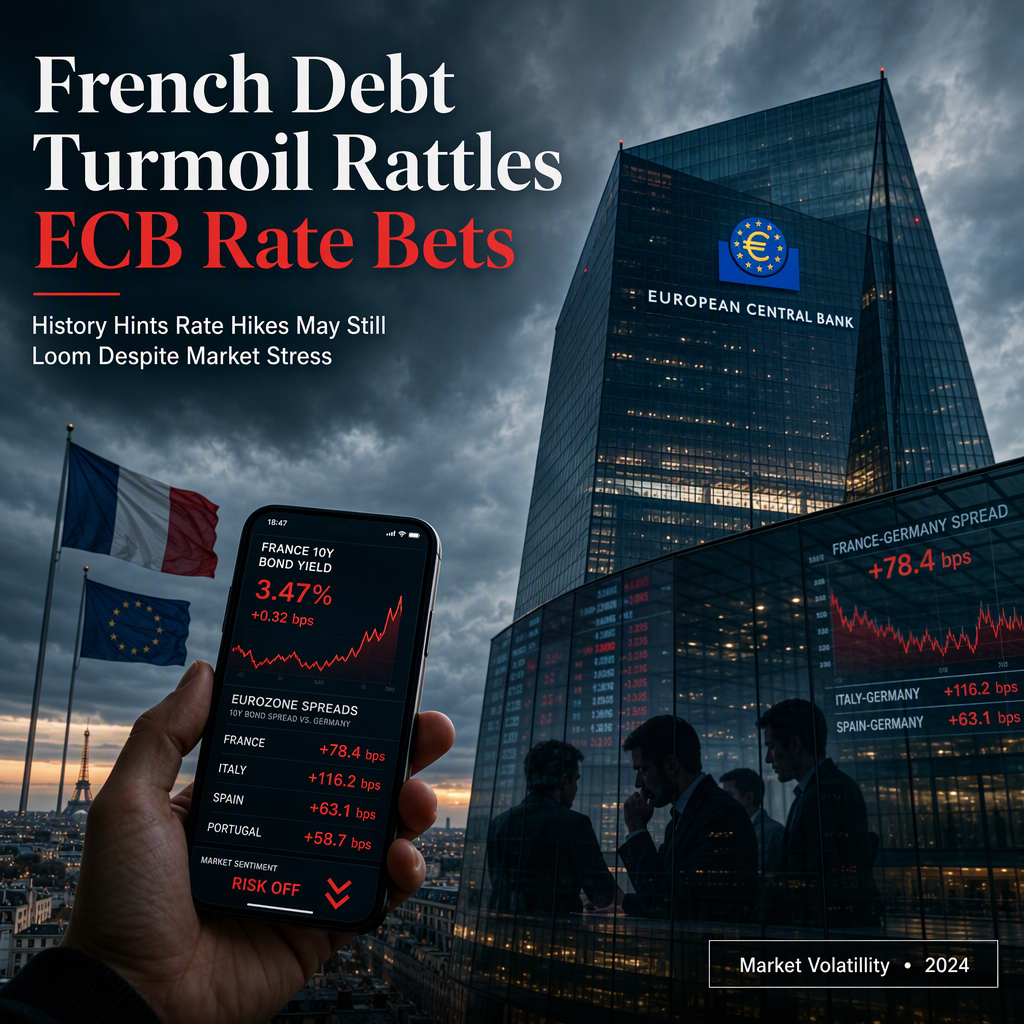
Traders have removed approximately one quarter-point hike from their European Central Bank (ECB) forecasts since mid-September, anticipating that the ECB will halt rate increases due to financial stress triggered by a French debt selloff [1]. This expectation is based on the widening gap between French and German 10-year borrowing costs, which reached 1.54 percentage points on October 2—the widest since 2011—following the largest one-week widening in 17 years [1]. The selloff also affected Italian, Belgian, and Greek bonds, and Spain responded by calling a snap election for November 29 [1]. France's 2027 budget aims for a deficit of 5% of output, down from 5.4%, but still above the EU cap of 3%, closing only a sixth of the gap [1].
Despite these developments, historical precedent from 2022 and 2023 suggests that traders' bets may be misplaced. In both years, the ECB continued to raise rates through periods of financial stress because euro-area inflation remained above its 2% target, with September inflation reported at 3.8% [1]. The ECB's deposit rate currently stands at 2.50% after hikes in June and September [1]. Germany's two-year bond yield, which reflects expectations for ECB policy, reached 3.32% on September 28—the highest since October 2008—and subsequently fell to 3.02% [1]. Notably, this peak was just above the yield seen before the Silicon Valley Bank failure in March 2023 [1].
Money-market pricing as of October 5 indicated 0.28 of a hike expected at the October 29 meeting, 0.89 by December 17, and 2.69 by September 2027. In mid-September, traders had priced in about three-quarters of a hike for October and one additional hike through mid-2027, showing that while some hikes have been priced out, 2.69 hikes remain expected [1].
ECB President Lagarde and Chief Economist Lane have acknowledged that higher long-term rates could slow growth and spread energy costs into other prices more than previously projected, providing traders with arguments for their revised forecasts [1]. However, past episodes—such as the June 2022 Italian bond scare—demonstrate that the ECB raised rates aggressively despite market stress, and yields recovered quickly after initial declines [1].
CONCLUSION
While traders have reduced their ECB rate hike expectations due to financial stress from the French debt selloff, historical patterns and persistent inflation suggest the ECB may continue tightening. The market impact is high, with significant volatility in European bond yields and ongoing uncertainty about the ECB's policy trajectory.