
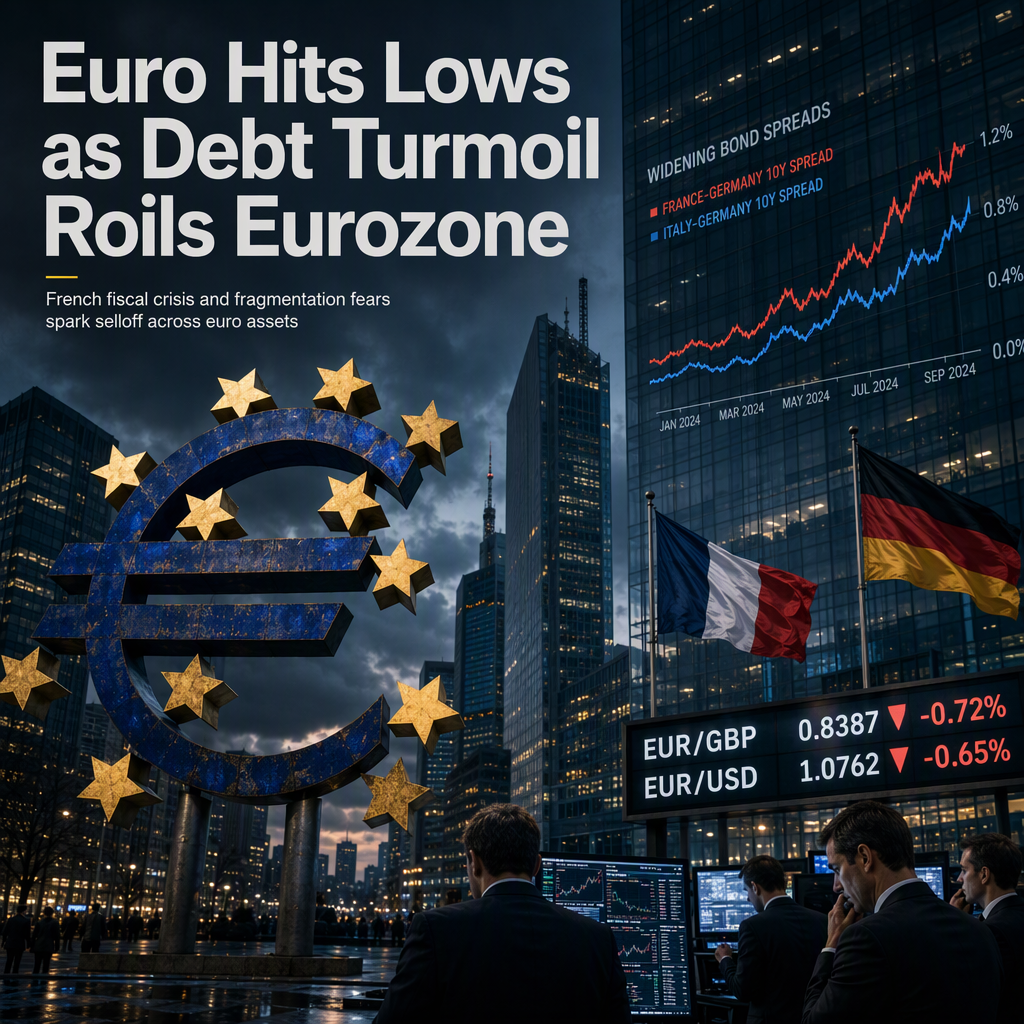
The Euro continued its decline against the British Pound and other major currencies on Monday, reaching its lowest level since mid-July, as political turmoil in France and mounting concerns over Eurozone public finances weighed heavily on sentiment [1]. At the time of reporting, EUR/GBP traded around 0.8478, down 0.24% on the day, after touching an intraday low of 0.8458 [1]. The sell-off in French government bonds, driven by high debt, a widening budget deficit, and doubts over the government's ability to pass its 2027 budget, has triggered a sharp widening in the yield spread over German Bunds to just over 140 basis points—almost 60 basis points wider than before the summer [1].
Analysts from MUFG and OCBC highlighted that these developments have intensified fears of financial fragmentation within the Eurozone, which could impede the transmission of monetary policy [1][2]. MUFG noted that the Euro has fallen to fresh year-to-date lows against the US Dollar and Yen, with EUR/USD at 1.1161 and EUR/JPY at 176.41 overnight [1]. OCBC's Christopher Wong stated that EUR/USD has dropped to its weakest level since May 2025, and warned that the Dollar could extend gains if the French-German spread remains wide [2]. Both banks emphasized that the European Central Bank's (ECB) Transmission Protection Instrument (TPI) is designed to counter disorderly market dynamics, but its activation depends on fiscal sustainability and compliance with EU rules [1][2].
The market reaction has been significant, with tightening financial conditions prompting market participants to scale back expectations for further ECB rate hikes [3]. MUFG's Lee Hardman observed that pricing for ECB hikes has shifted closer to their forecast of two additional moves, but cautioned that even this may be too aggressive if fragmentation risks intensify [3]. There is growing speculation that the ECB may need to slow quantitative tightening (QT) or activate the TPI to address contagion risks, though such a move would require governments to take fiscal action to restore investor confidence [3].
ECB Chief Economist Philip Lane commented that the rise in long-term rates will slow growth and reduce pass-through by more than projected, and that policymakers remain on a 'middle path' with a measured response [1]. Lane also warned that a second wave of the energy supply shock poses upside risks to inflation and downside risks to growth [1]. On the data front, the final Eurozone HCOB Composite PMI rose to 53.1 in September from 52.0, while the UK S&P Global Composite PMI was revised up to 52.0 from 51.7 [1].
According to OCBC, while the ECB's anti-fragmentation tools are expected to limit systemic stress, the threshold for activation remains high, and verbal intervention is likely to be the first line of defense if spreads continue to widen [2].
CONCLUSION
The Euro's sharp decline reflects mounting concerns over French fiscal stability and broader Eurozone fragmentation risks, which have tightened financial conditions and weighed on rate hike expectations. While the ECB possesses tools to address disorderly market dynamics, their activation is contingent on fiscal discipline and remains a last resort. Market participants are increasingly cautious, with further Euro weakness possible if spreads persist.