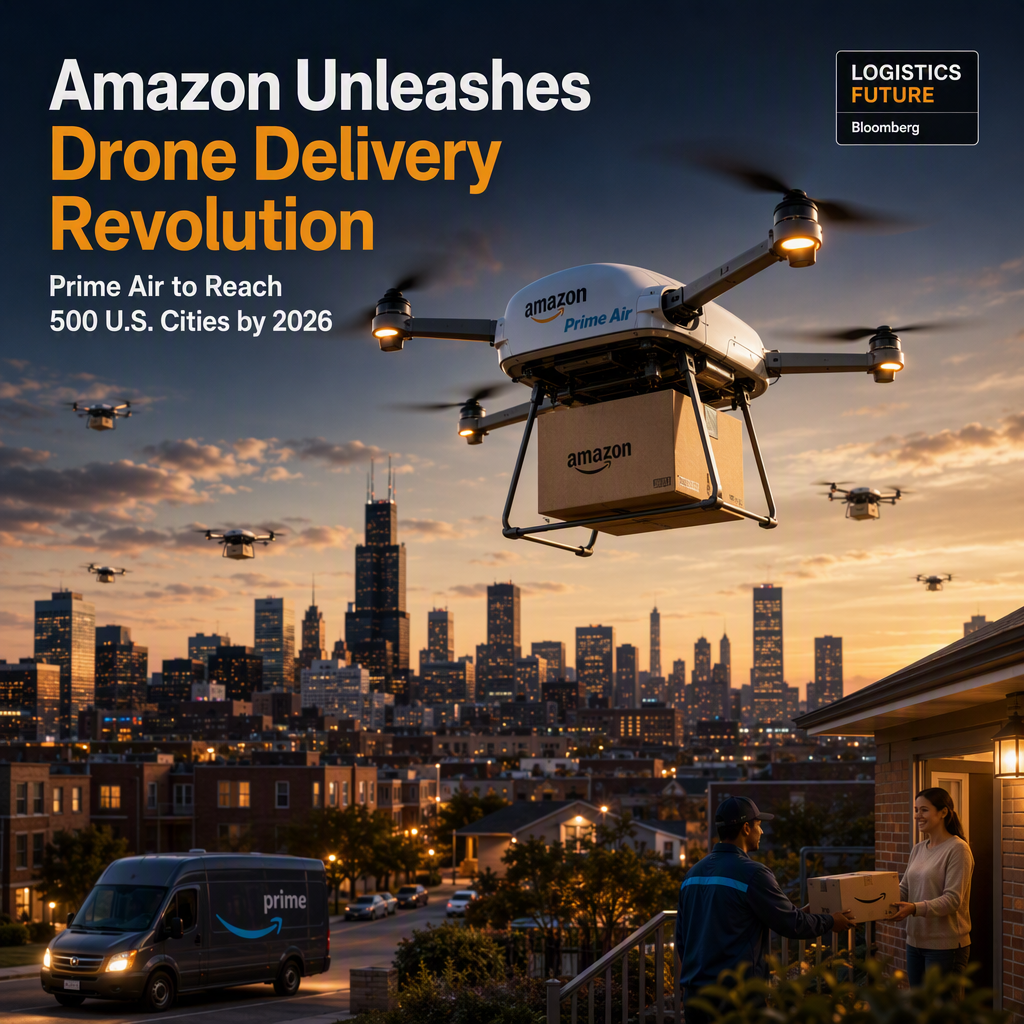
Amazon has announced a significant expansion of its Prime Air drone delivery network, aiming to reach nearly 500 U.S. cities and towns by the end of 2026, a roughly sixfold increase from its current 11 delivery sites across 10 metropolitan areas [1]. The next phase of the rollout will include the Chicago, Atlanta, Cleveland, Syracuse, and Boise metropolitan areas, with additional communities expected to be added later this year [1].
This expansion is part of Amazon's broader strategy to accelerate last-mile delivery and compete with other retailers and delivery companies, such as Walmart, which has expanded its drone delivery service through partners like Alphabet-owned Wing and Zipline, and DoorDash, which recently received federal approval to operate its own commercial drone delivery network. Uber has also announced a partnership with Zipline this week [1].
Prime Air drones are capable of carrying packages weighing up to 5 pounds, which covers more than 60% of the products most frequently purchased by customers. Deliveries can arrive in as little as 30 minutes, with most orders reaching customers about an hour after checkout. Prime members receive free drone delivery on orders of $50 or more, while smaller orders incur a $2.99 fee; non-Prime customers pay $4.99 per delivery [1].
Amazon holds Federal Aviation Administration Part 135 certification for Prime Air and utilizes an autonomous 'detect-and-avoid' system to ensure safety without requiring live video monitoring. Despite these advancements, drone delivery remains a small segment of the overall delivery market and faces challenges such as regulatory requirements, weather, noise, safety, and cost-effectiveness compared to traditional delivery methods [1].
The announcement had a positive impact on Amazon's stock, which rose by 2.11% to $264.94, while Walmart's stock increased by 0.21% to $115.44 [1].
CONCLUSION
Amazon's planned expansion of Prime Air marks a major step in the race for faster, more efficient last-mile delivery. While the initiative faces operational and regulatory hurdles, the market responded positively, reflecting investor optimism about the potential for drone delivery to become a scalable part of Amazon's logistics network.