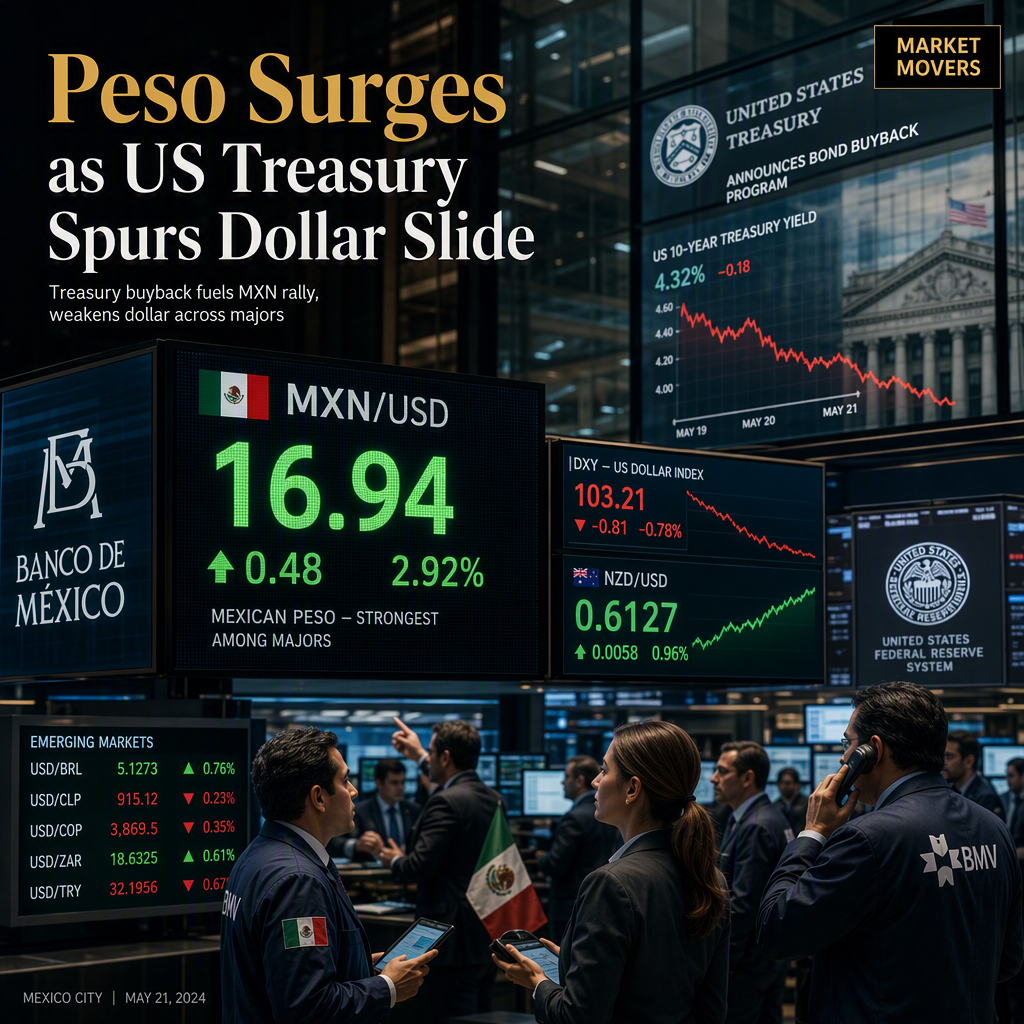
The US Treasury's decision to double the size of its long-duration bond buyback operations has triggered significant moves in global currency markets, notably strengthening the Mexican Peso and the New Zealand Dollar while weakening the US Dollar [1][2]. The Mexican Peso surged to a two-year high of 16.94 against the US Dollar, with USD/MXN trading at 16.95, down 0.27% on the day [1]. This rally was attributed to falling US Treasury yields, which retreated after the Treasury announced it would increase buybacks of nominal coupon securities in the 10-year to 20-year and 20-year to 30-year sectors from $2 billion to at least $4 billion per operation between September 9 and November 4 [2].
Similarly, the New Zealand Dollar jumped, with NZD/USD rising sharply to around 0.5930, up 0.96% on the day [2]. The US 10-year Treasury yield fell to 4.651% after reaching 4.712% earlier, directly weighing on the Greenback by reducing the yield advantage of Dollar-denominated assets [2]. The US Dollar Index (DXY) dropped 0.81% to 98.85, its lowest level since May 29 [2].
Market participants are closely watching upcoming events for further direction. The Federal Reserve is set to release its final meeting minutes at 18:00 GMT, which could provide clues about the future path of US monetary policy [1][2]. On the Mexican side, traders are awaiting the Bank of Mexico's minutes and retail sales data, with estimates suggesting a 0.1% month-on-month increase in June and a year-on-year rise from 1.6% to 3.1% [1]. In New Zealand, the hawkish stance of the Reserve Bank of New Zealand continues to support the Kiwi [2].
Technical analysis for USD/MXN shows the pair trading at 16.9672, extending its slide beneath longer-term simple moving averages, with persistent downside pressure indicated by a Relative Strength Index of 35.9 [1]. For NZD/USD, the pair maintains a bullish near-term tone, trading above key moving averages and extending gains above the intraday floor [2].
Geopolitical tensions, particularly the US-Iran standoff over the Strait of Hormuz, continue to pose upside risks to inflation and could influence future monetary policy decisions [1][2].
CONCLUSION
The US Treasury's expanded bond buyback program has led to a notable weakening of the US Dollar, boosting both the Mexican Peso and New Zealand Dollar. Market attention now turns to upcoming central bank minutes and economic data for further direction, while geopolitical risks and monetary policy uncertainty remain in focus.