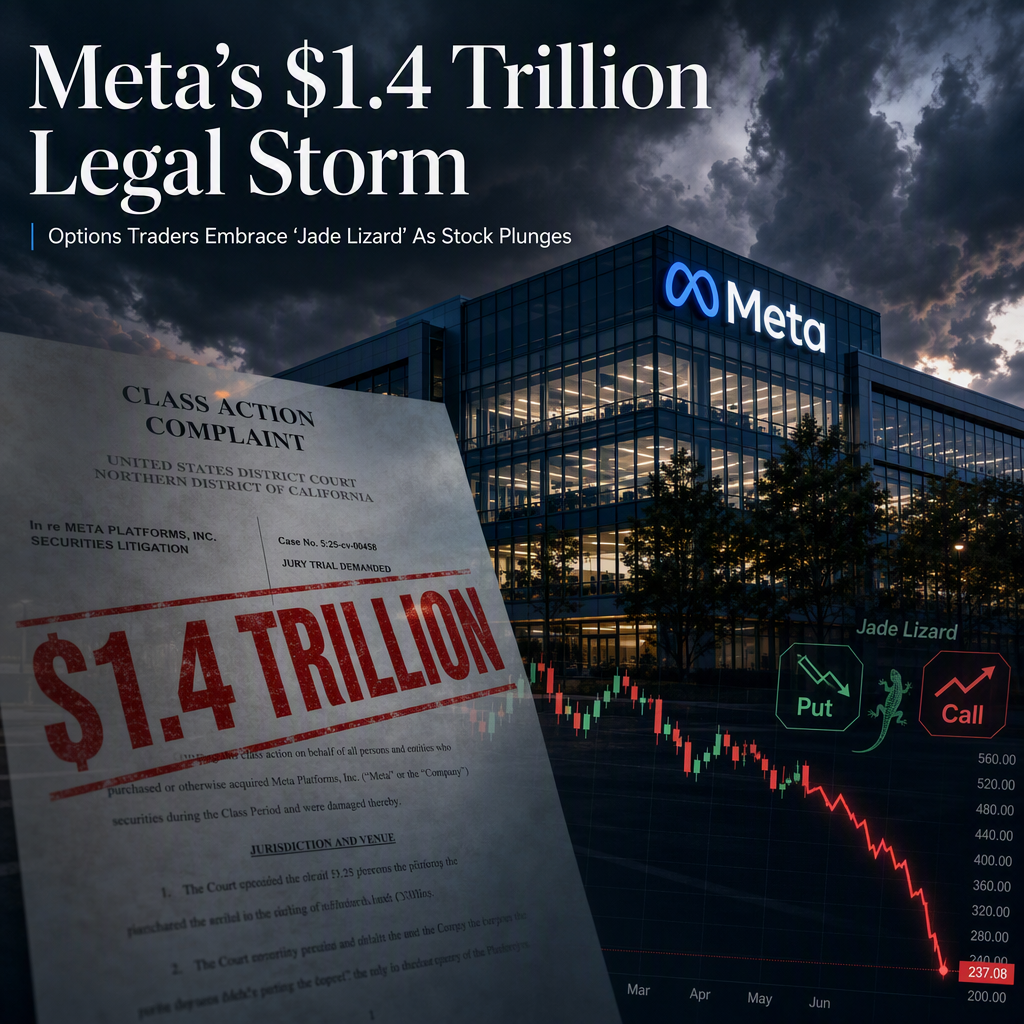
Meta Platforms is currently embroiled in significant legal challenges, as opening statements began in Oakland where 29 state attorneys general have accused the company of deliberately designing Facebook and Instagram to hook young users [1]. The litigation has introduced a theoretical worst-case scenario of $1.4 trillion in damages, though the article notes that this figure is widely considered unrealistic, especially given the likelihood of appeals [1]. In addition to this major lawsuit, Meta faces over 3,000 personal-injury suits in federal multi-district litigation, approximately 1,300 school-district claims, a nearly $1 billion judgment in New Mexico, and a $6 million bellwether loss in Los Angeles [1].
The market has already reacted sharply to these legal troubles. Meta shares are down more than 30% from their highs a year ago, and the company's market capitalization has fallen by over $600 billion, making it the worst-performing stock among the 'Magnificent Seven' over the past 12 months [1]. The stock's decline is also weighing on the broader communications sector, where Meta is the largest constituent [1]. While some of the decline is attributed to concerns about AI capital expenditures, the article highlights that much of the downside risk appears to be priced in, with Meta trading at about 22 times earnings and revenue still growing at 28% [1].
Options traders are responding to the elevated uncertainty and implied volatility by considering the 'jade lizard' strategy, which involves selling an out-of-the-money put and an out-of-the-money call spread to collect premium without unlimited upside risk [1]. The September 25th expiration is seen as attractive because it captures some of the lawsuit-driven volatility while avoiding the Q3 earnings report expected in late October and the anticipated six to eight week length of the trial [1]. The strategy is structured so that if Meta shares remain rangebound, traders can keep the full credit, with limited upside and downside risk [1].
Analyst commentary in the article suggests that, despite the headline risk, a sustained rally in Meta shares is unlikely during the seven-week trial, and that the market has already priced in much of the potential downside [1].
CONCLUSION
Meta's ongoing legal battles have led to a significant decline in its share price and market capitalization, with options traders seeking to capitalize on the elevated volatility through specialized strategies. While the theoretical damages are enormous, the market appears to have already priced in much of the risk, and a major rally is not expected during the trial period.