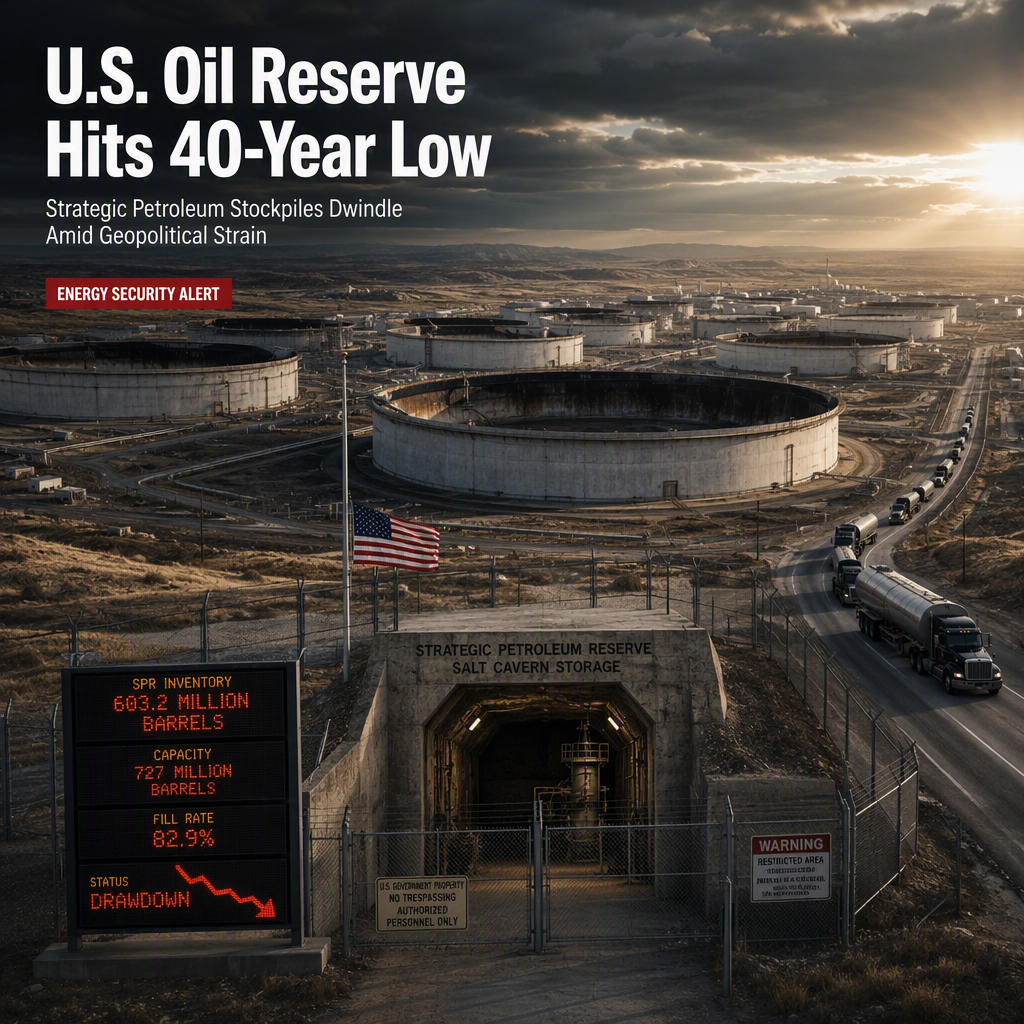
The U.S. Strategic Petroleum Reserve (SPR) has fallen to its lowest level since 1983, with inventories ending the week at 298.7 million barrels, according to data released by the Department of Energy on Monday [1]. This marks a decline of 6.1 million barrels from the previous week and represents the lowest level in the Energy Information Administration's (EIA) weekly data since January 1983 [1]. The SPR's decline comes as inventories, already low before the Iran war, face increasing pressure due to Iranian attacks that have slowed tanker traffic through the Strait of Hormuz [1].
The Trump administration authorized the release of up to 172 million barrels from the SPR in March 2026 in response to the impact of the Iran war on energy supplies, with the announcement made on March 11, 2026 [1]. At that time, the SPR held about 415.4 million barrels, but inventories have since dropped by approximately 116 million barrels as of early August [1]. This latest drawdown follows a historic release of 180 million barrels authorized by the Biden administration in early 2022 in response to Russia's invasion of Ukraine, which saw inventories fall from around 600 million barrels at the start of 2022 to 375 million barrels by the end of that year [1].
After hitting a low of about 347 million barrels in the summer of 2023, SPR inventories began to recover, reaching 400 million barrels in May 2025 and peaking at over 415 million barrels in February before the latest round of drawdowns began in March [1]. The SPR, created in 1975 under the Energy Policy and Conservation Act, was initially intended to have a capacity of 1 billion barrels but has never reached that level. Its current congressionally-authorized maximum is about 714 million barrels, with the highest ever inventory recorded at 726.6 million barrels in December 2009 [1].
SPR reserves are stored in four underground salt caverns, which offer advantages in cost, maintenance, and security. The Government Accountability Office (GAO) issued a report in May warning about the state of the SPR, though further details from the report are not provided in the article [1].
CONCLUSION
The U.S. Strategic Petroleum Reserve has reached its lowest level in over four decades due to successive emergency drawdowns in response to geopolitical crises. This significant depletion raises concerns about the nation's energy security and its ability to respond to future supply disruptions. Market participants are likely to view the current SPR levels as a source of heightened risk in the energy sector.