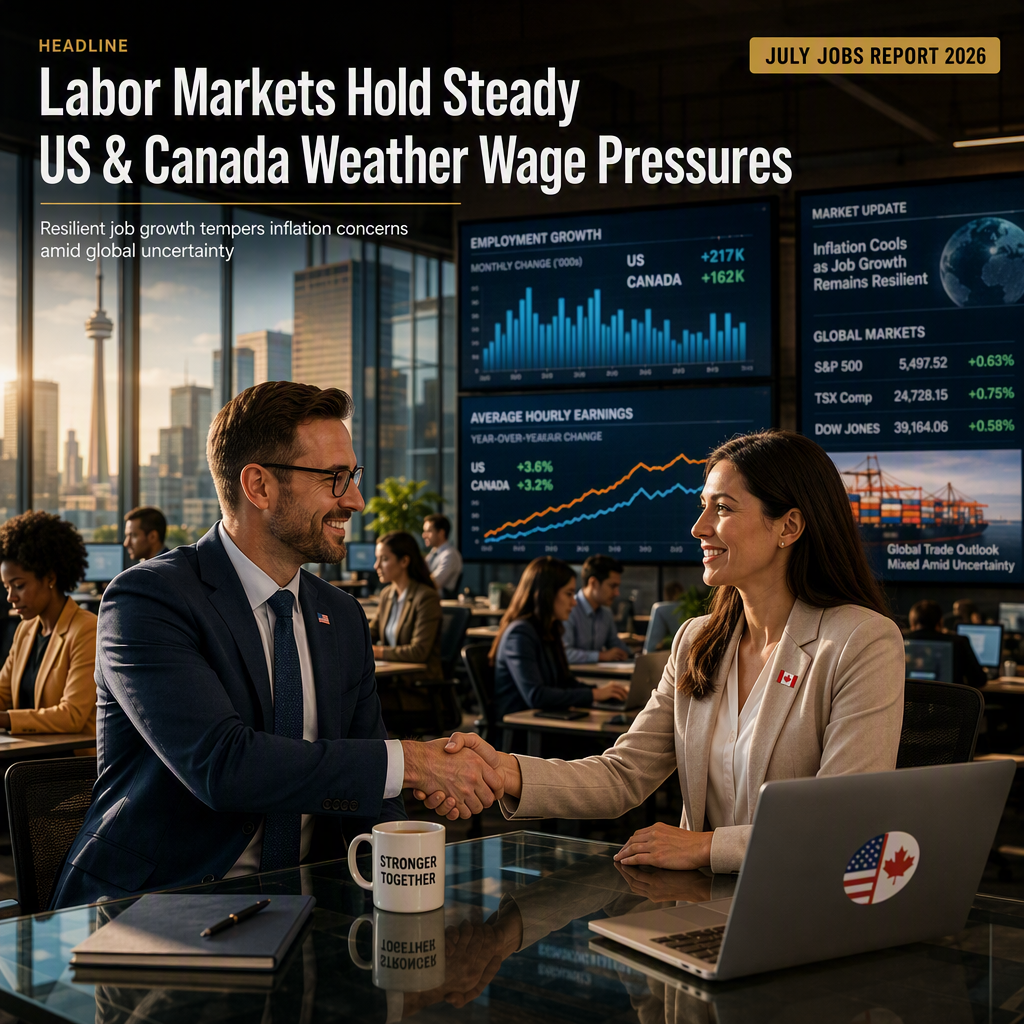
The July jobs reports for both the United States and Canada are expected to confirm ongoing labor market resilience, with modest employment gains and subdued wage growth. In Canada, TD Securities forecasts a 20,000 increase in employment for July, matching consensus estimates and continuing the recovery from job losses earlier in 2026. The unemployment rate is projected to dip to 6.4%, while wage growth is expected to slow to 3.4% year-on-year due to a large base effect from last July. Hiring intentions have been trending higher into Q3, with the S&P Composite Employment indicator reaching its highest level since Q4 2024. Payroll employment has shown a strong trajectory, although services may face mild headwinds from a partial unwind in accommodation and food services strength [1].
In the United States, Danske Bank expects nonfarm payrolls to rise by 70,000 in July, with the unemployment rate steady at 4.2% and average hourly earnings up 0.3% month-on-month. Leading indicators continue to point to solid labor market conditions, though weak labor supply growth weighs on the employment outlook. The July Challenger Report showed 33,429 announced layoffs, the lowest since July 2024, with AI-linked layoffs accounting for up to 33% of the total. Productivity growth improved to 1.4% quarter-on-quarter annualized in Q2, limiting unit labor cost growth to 1.3%. The Federal Reserve is monitoring these trends, with Chair Warsh reportedly prepared to raise interest rates in September if inflation remains elevated [2].
NBC News reports that economists surveyed by Dow Jones expect the US July jobs report to show 83,000 added roles, surpassing June’s 57,000, with the unemployment rate projected to hold at 4.2%. Wage growth is expected to rise 0.3% month-on-month, or 3.5% year-on-year, matching June’s pace. Inflation remains above the Fed’s 2% target at 3.5%, and wage growth has recently lagged inflation, particularly due to the ongoing US war with Iran and elevated energy prices. Diane Swonk of KPMG expects an above-consensus 100,000 jobs, citing renewed hiring by firms, while Bank of America’s Shruti Mishra projects 80,000 jobs added, highlighting potential rebounds in education, health services, and leisure & hospitality. Manufacturing employment has also shown signs of recovery, with four of the past six months posting gains, though the total increase in 2026 is modest at 18,000 jobs [3].
While all sources agree on continued labor market strength, there are discrepancies in the projected US nonfarm payroll gains: Danske Bank forecasts 70,000 [2], Dow Jones economists expect 83,000 [3], and KPMG’s Swonk anticipates 100,000 [3]. Wage growth projections are consistent, with both Danske Bank and NBC News citing a 0.3% month-on-month increase [2][3].
CONCLUSION
Labor markets in both the US and Canada are demonstrating resilience, with steady job gains and stable unemployment rates, though wage growth remains modest and inflation continues to outpace earnings in the US. Market impact is medium, as the data supports a narrative of gradual recovery but does not signal a dramatic shift in monetary policy or economic outlook. Discrepancies in US job growth forecasts highlight some uncertainty, but overall sentiment remains cautiously positive.