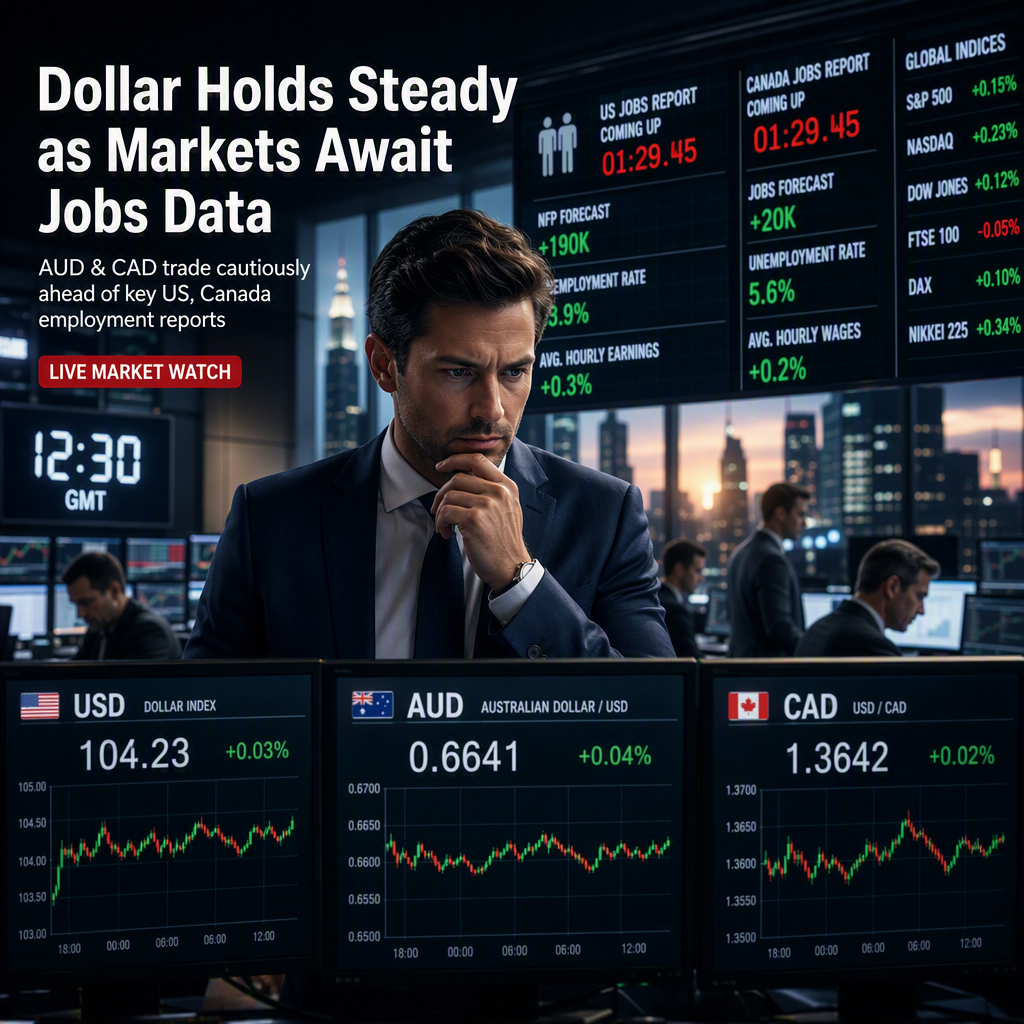
Both the Australian Dollar (AUD) and Canadian Dollar (CAD) traded with limited direction on Friday as investors awaited the release of the United States (US) Nonfarm Payrolls (NFP) data for July, scheduled for 12:30 GMT [1][2]. The AUD edged up to near 0.7040 against the US Dollar (USD), while USD/CAD hovered around 1.4020, up a modest 0.06% on the day, reflecting cautious sentiment ahead of key employment reports from both the US and Canada [1][2].
Economists expect the US economy to have added 80K jobs in July, following 57K in June, with the Unemployment Rate forecast to remain unchanged at 4.2% and annual wage growth holding steady at 3.5% [2]. TD Securities, however, projects US payrolls to edge up to 70K, noting that an upside surprise could fuel expectations for further Fed rate hikes, while a downside surprise would likely have a more muted impact on the Dollar [1]. The US Dollar Index (DXY) traded marginally lower near 99.92, and US Treasury yields remained elevated as markets reassessed the possibility of a prolonged restrictive policy stance by the Federal Reserve (Fed) if inflation persists [1][2]. According to the CME FedWatch tool, there is a 54.7% chance the Fed will raise interest rates at its September meeting [1].
On the Canadian side, higher oil prices provided fundamental support to the CAD, but this was insufficient to offset the current strength of the USD, keeping USD/CAD near recent highs [2]. Canada's July employment report, released alongside the US NFP, is expected to show a gain of 15K jobs, following an increase of 18.2K in June, with the Unemployment Rate forecast to remain at 6.5% [2]. TD Securities forecasts Canadian employment to rise by 20K, in line with market consensus, and notes that hiring intentions have been trending higher into Q3, with the S&P Composite Employment indicator reaching its highest level since Q4 2024 in July [2].
For the AUD, analysts at Standard Chartered expect the Reserve Bank of Australia (RBA) to keep the cash rate unchanged at 4.35% at its August 11 meeting, citing steady Q2 trimmed mean inflation at 0.8% quarter-on-quarter, below the RBA's prior forecast of 0.9%, and a recent retracement in oil prices as reasons for reduced pressure to tighten policy further [1]. Technical analysis shows AUD/USD trading at around 0.7037, maintaining a bullish tone above the 20-day EMA at 0.7004, with buyers retaining control and the RSI near 56 indicating steady upside momentum [1].
Geopolitical tensions in the Middle East, particularly uncertainty over the reopening of the Strait of Hormuz, continue to support safe-haven demand for the USD and fuel concerns over global supply chains and inflation [2]. Several Fed officials have adopted a cautious tone, reinforcing expectations that interest rates could remain higher for longer [2].
CONCLUSION
Markets are poised for increased volatility as investors await the July employment reports from the US and Canada, which could significantly influence the Federal Reserve's policy outlook. Both the AUD and CAD are trading cautiously, with technical and fundamental factors suggesting limited movement until the data is released. The outcome of the employment reports will be pivotal in shaping near-term currency and interest rate expectations.