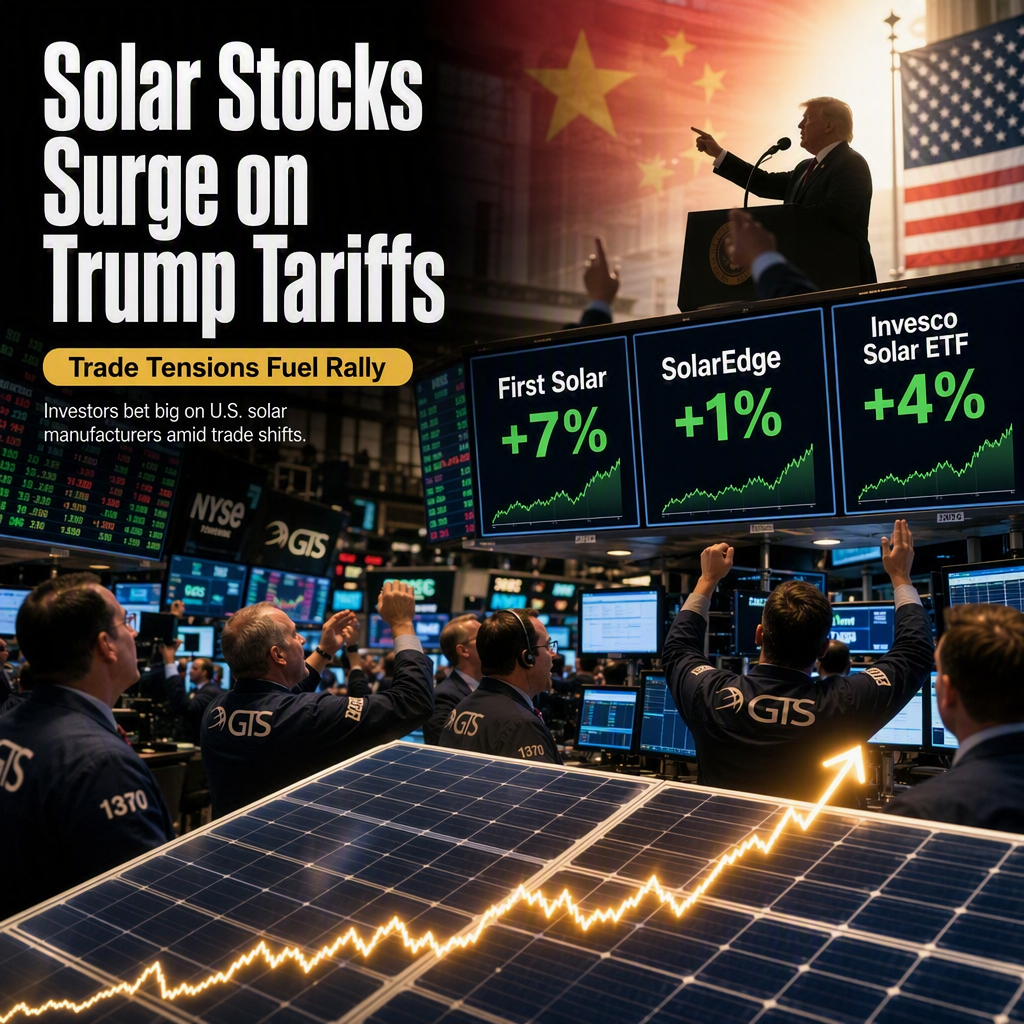
President Donald Trump announced new import restrictions targeting products made with polysilicon, a critical raw material for solar panels and semiconductors, escalating the ongoing U.S.-China trade tensions over chips, energy, and artificial intelligence [1]. The new measures include a 15% duty on products made from polysilicon and the introduction of minimum prices for certain related imports, with the stated aim of protecting U.S. domestic solar supply chains from Chinese competition [1].
The market responded positively to the news, with U.S. solar stocks rising in premarket trading on Friday. First Solar's stock advanced more than 7% ahead of the market open, Solaredge Technologies rose 1%, and the Invesco Solar ETF increased by 4% [1]. These gains reflect investor optimism about the potential benefits for domestic solar manufacturers following the imposition of the tariffs.
The tariffs were enacted under Section 232 of the U.S. Trade Expansion Act of 1962, following advice from Commerce Secretary Howard Lutnick [1]. In his executive order, President Trump stated, "For decades, America has allowed foreign countries to weaken United States producers in the polysilicon sector, eroding our economic and national security. Today, I am taking action to put a stop to these practices and revitalize the United States polysilicon sector" [1].
The move is part of a broader strategy to insulate U.S. supply chains in solar and semiconductor industries and to counter China's influence in the energy and AI sectors [1]. No forward-looking analyst opinions were provided in the article.
CONCLUSION
President Trump's decision to impose tariffs on Chinese polysilicon imports led to a notable rally in U.S. solar stocks, signaling strong market approval. The action is intended to bolster domestic solar manufacturing and supply chains, with immediate positive sentiment reflected in key sector equities.