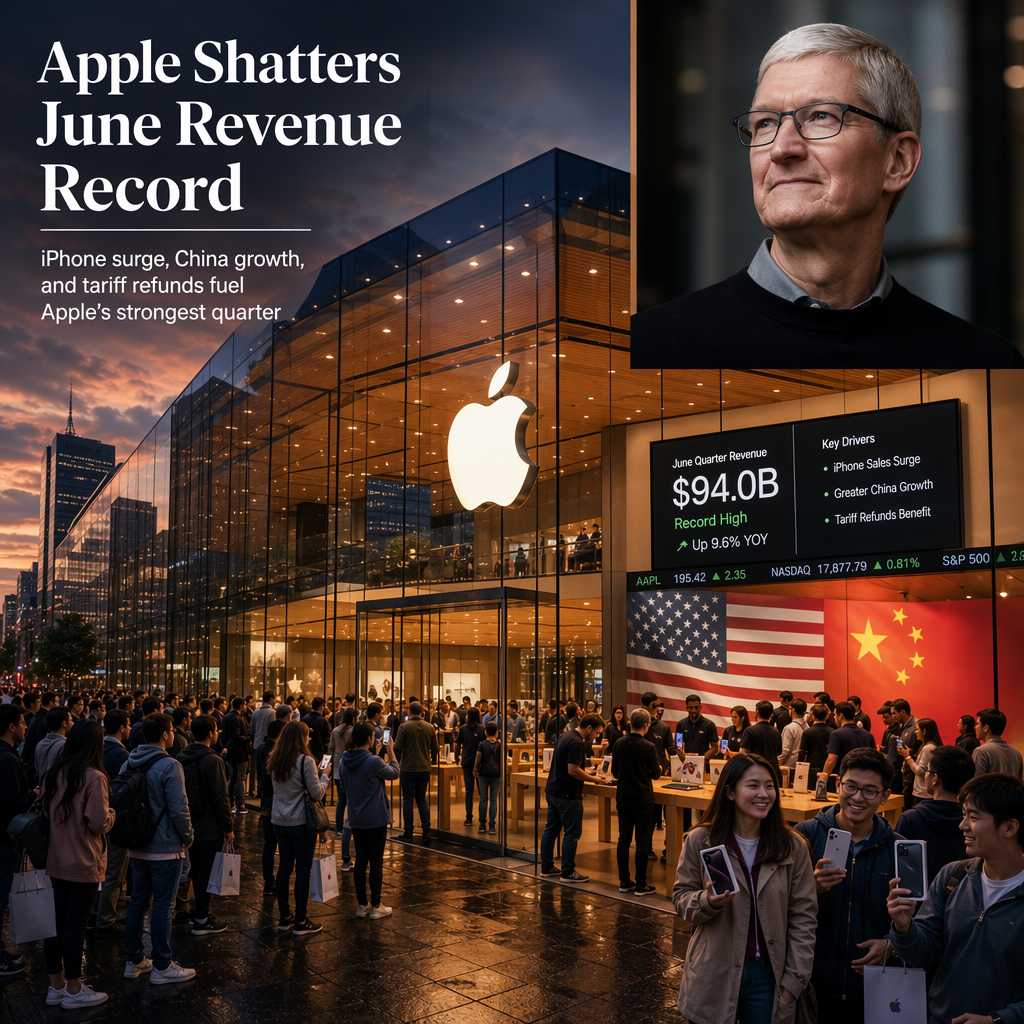
Apple posted its strongest June quarter on record, reporting $109.4 billion in revenue, surpassing analysts' estimates of $108.65 billion in the company's final earnings report before CEO Tim Cook steps down [1]. The results were propelled by a 22% increase in iPhone sales and record spring quarter Mac revenue, with tariff refunds contributing roughly 5% to profit during the period [1].
CEO Tim Cook addressed several key topics following the earnings release, including Apple's approach to open-source artificial intelligence, U.S.-China relations, rising memory chip costs, and his legacy after 15 years as CEO [1]. Cook stated he has "nothing negative" to say about open-source AI models and described them as "useful," indicating Apple's pragmatic stance in the ongoing industry debate over proprietary versus open-source AI systems [1]. Apple is preparing to launch its AI-powered Siri this fall using Google's Gemini, while Chinese AI company Moonshot's Kimi K3 has drawn attention for its competitive performance [1].
China remains a critical market for Apple, with China sales rising 22% during the spring quarter to $18.81 billion. However, this figure fell short of analysts' expectations of more than $19.5 billion for the region [1]. Apple Intelligence was recently approved in China after a nearly two-year delay compared to its U.S. launch, which could enhance Apple's competitiveness against domestic smartphone makers rapidly adopting generative AI features [1].
Tariff refunds also played a significant role in the quarter's performance. Cook emphasized that Apple is reinvesting these refunds into U.S. advanced manufacturing, aligning with the company's commitment to spend $600 billion over four years on the U.S. economy [1].
CONCLUSION
Apple delivered a record June quarter, driven by strong iPhone sales, robust Mac revenue, and a boost from tariff refunds. While China sales grew significantly, they did not meet analyst expectations, but the recent approval of Apple Intelligence in China may improve future prospects. The company's reinvestment of tariff refunds into U.S. manufacturing and its pragmatic AI strategy signal continued adaptation and growth.