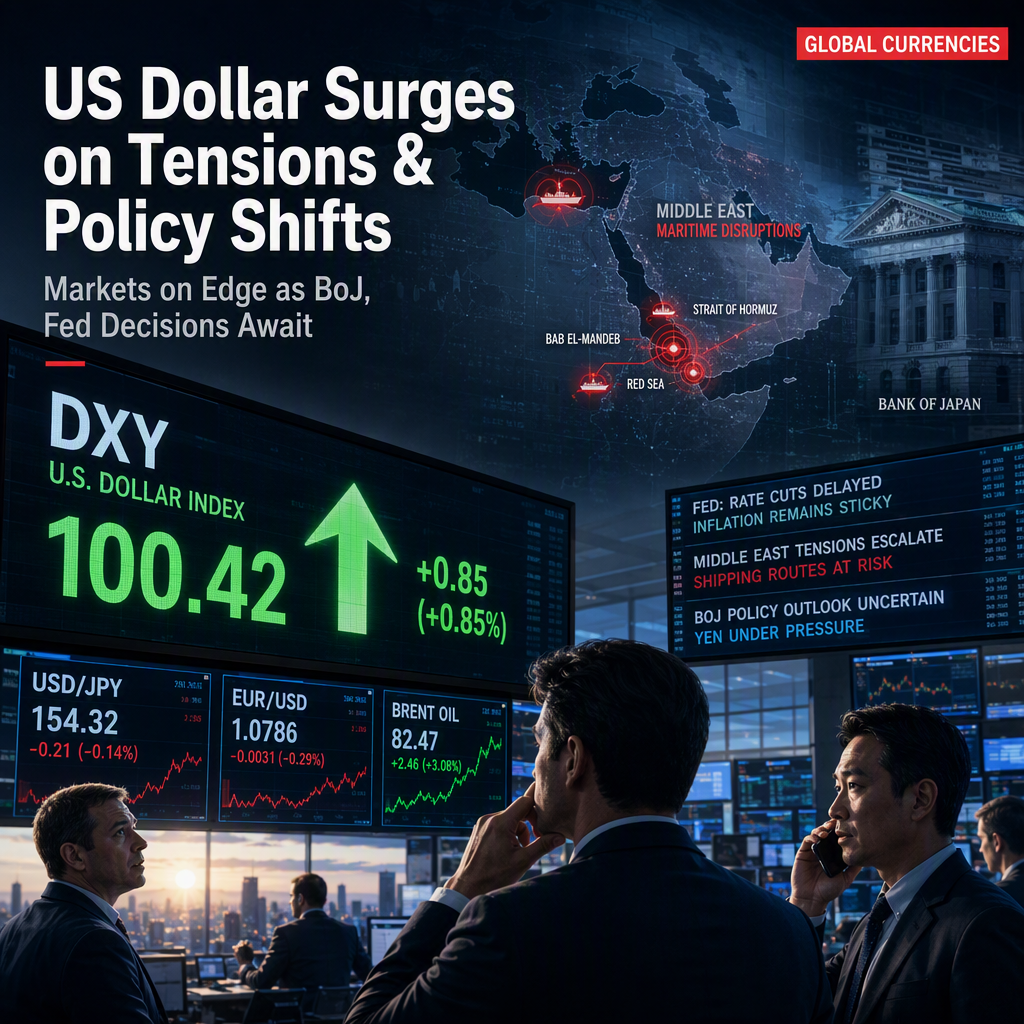
The US Dollar Index (DXY) rebounded above the 100.00 psychological mark during the Asian session on Friday, snapping a three-day losing streak after hitting its lowest level since June 17. This recovery was supported by renewed US Dollar buying and repositioning ahead of the Bank of Japan (BoJ) rate decision, as well as ongoing geopolitical tensions in the Middle East, particularly the US-Iran conflict and related disruptions to key shipping routes [1][2].
The USD/JPY currency pair climbed back above the 160.50 level, building on a late recovery from sub-158.00 levels, which had marked its lowest since May 14. Technical analysis indicates that further gains may face resistance at the 50.0% Fibonacci retracement level at 160.99, with additional barriers at 161.69 and 162.69. On the downside, support is seen at 160.28, 159.41, and 158.00. The Japanese Yen was the strongest major currency against the US Dollar this week, appreciating by 1.85% [1].
The US Dollar's rebound was also influenced by a 0.1% decline in the US Personal Consumption Expenditures (PCE) Price Index for June, the first monthly drop since April 2020. This data, combined with a temporary truce in the Iran war that lowered gas prices, dampened expectations for an immediate Federal Reserve rate hike. However, volatile crude oil prices and ongoing US-Iran tensions, including recent US military strikes against Iran and a maritime embargo by Iran-aligned Houthis, have kept inflation concerns alive and maintained a geopolitical risk premium in the market [2].
In the Eurozone, the EUR/USD pair softened to near 1.1515 amid risk-off sentiment and fears of a wider Middle East conflict. The US Federal Reserve held interest rates unchanged at its July policy meeting, leading to a decrease in market expectations for a September rate hike from 77% to 63.4%. Despite this, strategists at DBS Bank noted that the Euro is drawing support from clearer European Central Bank (ECB) policy guidance, with the ECB unified in flagging a September rate hike, in contrast to US policy uncertainty [3].
Market participants remain cautious, with the potential for further US rate hikes by year-end still in play due to persistent inflationary pressures. The upcoming BoJ rate decision and key economic data releases, such as the Eurozone HICP and US Michigan Consumer Sentiment Index, are likely to influence further currency movements [1][2][3].
CONCLUSION
The US Dollar's rebound is driven by renewed buying interest, technical factors, and heightened geopolitical risks, particularly in the Middle East. While the Federal Reserve's policy uncertainty and softer inflation data have tempered expectations for immediate rate hikes, persistent inflation and global tensions continue to support the Dollar. Markets are closely watching upcoming central bank decisions and economic data for further direction.